


Category Archives: Understanding Pain
This section is dedicated to understanding pain while sitting through two complementary perspectives: understanding the mechanisms involved in common pathologies and understanding how the body develops adaptive strategies in response to prolonged constraints and mechanical stress.
Through a mechanistic and educational approach, this section examines how tissues, movement, neuro-sensory regulation, and postural adaptation interact in chronic pain and pain while sitting.
Natural Postures: Preserving Adaptive Potential
By Gil Ayache, PhD — Mines Paris – PSL · co-founder of Blue Portance September [...]
Adaptability and Adaptive Potential: A Law of Living Systems
By Gil Ayache, PhD — Mines Paris – PSL · co-founder of Blue Portance September [...]
Continuous Postural Regulation: The Cone of Balance as a Dynamic Model
By Gil Ayache, PhD — Mines Paris – PSL · co-founder of Blue Portance September [...]
Back Pain and Biotensegrity: What If Your Spine Isn’t a Stack of Vertebrae?
By Gil Ayache, PhD — Mines Paris – PSL September 22, 2026 We often picture [...]
Spinal profiles and seated posture: restoring your natural balance rather than correcting it
Your pain in a seated position may depend on your pelvi-spinal organization. Understanding your natural [...]
Part 2: When Pain Becomes Autonomous — Neurosensory Reprogramming
Body Dynamics & Adaptability Blue Portance Insights Chronic Pain Decoded: Understanding the Invisible Mechanisms to [...]
Part 1: Why Does Pain Persist When Everything Seems Normal?
Body Dynamics & Adaptability Blue Portance Insights Chronic Pain Decoded: Understanding the Invisible Mechanisms to [...]
Tissue Adaptability: An Overlooked Biological Factor in Back Pain
By Gil Ayache — co-founder of Blue Portance May 19, 2026 Back pain rarely has [...]
Back Pain With a Normal MRI: Why Do I Still Hurt?
Back Pain With a Normal MRI: Why Do You Still Hurt? By Gil Ayache — [...]
Fascia and Tensegrity Explained: How Your Body Regulates Mechanical Stress, Movement, and Pain
Why knee pain can originate from the pelvis — and how your brain sometimes misinterprets [...]
Coccygodynia: Why Does Sitting Hurt So Much?
“It feels like I’m sitting on a nail” By Gil Ayache Co-founder — Blue Portance [...]
2 Comments
Why Your Body Is “Crystallizing”
Is your body feeling like a 'concrete armor' that no longer responds? Discover the hidden [...]
Pudendal Neuralgia: Why Can a Simple Sitting Position Become an Ordeal?
Pudendal neuralgia doesn't have to be a life sentence. Learn how to break the 'rubber [...]
Back Pain While Sitting: Why Even a “Good Posture” is Pathogenic?
By Gil Ayache — Blue Portance co-founder December 2, 2025 Summary Back pain while sitting [...]


Proprioception: Our Sixth Sense
Body Dynamics & Adaptability Blue Portance Dossiers Proprioception, our sixth sense: how our body perceives [...]

Pain Management Through Dynamic Balance: Understanding Compensation Mechanisms
Pain Management Through Dynamic Balance: Understanding Compensation Mechanisms By Pierre Ivaldi, osteopath — contribution for [...]
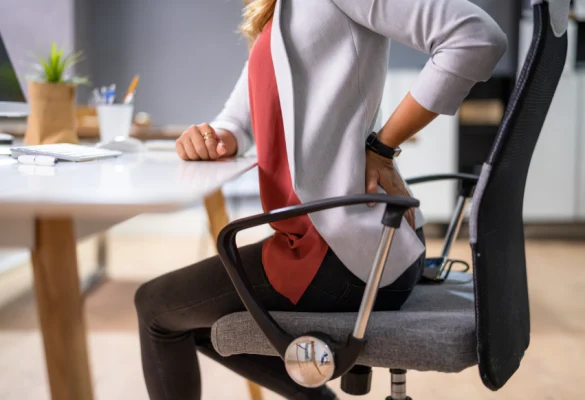
Musculoskeletal Disorders and Pain from Sitting in a Chair
By Gil Ayache — co-founder of Blue Portance May 28, 2026 Sitting in a chair [...]
