


Do you experience discomfort when seated despite normal test results? Understanding proprioception means understanding how your body perceives mechanical stress—and how to stimulate it to regain comfort and balance.
Summary — Proprioception is our body awareness: it allows us to perceive the position, movement, and orientation of our body in space, even without looking at or directly touching our limbs. Proprioceptive receptors—muscle spindles, Golgi tendon organs, and joint receptors—continuously exchange information with the brain to build an internal representation of the body, essential for precise movements and stable balance. The bioactive Aporia® seat directly acts on this system by supporting postural micro-adjustments and stimulating the proprioceptive receptors of the four support segments, promoting a reduction in tension, improved movement fluidity, and progressive pain relief.
1. What Is Proprioception?
Proprioception is our body awareness. Furthermore, it allows us to perceive and understand the position, movement, and orientation of our body in space, even without looking at or directly touching our limbs.
It is thanks to proprioception that we can move fluidly and perform precise actions, such as grasping an object or walking without stumbling. It also allows us to maintain our balance at all times and intuitively sense uncomfortable or painful positions before we even become consciously aware of them. It is rightfully our true 6th sense.
Stand up with your eyes closed. Even without vision, you can still feel where your arms and legs are, how they are bent or extended, whether you raise or lower them. This is proprioception at work—real-time, effortlessly, and without conscious thought.
Proprioception operates silently, continuously, at every moment of our bodily life.
2. Proprioceptive Receptors: Who Detects What?
Millions of specialized sensory receptors—called proprioceptors—are distributed throughout the body: in muscle fibers, tendons, joints, and skin. There are three main families.
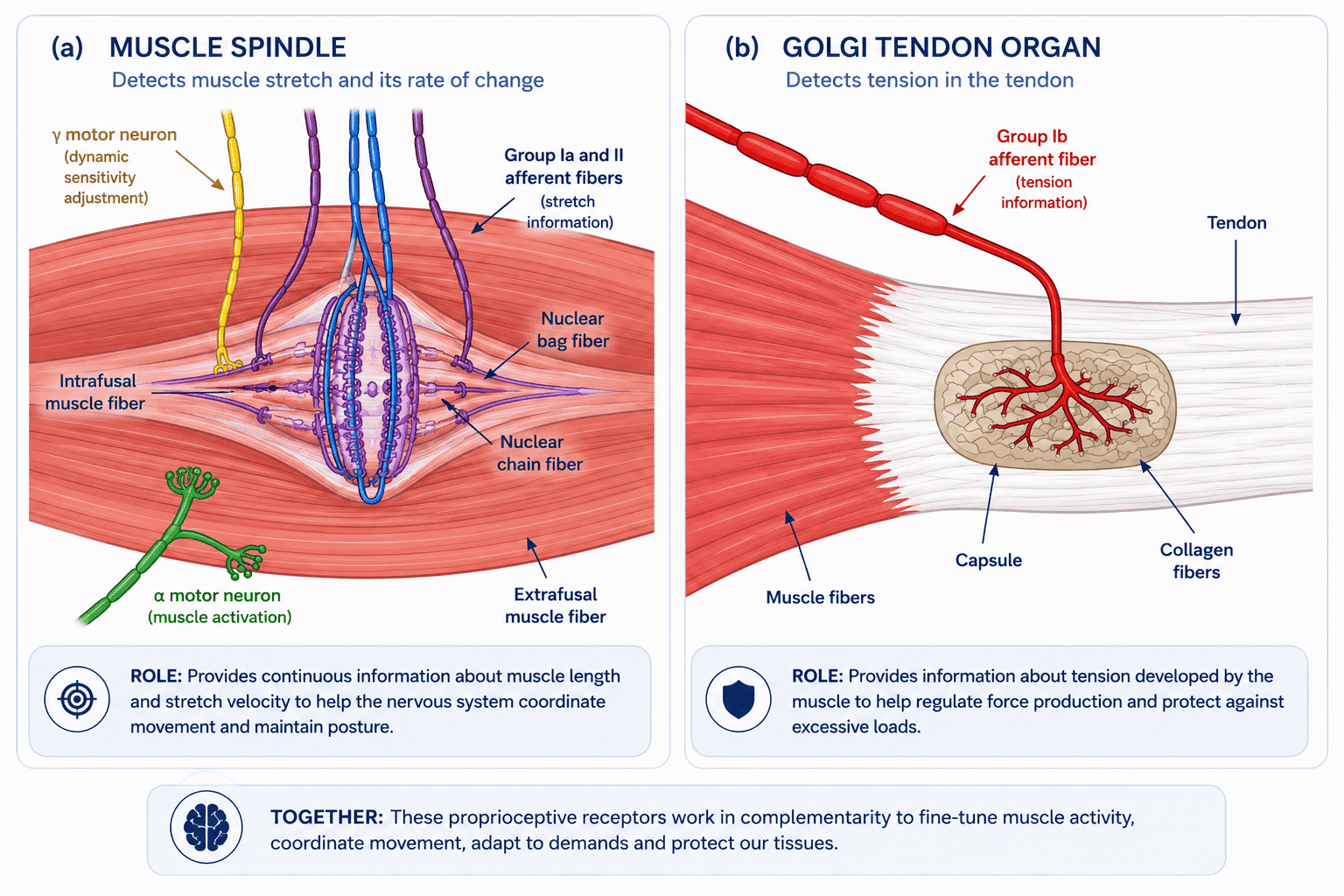
2.1 Muscle Spindles
Located within muscle fibers, they detect changes in muscle length and tension. As a primary action, they trigger dynamic postural adjustments; consequently, as soon as a muscle stretches, the spindle sends a signal to the brain to trigger the appropriate response.
2.2 Golgi Tendon Organs
Furthermore, these receptors are found at the muscle-tendon junction. They signal the tension exerted on the tendon and play a protective role by regulating muscle force to prevent overload, thereby acting as a safety limiter for the locomotor system.
2.3 Joint Receptors
Finally, those present in joint capsules inform the brain about the angle and position of the joints. By doing so, they enable a precise representation of overall posture and ensure fine coordination between body segments.
These receptors continuously exchange information with the brain about the position, kinematics, and dynamics of the various body segments. The brain processes these signals and continually builds an internal representation of the body in space—what we call body awareness or body schema.
3. Proprioception, Balance, and Movement Precision
Essentially, thanks to all these receptors, the brain can automatically adjust muscle contraction and the necessary force to perform precise movements; therefore, we do not need to think about them or evaluate anything consciously.
For instance, when you pick up a fragile object, your brain uses proprioceptive information to coordinate the muscles in your hand and arm. Consequently, this allows you to provide exactly the right amount of force and precision.
Furthermore, the more developed our 6th sense is, the more accurate our internal representation of our body in space becomes. As a result, our movements are fluid, efficient, and safe.
Because of this, athletes practicing precision sports—such as gymnastics, archery, or dance—develop particularly fine proprioception. Without it, none of these arts or disciplines would be possible.
Proprioception is also fundamental in maintaining postural balance. Consequently, it enables:
- detection of postural changes;
- activation of adaptive muscle responses;
- coordination of movements;
- integration with other sensory systems (vision, inner ear).
Well-developed proprioception is crucial for preventing falls, correcting imbalances, maintaining stable posture, and performing movements safely.
Furthermore, research has shown that when proprioceptive information is stimulated—for example, by applying light pressure or making small movements in a painful area—this can reduce the perception of pain. Proprioceptive signals partially inhibit the nociceptive signals transmitted to the brain, creating a natural analgesic effect.
Proprioception is not only useful for athletes. It is active at all times—and especially when seated. Every postural micro-adjustment, every change in support, every slight trunk oscillation engages this system. This is precisely what the bioactive Aporia® seat seeks to preserve and stimulate.
4. The Bioactive Aporia® Seat and Proprioception
The bioactive Aporia® seat* is a multi-articulated structure that supports and accompanies all movements while seated—including the most imperceptible ones.
Its design is based on two complementary levels of proprioceptive action:
- The curved base supports macro-postural adjustments induced by trunk movements, preserving the overall mobility of the spine.
- The 4 independently articulated pads—one under each thigh, one under each glute—act directly on the proprioceptive receptors by continuously supporting the soft tissues of these four body segments and accompanying their micro-movements for postural regulation.
It is precisely these support areas—thighs and glutes—that contain a high density of proprioceptive receptors. By continuously engaging them, Aporia® maintains a permanent sensorimotor dialogue between the body and the brain.
* Note: We refer to it as a “seat” rather than a “cushion,” as Aporia® represents a new class of seating devices, somewhere between an exoskeleton and a cushion—its multi-articulated structure sets it apart from conventional ergonomic cushions.
5. Combined Effects: Comfort, Fluidity, Pain Reduction
The mobility of the Aporia® seat, in constant interaction with the proprioceptive system, produces four complementary effects.
Movement Fluidity
Firstly, the combined support of macro-postural movements and regulatory micro-movements improves coordination. In addition, better proprioception promotes muscle harmony, making movements less stressful for muscle fibers, tendons, and fascia.
Improved Postural Adjustment
Because the pads continuously support micro-movements, they help maintain proper postural alignment while reducing strain on joints and soft tissues. Ultimately, this contributes to both improved posture and a reduction in associated pain.
Reduction of Muscle Tension
When muscles are supported and accompanied, they can relax more easily and contract more fluidly. Additionally, less muscle tension also means less pressure on proprioceptive receptors—and thus a reduction in the sensation of discomfort or pain.
Enhanced Body Awareness
With fibers under less painful stress, nerve sensations are reduced, and inflammation in certain areas is relieved. This gradually makes us more receptive to our own body awareness, better able to detect signals of tension or imbalance more easily and respond to them more quickly and fluidly.
These combined effects lead to an enhanced perception of comfort and a reduction in pain associated with musculoskeletal tension or imbalance.
For some people, this rediscovery and pain relief can be almost immediate. However, it is through repeated sessions, day after day—that neural plasticity helps—that relief becomes lasting.
6. Exercises to Develop Proprioception
Several practices can strengthen proprioception by stimulating receptors and improving communication between the brain and the rest of the body.
- balancing on one leg (eyes open, then closed);
- walking on unstable surfaces;
- using balance boards;
- practicing yoga or Pilates;
- jump rope, dance;
- Qi Gong, Shiatsu;
- and, of course, daily use of the bioactive Aporia® seat.
It is important to start with exercises suited to your level and progress gradually according to your abilities. Do not hesitate to consult a healthcare professional or qualified trainer for personalized guidance.
Discover Bioactive Aporia® Seats
Aporia® transforms the seated position into a space of stabilized mobility where proprioceptive receptors remain continuously active, promoting postural adjustment, movement fluidity, and progressive pain relief.
Frequently Asked Questions
What exactly is proprioception?
Why is it called the “sixth sense”?
Can you improve your proprioception?
How does Aporia® affect proprioception?
Can proprioception reduce pain?
Are the effects immediate?
Learn More
Go Further: Proprioception in Images
This Arte documentary illustrates, through concrete examples and clinical observations, the mechanisms described on this page: the role of proprioception in movement, nervous system adaptation, the importance of micro-movements, and neural plasticity.
It is a useful supplement to visualize these phenomena and grasp their reality through real-life situations.
Source: Arte — Proprioception, Our Sixth Sense
Explore More on Blue Portance
- ➡️ How to Act on Fascia: « Acting on Fascia: Load Variability and Micro-Movements »
- ➡️ Understanding Fascia and Tensegrity: « Fascia and Pain: The Invisible System of Constraint Regulation »
- ➡️ The Importance of Micro-Movements: « Why Moving a Little Is More Important Than Moving a Lot? »
- ➡️ Postural Harmony — Part 1: « How Aporia® Restores Postural Dynamics While Seated »
Scientific References
- Roland Blumer, Génova Carrero-Rojas, Paula M. Calvo, Johannes Streicher, Rosa R. de la Cruz, Angel M. Pastor — Proprioceptors in extraocular muscles — Experimental Physiology, published by John Wiley & Sons Ltd on behalf of The Physiological Society, March 3, 2023. [Source]
- SOLINAS Miguel, JAUNET Théo, DENOUN Brice — La proprioception — CNRS. [CNRS PDF]
- Brian Resnick — The silent “sixth” sense — Vox, 2019. [Read the article]
- Panjabi, M. M. (1992). The stabilizing system of the spine. Journal of Spinal Disorders. [PubMed Source]
- Schleip, R. (2003). Fascial plasticity – a new neurobiological explanation. Journal of Bodywork and Movement Therapies. [PubMed Source]
© Blue Portance — 2023, updated May 2026.
Reproduction and distribution permitted for non-commercial purposes,
subject to source citation:
« Blue Portance – SBNFA™ Doctrine ».
