


The major problem with sitting is not only pressure. It is the prolonged repetition of the same mechanical organization — and the invisible consequences this has on living tissues.
Most seats seek to reduce pressure. Aporia® explores a different hypothesis: restoring the mechanical variability of the seated body. Living tissues do not appear to suffer only from excessive constraint, but also when constraints stop varying. Constraints then stop remaining fixed, support points are continuously redistributed and tissues retain their mobility for longer.
By acting on the mechanical mechanisms that influence fascia biochemistry, Aporia® transforms sitting into a true functional rehabilitation environment. This second part explores how load variability, micro-adjustments and the multi-articulated structure of the 4 independent pads help preserve tissue gliding, limit the fixation of mechanical constraints and support the body’s natural adaptation capacities.
The objective here is not to re-explain the entire biology of fascia, but to understand how the Aporia® multi-articulated structure acts on load variability in the seated body. Because living tissues do not suffer only from excessive constraint: they suffer above all when constraints stop varying.
1. Living tissues need variability
The human body is never completely still. Even at rest, it oscillates, adjusts, distributes and continuously modulates its mechanical constraints.
1.1. Permanent micro-variations: the foundation of tissue adaptability
Breathing slightly modifies support points. Muscle tone varies continuously. The pelvis performs micro-adjustments. The center of gravity oscillates by a few millimeters. Although these variations may seem minimal, they play a fundamental role in maintaining the adaptability of living tissues.
A simple example to illustrate this: imagine carrying a shopping bag only on your right shoulder for 4 hours. The pain does not come only from the weight of the bag — it comes above all from the fact that it never changes position. This is exactly what happens on a conventional seat: the same areas absorb the same constraints for hours. Aporia® reintroduces permanent load variability: loads stop remaining fixed in the same place and are consequently redistributed continuously without requiring conscious effort.
Research on fascia shows that these tissues are not simple passive anatomical envelopes. On the contrary, they form a living network capable of transmitting mechanical constraints, enabling gliding between structures and participating in the body’s neuro-sensory regulation (Schleip, 2003; Langevin, 2006).
1.2. Load variability and the fascial network
In a functional system, constraints never remain completely fixed. Instead, they circulate, redistribute and modulate through fascial chains. This load variability therefore helps:
- limit local overloads;
- maintain gliding between tissues;
- preserve the mobility of mechanical chains;
- and provide the nervous system with rich and varied information.
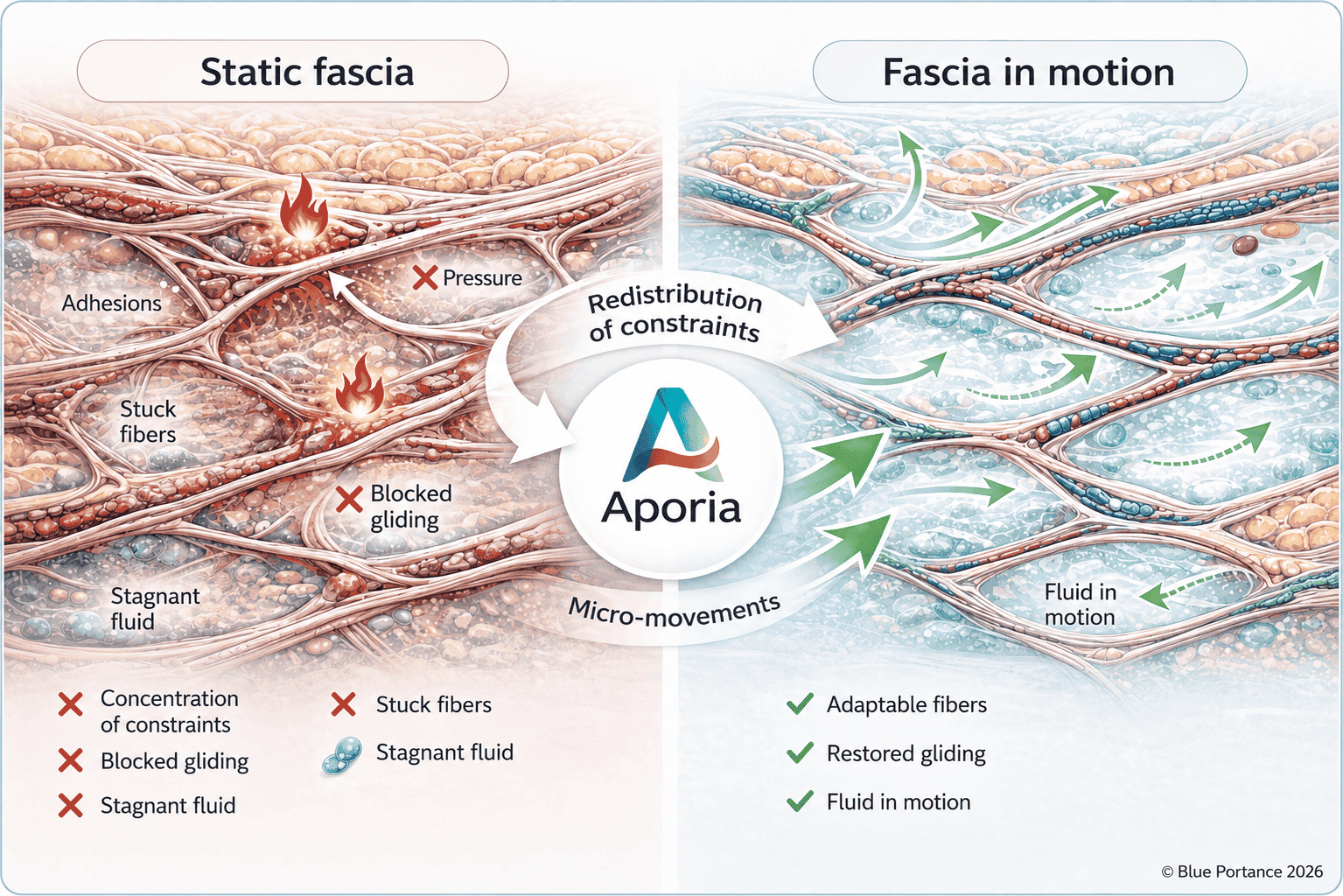
It is not only the intensity of a constraint that becomes problematic. It is its lack of variation.
As a result, when the body loses this capacity for modulation, constraints become more repetitive, more localized and more predictable. Consequently, tissues glide less effectively, compensations increase and some areas progressively begin to stiffen.
To further explore the role of fascia in constraint regulation, see also: Understanding fascia and tensegrity.
2. When conventional seating fixes constraints
Most modern seats stabilize the body… but often at the cost of a progressive reduction in its natural load variability.
A conventional seat generally relies on a relatively homogeneous, monobloc surface. Even when ergonomic or comfortable, it often treats the support points of the pelvis and thighs as a single unit.
The problem is not only pressure. Above all, the problem is the prolonged repetition of the same mechanical organization:
- same support lines;
- same load zones;
- same compensations;
- same dominant tensions.
2.1. The progressive disappearance of micro-adjustments
In a living posture, the pelvis should retain a permanent capacity for micro-adaptation. Support points should therefore be able to vary subtly according to breathing, fatigue, eye movements or changes in muscle tone.
However, when seating excessively homogenizes support points, these micro-adjustments become more difficult. As a result, tissues are then exposed to more repetitive and less distributed constraints.
In certain studies of patients with chronic low back pain, a reduction in the relative gliding of certain fascial structures was observed compared to asymptomatic subjects (Langevin et al., 2011). These observations do not allow conclusions about a single mechanism, but they suggest that a loss of tissue mobility may accompany certain chronic mechanical organizations.
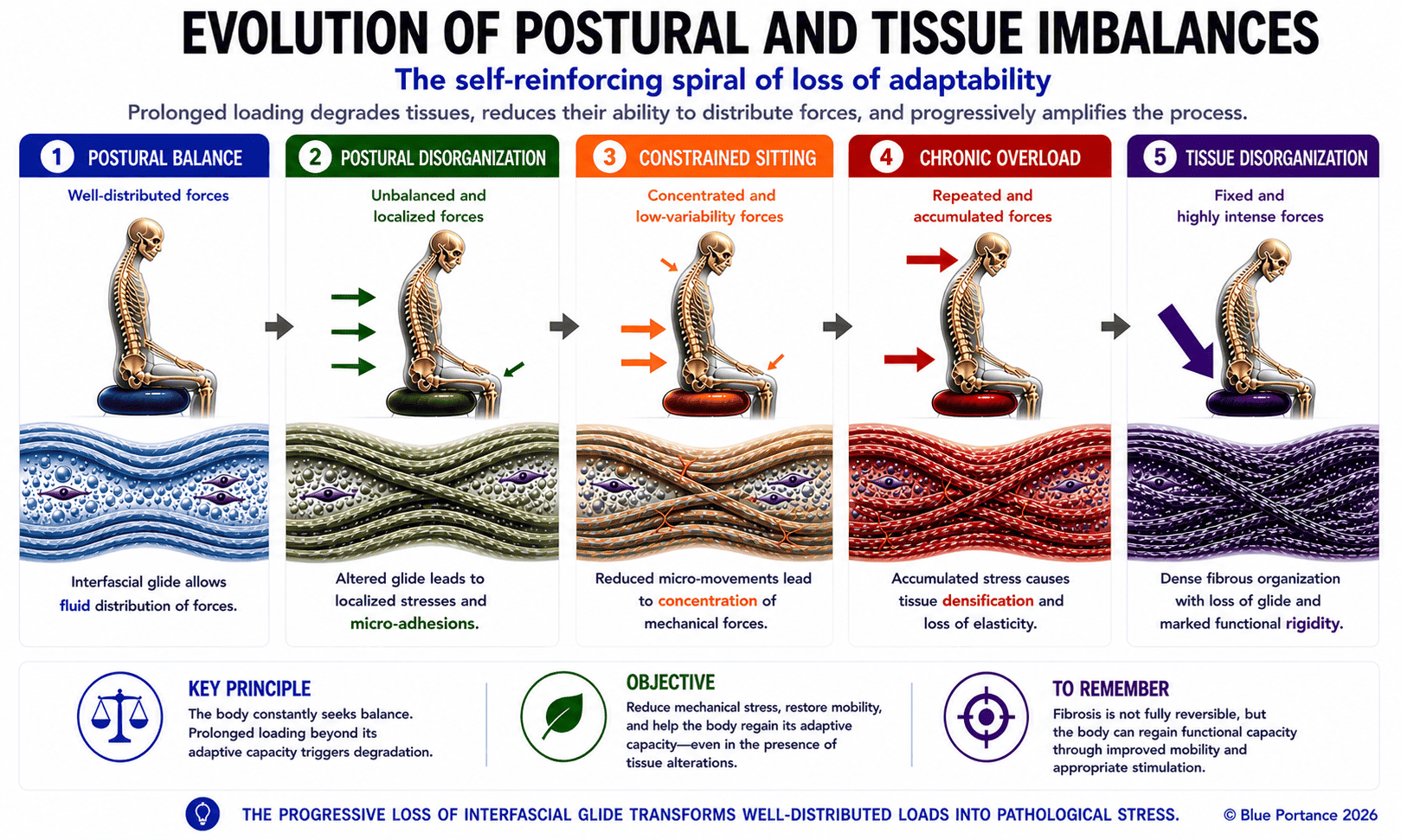
2.2. The feedback spiral of lost adaptability
Stiffening usually does not occur suddenly. Instead, it appears progressively through a sequence of adaptive responses.
A fixed constraint limits micro-movements. The less tissues move, the less constraints redistribute. Moreover, the more constraints remain localized, the more the body increases its protective strategies: hypertonia, locking, limitation of range of motion.
These protective strategies further reduce local mobility. The system then enters a feedback spiral of lost adaptability.
The body does not stiffen suddenly. It progressively loses its capacity to circulate constraints.
3. Why global movement is not enough
Not all movement produces the same effect on living tissues.
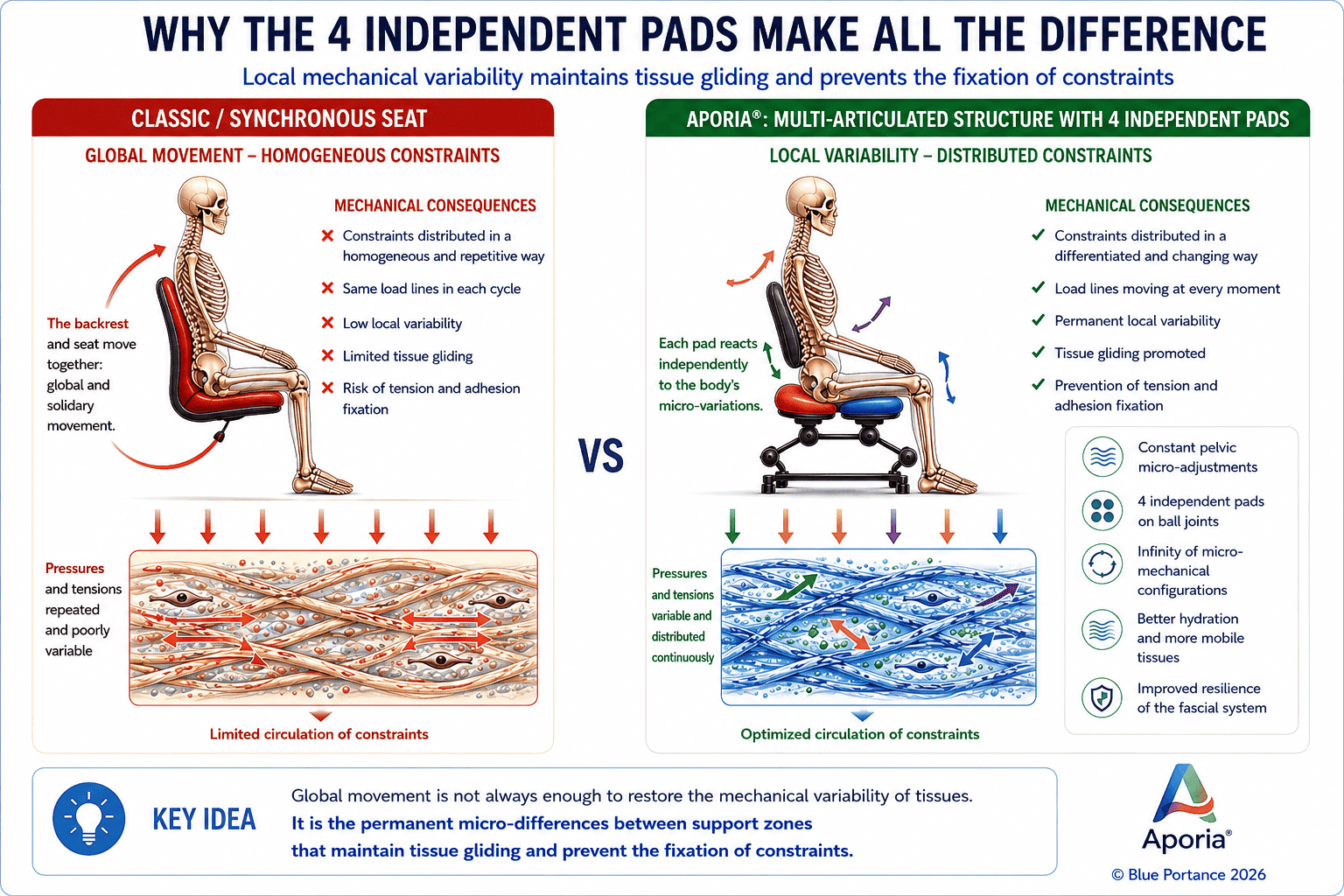
Many so-called “dynamic” or “synchronous” chairs do indeed reintroduce some mobility. However, this mobility often remains global and coupled: the backrest and seat move together according to a relatively uniform kinematic pattern.
This type of movement can improve general comfort and limit certain forms of stiffness. Nevertheless, it does not necessarily restore the fine load variability on which deep tissue gliding depends.
3.1. Global movement and mechanical coupling
In a conventional synchronous chair, the body often continues to function as a relatively coupled block:
- body segments remain mechanically linked;
- deep tension relationships change little;
- main load lines remain similar.
Movement therefore exists… but it does not profoundly modify local mechanical relationships between the different areas of the pelvis and lower limbs.
3.2. Living tissues need relative gliding
In contrast, fascia depends on local and differentiated variations. It needs:
- micro-shifts;
- partial dissociations;
- asymmetrical variations;
- relative gliding between segments.
It is precisely this distributed segmental mobility that maintains mechanical exchanges within living tissues.
Aporia® does not merely reintroduce movement. It reintroduces relational variability between body segments.
4. Aporia®: a multi-articulated structure designed for load variability
Aporia® is based on the opposite logic to conventional seating: not fixing the body in a single mechanical organization.
4.1. A design built around adaptation, not correction
The Aporia® structure was not designed to impose an ideal posture. Rather, it was designed to support the natural adaptation capacities of the pelvis and surrounding tissues.
As we saw in Part 1, dedicated to dynamic postural harmony, movement within stability is one of the fundamental principles of human balance.
Furthermore, this logic does not concern posture alone. It also influences:
- constraint circulation;
- protective strategies;
- tissue gliding;
- and the mobility of fascial chains.
4.2. Independent degrees of freedom between support areas
The Aporia® multi-articulated structure introduces several independent degrees of freedom between support areas. The pelvis, buttocks and upper thighs no longer rest on a single homogeneous surface.
Aporia® does not seek to eliminate constraints. It seeks to prevent the same mechanical organization from becoming dominant for too long.
5. The 4 independent pads: creating an infinity of mechanical micro-configurations
The biomechanical core of Aporia® lies in its four independent pads mounted on ball joints.
These four pads separately support:
- the right buttock;
- the left buttock;
- the right thigh;
- the left thigh.
Unlike a monobloc surface, each area can respond differently according to the body’s variations.
5.1. Seating that never reacts in exactly the same way
Even when a person thinks they are still, their body continues to vary:
- breathing slightly modifies support points;
- muscle tone fluctuates;
- the pelvis subtly oscillates;
- the center of gravity shifts.
On Aporia®, these micro-variations locally modify:
- pad orientation;
- pad compression;
- tension lines;
- load zones.
The overall mechanical geometry of the seat is therefore never completely identical.
5.2. An infinity of mechanical micro-configurations
A conventional seat tends to reproduce the same mechanical organization.
Aporia®, on the contrary, produces a very large diversity of mechanical micro-configurations:
- support points migrate slightly;
- tensions redistribute;
- compensation chains change;
- compression zones vary;
- loads stop remaining concentrated in the same place.
This permanent load variability creates a continuous circulation of mechanical constraints instead of repetitive and fixed pressure.
Constraints do not disappear. They simply stop remaining fixed in the same place.
5.3. Permanent load-unload cycles
This multi-articulated structure also generates permanent cycles of:
- compression;
- decompression;
- tension;
- release.
These variations often remain below conscious perception. The user does not need to voluntarily produce a large movement: variability is built into the mechanical environment itself.
6. Restoring tissue gliding and the circulation of constraints
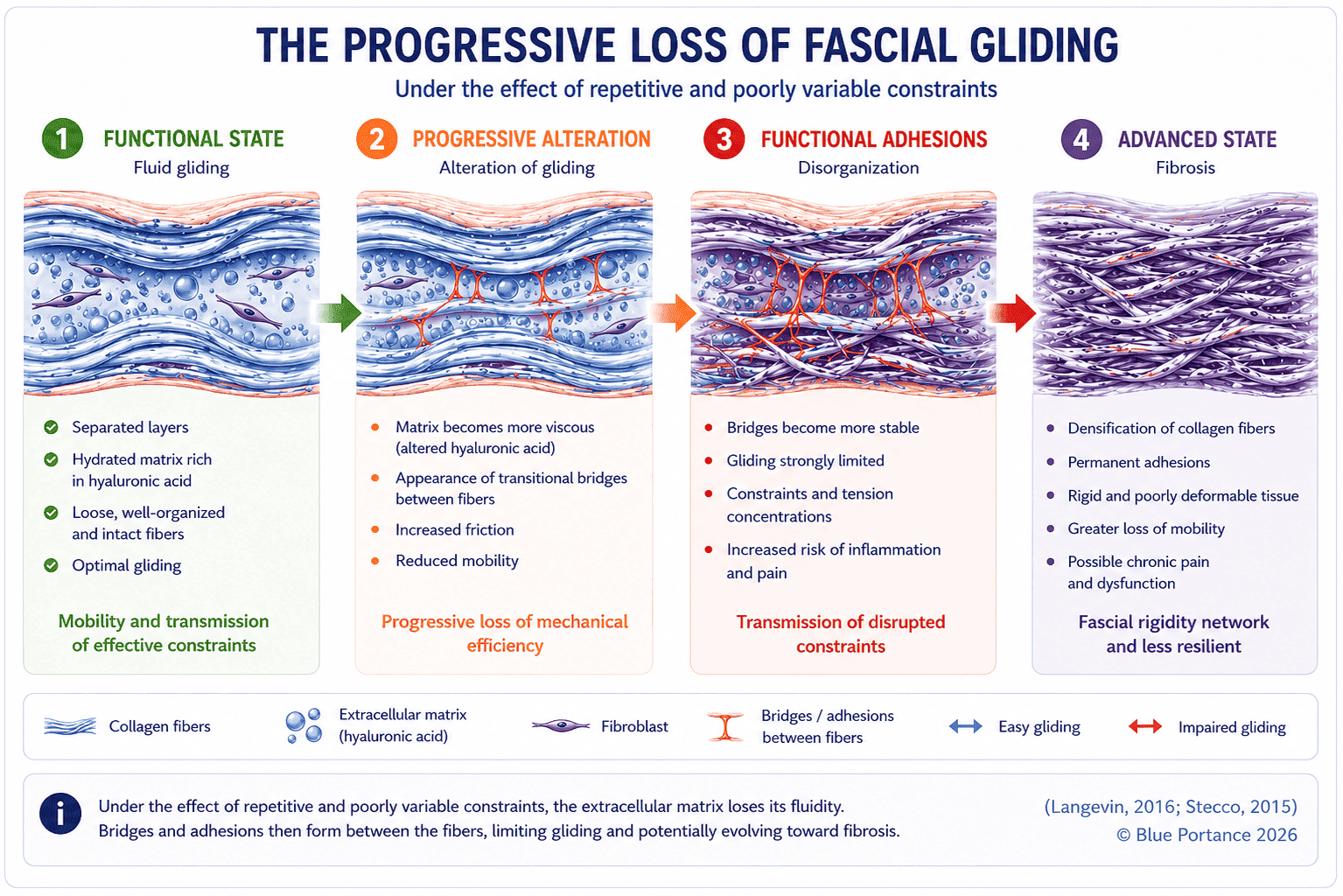
6.1. Why fascia needs mobile constraints
Fascia needs mobile constraints to preserve its gliding capacity.
When tensions, pressures and support points remain variable, the different tissue layers continue to slide relative to one another.
This mobility promotes:
- constraint diffusion;
- tension modulation;
- mechanical exchanges within the extracellular matrix;
- and the richness of information transmitted to the nervous system.
6.2. How Aporia® transforms the tissue environment
Conversely, when constraints become repetitive and poorly variable, tissues progressively tend to lose their gliding capacity.
For this reason, Aporia® acts here indirectly but fundamentally: it transforms the mechanical environment in which tissues evolve.
Tissue gliding depends less on the absence of constraint than on the capacity of constraints to remain mobile.
This logic echoes the work of Schleip (2012), which describes fascia as a sensory organ capable of responding finely to mechanical variations.
7. From stiffening to progressive readaptation
When a system has been functioning in protection for a long time, it is not enough to ask it to “relax.”
7.1. Understanding protective strategies
Hypertonia and locking strategies often appear because the body interprets certain constraints as too repetitive or threatening.
Readaptation therefore requires progressively modifying the mechanical environment in which these protective strategies are triggered.
7.2. Re-exploring forgotten movements
Through its distributed load variability, Aporia® allows the body to gradually re-explore:
- different support points;
- load variations;
- segmental adjustments;
- forgotten micro-movements.
The body begins to explore again movements it had progressively stopped using.
As a result, this readaptation must be understood as a progressive process. The goal is not to eliminate all constraint, but rather to restore a permanent capacity for:
- modulation;
- redistribution;
- variation;
- and adaptation.
8. Continuous rehabilitation and the seating environment
Rehabilitation does not depend only on exercises performed during a session. It also depends on the mechanical environment in which the body continues to evolve for several hours a day.
8.1. The vicious cycle of rehabilitation / static seating
Many patients observe the same pattern: they temporarily recover movement, flexibility and a reduction in tension during care — then return to seating that reproduces exactly the same constraints, the same support points and the same stiffening patterns.
This is not a failure of rehabilitation: rather, it is the logical consequence of a daily mechanical environment that works counter to treatment. Indeed, tissues loosened during the session are immediately re-exposed, for several hours, to the same fixed constraints that contributed to their stiffening.
A concrete example: a patient treated for perineal tension or lower back pain will make slow progress if, three to eight hours a day, their seat reproduces the same fixed ischial support points, the same load lines and the same absence of mechanical variability. The session heals; the seat reconditions.
8.2. Seating as an extension of rehabilitation
Functional rehabilitation seeks to restore mobility, variability and the adaptation capacities of the locomotor system. Aporia® does not replace this approach — it extends it into daily life by transforming each seated period into a space of continuous micro-adaptation:
- micro-variations in load — support points never remain identical;
- dynamic redistribution of tensions — overload zones no longer concentrate;
- maintained segmental mobility — the pelvis retains its physiological micro-adjustments;
- constraint circulation — tissues continue to glide and adapt.
8.3. What this changes for chronic pain patients
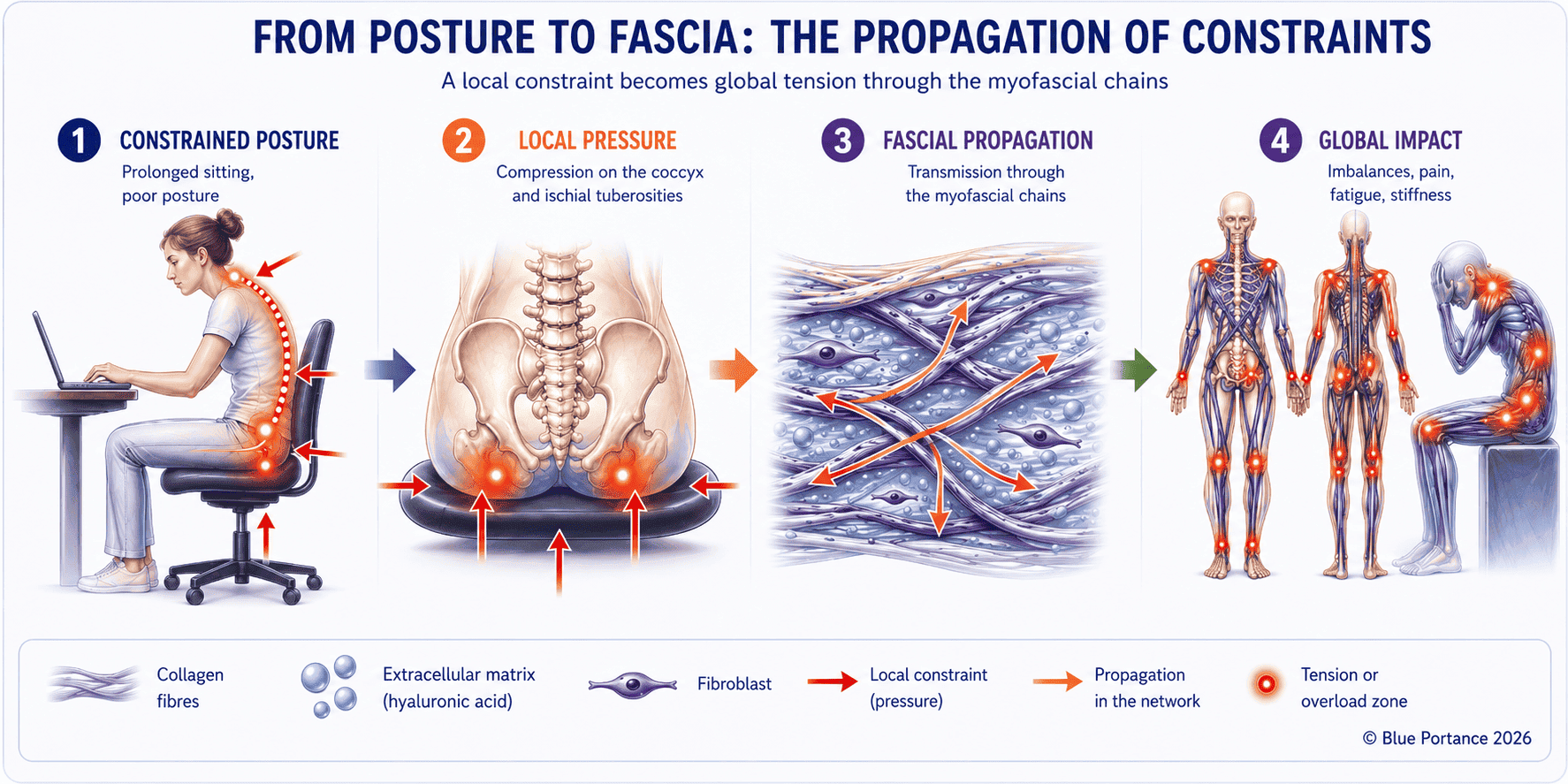
For patients suffering from pelvic-perineal pain, coccydynia or chronic lumbar tension, sitting often represents one of the main factors perpetuating pain. Repetitive pressure on the same areas — ischial bones, coccyx, perineal structures — sustained for several hours a day ultimately exceeds the body’s tissue recovery capacities.
Restoring mechanical variability in the seated position does not eliminate pain — but it modifies the environment in which protective strategies are triggered. This is a necessary, if not sufficient, condition for lasting readaptation.
Rehabilitation does not depend only on exercises performed — it also depends on the mechanical environment in which the body evolves for several hours a day. Living tissues do not suffer only from excessive constraint: they suffer above all when constraints stop circulating.
This logic of dynamic constraint redistribution will be explored in Part 3.
9. Summary table: from fixed constraint to bioactive variability
| Criterion | Conventional seating | Synchronous chair | Aporia® |
|---|---|---|---|
| Type of movement | Very limited | Global | Distributed |
| Local variability | Low | Partial | Permanent |
| Segmental mobility | Limited | Coupled | Differentiated |
| Tissue gliding | Reduced | Partially restored | Promoted |
| Dominant constraints | Strong | Reduced | Redistributed |
| Mechanical relationship | Homogeneous | Synchronized | Multi-articulated |
Frequently Asked Questions
Why does sitting create tension?
Why is fascia important in sitting?
Why is movement important for living tissues?
Why can a conventional seat promote stiffening?
Why is the global movement of a synchronous chair not always enough?
What is the difference between a synchronous chair and Aporia®?
Why are the 4 independent pads important?
What is load variability?
How does Aporia® act on tissue gliding?
Why are micro-movements important even when they are imperceptible?
Does Aporia® replace functional rehabilitation?
Why speak of “movement within stability”?
Further Reading
Explore on Blue Portance
- ➡️ Understanding dynamic postural harmony: “The Aporia® Paradigm Shift: Revolutionizing Active Rehabilitation Cushion Technology”
- ➡️ The importance of micro-adjustments: “Why Micro-Movement Matters More Than Moving A Lot?”
- ➡️ Understanding the key role of fascia: “Fascia and Tensegrity Explained: How Your Body Regulates Mechanical Stress, Movement, and Pain”
These mechanisms — load variability, tissue gliding, progressive readaptation — are not abstract concepts. They form the biomechanical foundation on which each Aporia® version has been designed: not to impose a posture, but to restore to the body the mechanical conditions of its natural balance.
Discover Aporia® Bioactive Seating
Aporia® transforms sitting into a space of stabilized mobility where the pelvis, postural micro-adjustments, and the body’s natural balance mechanisms can continue to function throughout daily life.
Each version is designed around a specific adaptation logic: back pain, postural tension, coccydynia, pelvic-perineal pain, or prolonged sitting.
Scientific References
- Langevin, H. M. (2006). Connective tissue: A body-wide signaling network? Medical Hypotheses, 66(6), 1074–1077. [PubMed Source]
- Langevin, H. M., Fox, J. R., Koptiuch, C., et al. (2011). Reduced thoracolumbar fascia shear strain in human chronic low back pain. BMC Musculoskeletal Disorders. [PubMed Source]
- Schleip, R. (2003). Fascial plasticity – a new neurobiological explanation. Journal of Bodywork and Movement Therapies. [PubMed Source]
- Schleip, R., Jäger, H., & Klingler, W. (2012). What is ‘fascia’? A review of different nomenclatures. Journal of Bodywork and Movement Therapies. [PubMed Source]
- Schleip, R., Findley, T. W., Chaitow, L., & Huijing, P. (2012). Fascia: The Tensional Network of the Human Body. [Elsevier Source]
- Panjabi, M. M. (1992). The stabilizing system of the spine. Part I: Function, dysfunction, adaptation, and enhancement. Journal of Spinal Disorders. [PubMed Source]
© Blue Portance. Reproduction and distribution authorized for non-commercial purposes, provided the source is cited: “Blue Portance – SBNFA™ Doctrine”.
