


“The body should no longer have to freeze itself in order to adapt to the seat. The seat should accompany the natural adaptive mechanisms of the human body.”
Summary: Active rehabilitation cushion technology, as embodied by Aporia®, is not limited to muscular strengthening or simple segmental correction. While it takes the form of a seat, its multi-articulated structure brings it closer to an exoskeleton. Its function is fundamentally different: it does not support a posture — it restores an active dynamic.
Based on the concepts of the cone of economy and balance and compensation chains, this bioactive approach represents a break from traditional static ergonomics. Rather than constraining the body into a theoretical posture, it creates a space of stabilized mobility in which the pelvis reclaims its central role in postural mediation and sensorimotor regulation.
1. Active Postural Harmony: The Foundation of Functional Rehabilitation
Before any functional rehabilitation can begin, the body must recover an essential condition: the ability to move without overload, without rigidity, and without apprehension.
When pain becomes chronic, the problem does not originate solely from a painful structure. Gradually, the entire postural system may reorganize itself around protective strategies: reflex hypertonicity, mobility restrictions, rigid support patterns, and asymmetric compensations.
Movement then becomes energetically costly. Certain postures are unconsciously avoided. Stabilizing muscles remain constantly contracted, natural adjustments decrease, and the body progressively loses its capacity to adapt.
Restoring active postural harmony means recreating the conditions that allow the body to once again redistribute constraints, adjust its support points, and let compensatory mechanisms circulate with minimal muscular effort.
The primary goal of active postural harmony is not movement performance. It is to allow the body to recover its ability to adapt without pain, without overload, and without permanent protective strategies.
This approach aligns with Panjabi’s work on spinal stabilization systems (Panjabi, 1992), according to which optimal stability depends on fine cooperation between passive structures, active muscular structures, and neurosensory control.
However, conventional sitting often works in the opposite direction: it drastically reduces the pelvis’ ability to adjust and forces the body into a relatively fixed posture that is poorly compatible with natural balance-regulation mechanisms.
2. The Biomechanical Foundations of the Active Rehabilitation Cushion Aporia®
The development of Aporia® is notably based on research dedicated to active postural balance and functional economy, particularly the work of Jean Dubousset on the human cone of balance.
These studies demonstrate that the human body never maintains balance through immobility. Even while standing, we are continuously animated by micro-oscillations that redistribute mechanical constraints, reduce local overload, and maintain active stability with minimal muscular effort (Dubousset, 1997; Barrey et al., 2013).
2.1. The Cone of Balance: Stability Through Movement
While standing, anyone can experience dynamic balance. It is possible to oscillate slightly:
- forward and backward,
- side to side,
- or rotationally,
without losing stability, as long as the center of gravity remains within the base of support created by the feet.
These oscillations form what Dubousset describes as a cone of balance and functional economy: a space within which the body can move freely while remaining stable.
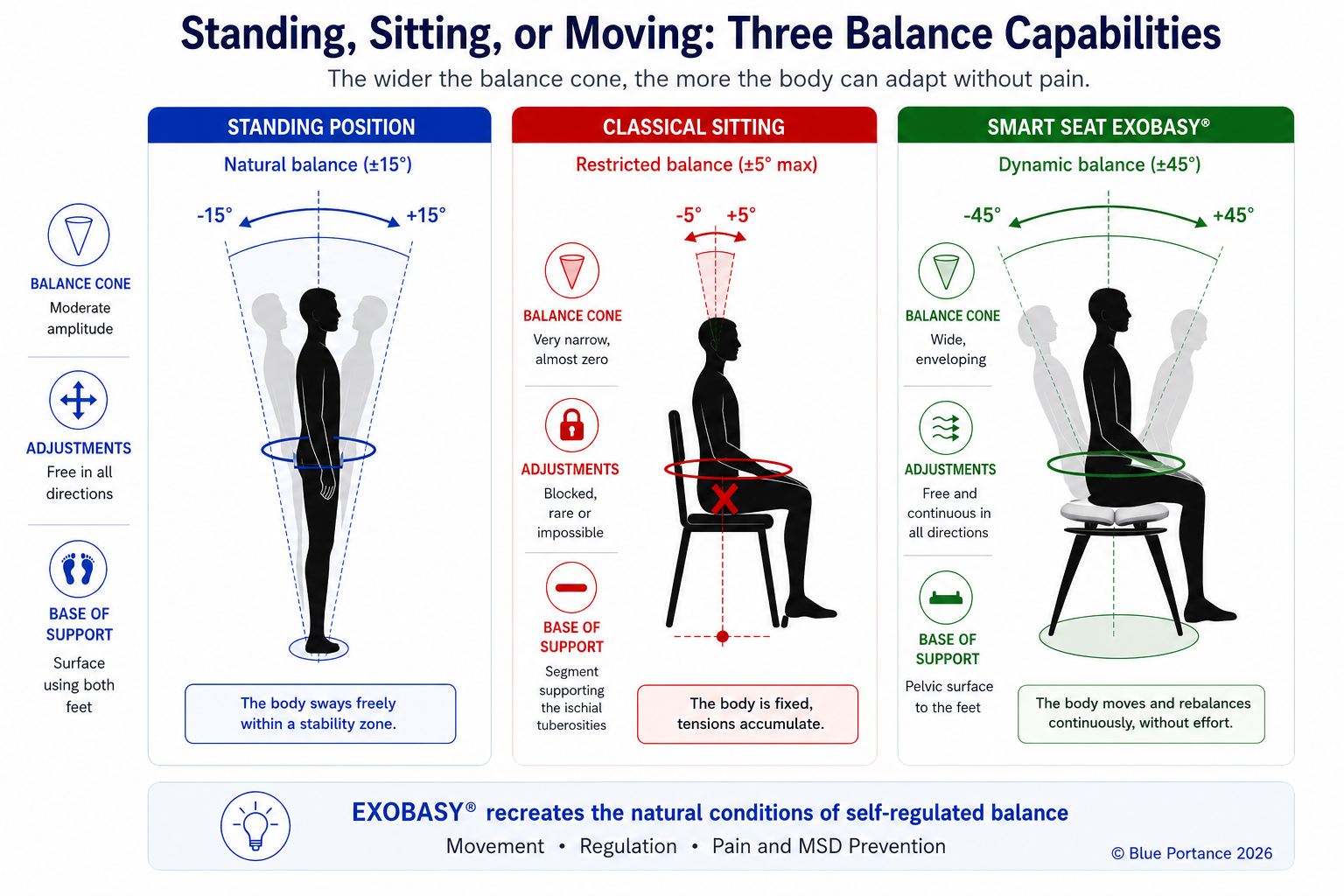
Within this cone:
- tension does not accumulate locally,
- adjustments continuously circulate,
- muscles operate with minimal effort,
- mechanical constraints are constantly redistributed.
Human balance is therefore a living balance.
It is precisely from this observation that Aporia® was born: to recreate in the seated position a space where these permanent adjustments can continue to exist.
The human body does not maintain balance by remaining still. It maintains balance through constant adaptation.
2.2. The Pelvis: The Conductor of Active Postural Adjustments
Maintaining this active balance relies primarily on coordination between the hips and the ankles.
The ankles provide fine adjustments and absorb micro-variations, while the hips contribute to broader adjustments and load variations (Boonstra et al., 2013; Versteeg et al., 2016).
The pelvis therefore acts as a true mediation interface:
- it directs compensatory mechanisms,
- redistributes mechanical constraints,
- absorbs imbalances,
- coordinates trunk and lower-limb adjustments.
This mediation occurs primarily within the horizontal plane: translations, rotations, tilting movements, and continuous micro-adjustments.
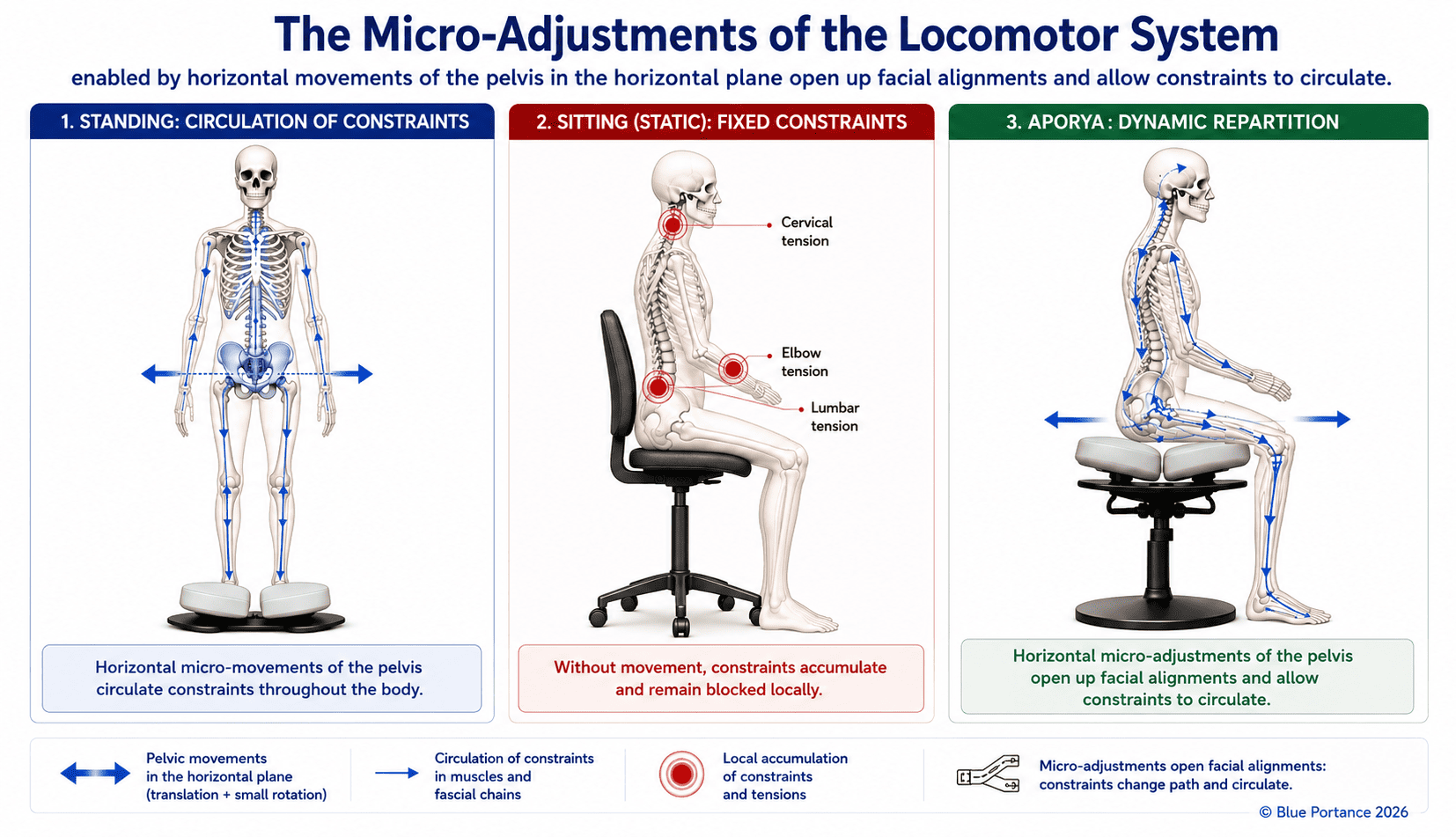
These continuous micro-adjustments are not limited to postural mechanics alone. They also reactivate proprioceptive mechanisms through which the body perceives support points, adjusts muscular tone, and refines balance strategies.
By restoring mobility to the pelvis and hips, Aporia® reactivates this continuous sensorimotor dialogue that is essential to active postural harmony.
3. Why Conventional Sitting Disrupts Postural Harmony
Traditional sitting drastically reduces the possibilities for dynamic balance. The pelvis becomes immobilized, the hips lose their natural mobility, and continuous adjustments progressively disappear.
Conventional ergonomics has significantly improved workplace comfort:
- seat height,
- lumbar support,
- armrests,
- adjustable backrests,
- workspace organization.
But one structural limitation remains: the pelvis stays immobilized.
As a result, only one “correct posture” becomes possible. The longer this posture is maintained:
- the more compensations become rigid,
- the more muscular tension increases,
- the more natural adaptive mechanisms deteriorate.
The major problem with sitting is therefore not pressure alone. It is the progressive disappearance of balance-related movement.
Over time, this rigidity promotes:
- chronic lower back tension,
- musculoskeletal disorders,
- postural fatigue,
- localized mechanical overload phenomena.
Movement is the intervertebral disc’s greatest ally. Bioactive seating transforms office time — once harmful — into a period of infra-conscious proprioceptive stimulation.
4. How Aporia® Reinvents the Sitting Experience Through an Active Rehabilitation Cushion
As the world’s only active rehabilitation cushion of its kind, Aporia® enables the creation of a cone of balance while seated. Its multi-articulated structure introduces a level of pelvic mobility that was previously non-existent in any seating technology.
Indeed, Aporia® is based on a completely different logic from traditional ergonomics. Its purpose is not to hold the body in an “ideal” static posture, but to implement the body’s natural mechanisms of balance and active adaptation within the seated environment.
The body should no longer have to freeze itself in order to adapt to the seat. The seat should accompany the natural adaptive mechanisms of the human body.
4.1. Restoring a Cone of Balance While Sitting
The Aporia® Exobase combines:
- a curved base,
- and four independent 360° articulated pads.
The curved base supports macro-adjustments associated with shifts in the center of gravity. The four pads independently support:
- the right gluteal area,
- the left gluteal area,
- the right thigh,
- the left thigh.
The four independent pads partially decouple lower-limb, pelvic, and trunk adjustments. This decoupling promotes the circulation of compensatory mechanisms and limits their fixation into a single overload zone.
The pelvis then recovers:
- its translational movements,
- its rotational movements,
- its tilting capacity,
- its horizontal mobility.
The seating environment once again becomes a space of stabilized mobility.
The independent mobility of the pads also preserves the pelvis and sacrum’s natural micro-adjustments, particularly sacral nutation and counternutation phenomena, which are often essential for pelvic-spinal balance.
Note: Nutation and counternutation refer to the sacrum’s physiological micro-tilting movements between the iliac bones. These subtle yet continuous movements contribute to load absorption, postural adaptation, and the pelvis’ functional mobility.
As in the cone of balance described by Dubousset, the goal is no longer to guide the body toward a single ideal posture, but to restore access to a continuous range of stable positions, available with reduced postural effort.
Unlike a conventional chair that imposes a fixed posture, Aporia® opens a continuum of balanced postures.
4.2. Adapting Seating to the Natural Balance Profile
Every individual has their own natural balance profile. Some people naturally present:
- an anterior pelvic tilt,
- others a more posterior pelvic tilt,
- and others a more neutral balance.
These differences influence:
- lumbar curvature,
- spinal organization,
- the way mechanical constraints are distributed.
This is why Aporia® Exobases integrate adaptive wedges designed to restore each individual’s personal zero-balance point.
Depending on the profile:
- the wedge is positioned at the front,
- at the rear,
- or not used at all.
The purpose of the zero-balance point is not to correct the body toward a standardized norm. On the contrary, it is designed to respect each individual’s natural postural organization.
Once this balance point is restored:
- the cone of balance,
- micro-adjustments,
- pelvic mobility,
- and dynamic regulation
can naturally redeploy themselves.
5. Summary Table: From Static Sitting to Bioactive Seating
The mechanisms described above help clarify the fundamental shift introduced by Aporia® bioactive seating. The following comparison highlights the rupture introduced by the Aporia® active rehabilitation cushion. It demonstrates how this unique technology replaces traditional immobilization with the first-ever system of stabilized seated mobility.
| Criteria | Conventional Seating | Aporia® Bioactive Seating |
|---|---|---|
| Postural Logic | Maintain a supposedly correct posture | Restore active postural harmony |
| Pelvic Mobility | Pelvis largely immobilized | Pelvis free to translate, rotate, and tilt |
| Balance | Stability achieved through immobilization | Stability achieved through movement within stability |
| Micro-adjustments | Severely restricted | Reactivated by the curved base and the 4 articulated pads |
| Mechanical Constraints | Localized accumulation and fixed compensations | Continuous redistribution of mechanical loads |
| Proprioception | Reduction of sensory input quality | Continuous infra-conscious proprioceptive stimulation |
| Spinal Profile | Standardized posture | Adaptation to the individual zero-balance point through wedges |
| Functional Rehabilitation | Sitting often experienced as a constraint | Sitting transformed into an active adaptation environment |
6. The Adaptability Journey: Learning to Move With the Seat
Using an Aporia® Exobase is less about “holding a posture” and more about rediscovering forgotten mobility.
Imagine a rider sitting on a horse without understanding its movements: even with the best saddle, an inappropriate posture may generate pain and imbalance.
The Exobase® works in a similar way: it reacts to the body’s micro-adjustments.
The user progressively learns to:
- release certain muscular tensions,
- explore different postures,
- feel pelvic displacement,
- follow the movements of the seat,
- develop their own mobility.
This phase represents a true adaptability journey.
The more the user:
- breathes freely,
- varies support points,
- follows the micro-movements,
the more the seat deploys its biomechanical potential.
Aporia® does not hold you in place. It gives you back the keys to your balance.
7. Continuous Rehabilitation: A Paradigm Shift
Once the seating environment stops freezing the body, rehabilitation is no longer limited to therapy sessions or exercise routines alone. It can continue throughout every situation of daily life.
7.1. Restoring a Permanent Dynamic of Adaptation
By profoundly transforming the mechanical organization of sitting, the Aporia® active rehabilitation cushion does far more than provide comfort or support. It implements a unique bioactive environment where the body can, for the first time, continuously maintain a process of active adaptation while seated.
This new organization of support points creates a continuous redistribution of mechanical constraints. Tissues are no longer subjected to repeated loading in the same area, limiting localized overload, muscular rigidity, and fixation of tension patterns.
The restored mobility of the pelvis, combined with the permanent micro-adjustments enabled by the articulated pads, also promotes the return of tissue gliding and the diffusion of compensatory mechanisms throughout the body’s mechanical chains.
7.2. A Simultaneous Mechanical and Neurosensory Action
At the same time, perceived stability progressively alters the nervous system’s response. Sitting is no longer interpreted as a situation of constraint or threat. The level of vigilance decreases, fear of movement diminishes, and reflex protective hypertonicity can progressively relax.
This dual action — mechanical and neurosensory — allows movement to re-emerge without excessive effort or permanent protective strategies.
The pelvis regains three-dimensional mobility, adjustments become more refined, and the body begins once again to explore movement amplitudes and possibilities that are often restricted in conventional seating environments.
This evolution does not result from an additional voluntary exercise. It arises from a permanent transformation of the environment in which the body evolves every day.
Rehabilitation is no longer a moment. It becomes a continuous process.
7.3. Restoring Permanent Exploration of Movement Possibilities
Every sitting situation — work, transportation, rest — therefore becomes a space in which the body can maintain, explore, and reinforce its adaptive capacities.
While standing, the body already benefits from a dynamic cone of balance allowing continuous adjustments necessary for stability. However, this cone remains relatively limited.
With Aporia® bioactive seating, this adaptive space expands considerably thanks to a base of support multiplied nearly fourfold, now extending from the ischial bones to the knees.
This expansion of the cone of balance drastically reduces postural maintenance tension and opens possibilities for fluidity, release of mechanical constraints, and movement amplitudes that are difficult to achieve in conventional seating.
📉 Back School: Recovering Mobility and Fluidity Otherwise Difficult to Access
According to the director of the Back School, restoring the cone of balance opens possibilities for mobility, fluidity, and tension release that are difficult to achieve in conventional seating environments, thereby providing access to an almost infinite number of adaptation and rehabilitation strategies.
Observations carried out notably within the Groupe Saint Jean Back School appear to confirm this functional evolution.
In certain situations, clinical teams report improvements in adaptive capacity and mobility significant enough that some rehabilitation times may be substantially reduced.
This observation does not rely on intensifying exercises, but on a permanent transformation of the mechanical environment in which the body evolves.
By reintroducing a continuous dynamic of micro-adjustments, redistribution of constraints, and infra-conscious proprioceptive stimulation, bioactive seating allows the body to continue adapting far beyond rehabilitation sessions alone.
🎥 Sébastien Bottau – Director of the Back School (Groupe Saint Jean): “Why I Use Aporia® Technology in Spinal Rehabilitation”
Rehabilitation does not depend solely on the exercises performed. It also depends on the mechanical environment in which the body continues to evolve every day.
Frequently Asked Questions
Why does sitting generate tension?
Is there an ideal sitting posture?
What does “dynamic postural harmony” mean?
How does Aporia® work differently from a conventional ergonomic chair?
Further Reading
Explore More on Blue Portance
- Why Micro-Movement Matters More Than Moving A Lot?
- Understanding Spinal Profiles and Natural Balance (coming soon)
- Back Pain While Sitting: Why Even a “Good Posture” is Pathogenic?
- Pudendal Neuralgia: Why Can Simple Sitting Become an Ordeal?
- Coccydynia: Why Does Your Tailbone Hurt When Sitting?
Discover the Aporia® Bioactive Cushions
Aporia® transforms sitting into a space of stabilized mobility where the pelvis, postural micro-adjustments, and the body’s natural balance mechanisms can continue to express themselves every day.
Each version is designed for a specific adaptive need: back pain, postural tension, coccydynia, pelvic-perineal pain, or prolonged sitting.
Scientific References
- Dubousset, J. (1997). Sagittal balance: the cone of economy concept and balance chain. Bulletin de l’Académie Nationale de Médecine. [PubMed Source]
- Panjabi, M. M. (1992). The stabilizing system of the spine. Part I. Function, dysfunction, adaptation, and enhancement. Journal of Spinal Disorders. [PubMed Source]
- Vleeming, A., Schuenke, M. D., Masi, A. T., et al. (2012). The sacroiliac joint: an overview of its anatomy, function and potential clinical implications. Journal of Anatomy. [PubMed Source]
- Versteeg, A. C., et al. (2016). Hip and ankle coordination in balance regulation during standing and sitting. Gait & Posture. [PubMed Source]
- Boonstra, T. W., et al. (2013). Postural control mechanisms during human balance. Journal of Neurophysiology. [PubMed Source]
- Barrey, C., et al. (2013). Sagittal balance of the pelvis-spine complex and its importance in spinal surgery. Journal of Orthopaedic Science. [PubMed Source]
- Lengsfeld, M., et al. (2000). Spinal load changes during rotatory dynamic sitting. Clinical Biomechanics. [PubMed Source]
© Blue Portance. Reproduction and distribution authorized for non-commercial purposes, provided the source is cited: “Blue Portance – SBNFA™ Doctrine”.
