


- Static sitting progressively fixes mechanical stresses, reduces pelvic mobility, and disrupts the body’s natural dynamic balance regulation.
Summary
Back pain while sitting is not solely linked to “bad posture.” The real issue often stems from the immobility imposed on the pelvis and the loss of the body’s natural micro-adjustments.
In a standing position, the locomotor system constantly redistributes stresses through fine regulations involving the feet, hips, pelvis, and spine. In a classic sitting position, this adaptability progressively diminishes.
This article explains how immobility, the fixation of stresses, and the loss of movement foster chronic pain and MSDs, and why dynamic balance plays a central role in preventing back pain while sitting.
1. Back pain while sitting: why does it hurt even with good posture?
Back pain while sitting is today one of the leading causes of discomfort and musculoskeletal disorders, even among people who believe they adopt good posture.
Is it truly necessary to “sit up straight” to have less back pain? For years, ergonomic recommendations repeated the same message: “Sit straight, keep your back well-aligned, feet flat, elbows at 90°.” In theory, this so-called “correct” posture was intended to protect the back, prevent MSDs, and make sitting more comfortable.
In practice, one observation is clear: despite all these instructions, pain is increasing. Low back pain, neck pain, shoulder tension, pelvic pain, muscle fatigue… The classic sitting posture, even when “well-adjusted,” remains difficult to endure over time.
The reason is simple and disturbing: the human body is not made to remain immobile, even in a posture that is perfect on paper. Moreover, in-vivo measurements have proven that static sitting imposes disc stresses superior to standing (Wilke, 1999).
2. Back pain while sitting: the key role of the pelvis in the onset of pain
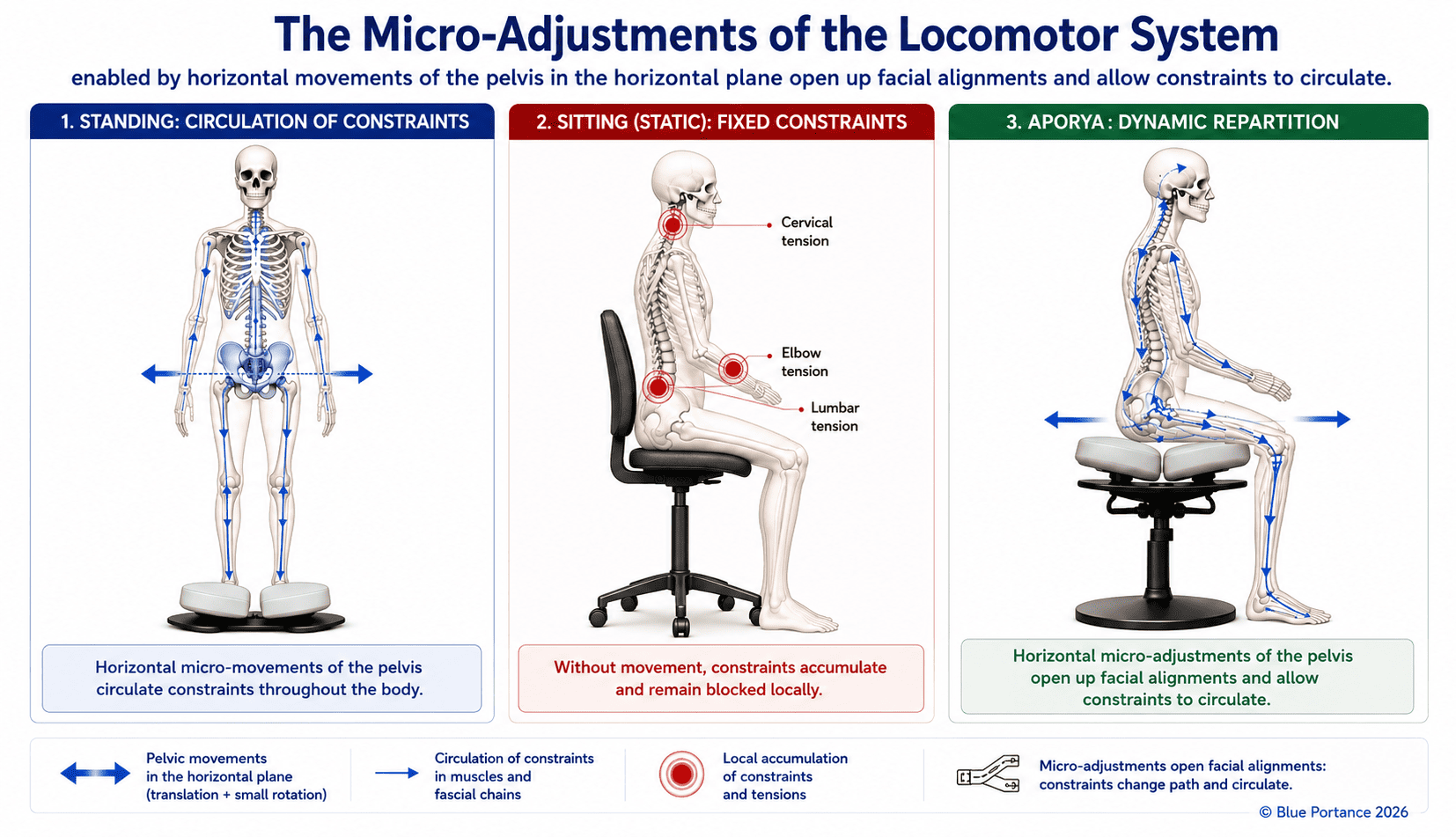
In a standing position, balance is ensured by an extremely fine system: the ankles, hips, and spine work in concert to maintain the center of gravity within a stability zone. At the heart of this system, the pelvis plays a central role.
- It receives adjustments coming from the feet and hips.
- It redistributes compensations toward the trunk and spine.
- It allows the body to remain upright with minimum muscular effort.
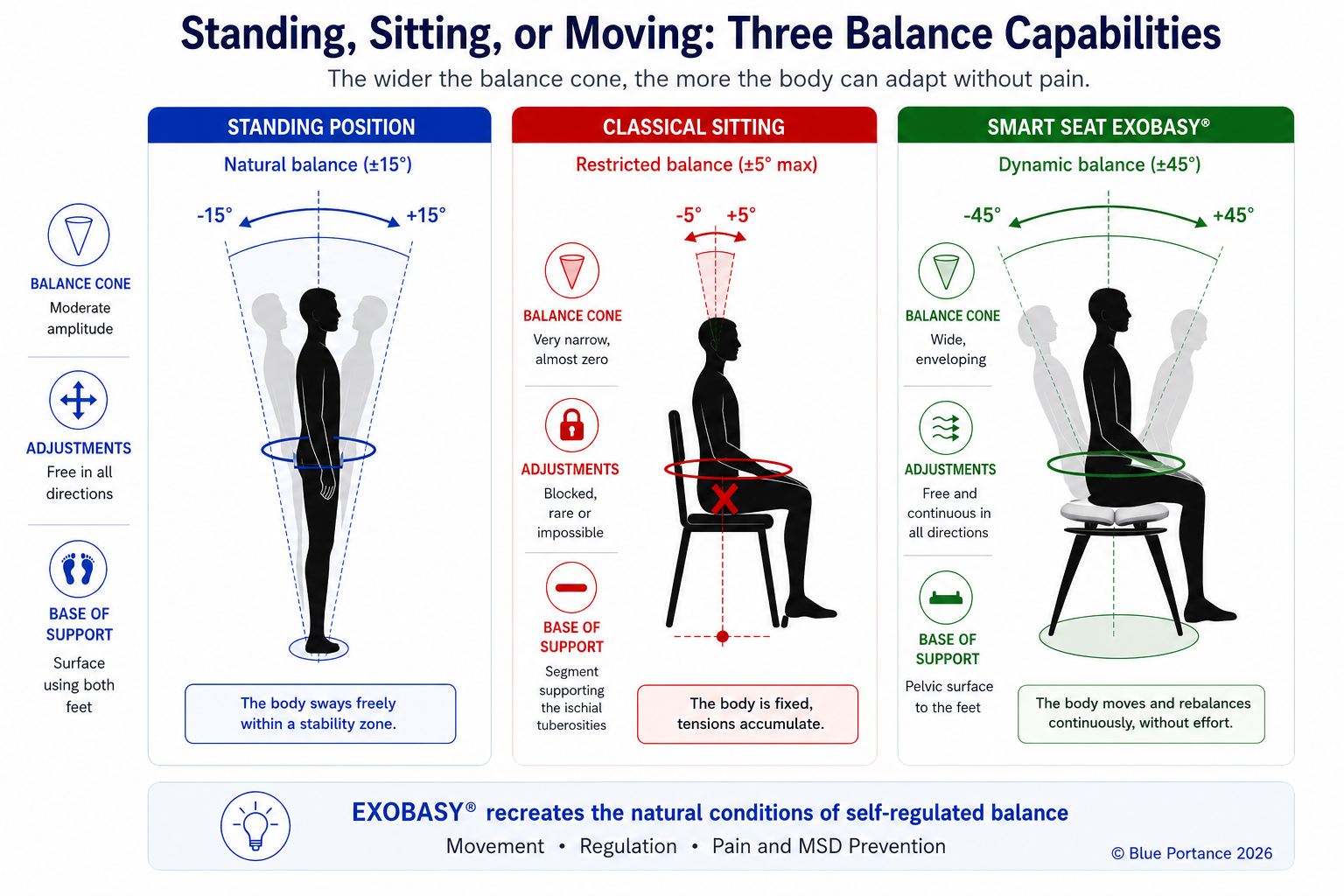
In other words, the pelvis is a regulator, not a rigid block. It constantly accompanies small movements of tilting, inclination, and rotation. These are the permanent micro-adjustments that allow the entire locomotor system to remain fluid, efficient, and painless. This is the principle of the “cone of economy” where the body seeks to minimize effort to maintain its stability (Dubousset, 1984).
3. Why the classic sitting position causes back pain
In a traditional sitting position, everything changes:
- The support base is reduced to the ischia (the “sit bones”).
- The hips are locked in flexion.
- The pelvis is wedged against a backrest or frozen on a flat surface.
- The feet no longer truly participate in balance.
Result: the pelvis can no longer play its role as a manager of postural compensations. It is enclosed in a quasi-fixed position. Adjustments that, while standing, were distributed throughout the body, are now stuck in a few zones.
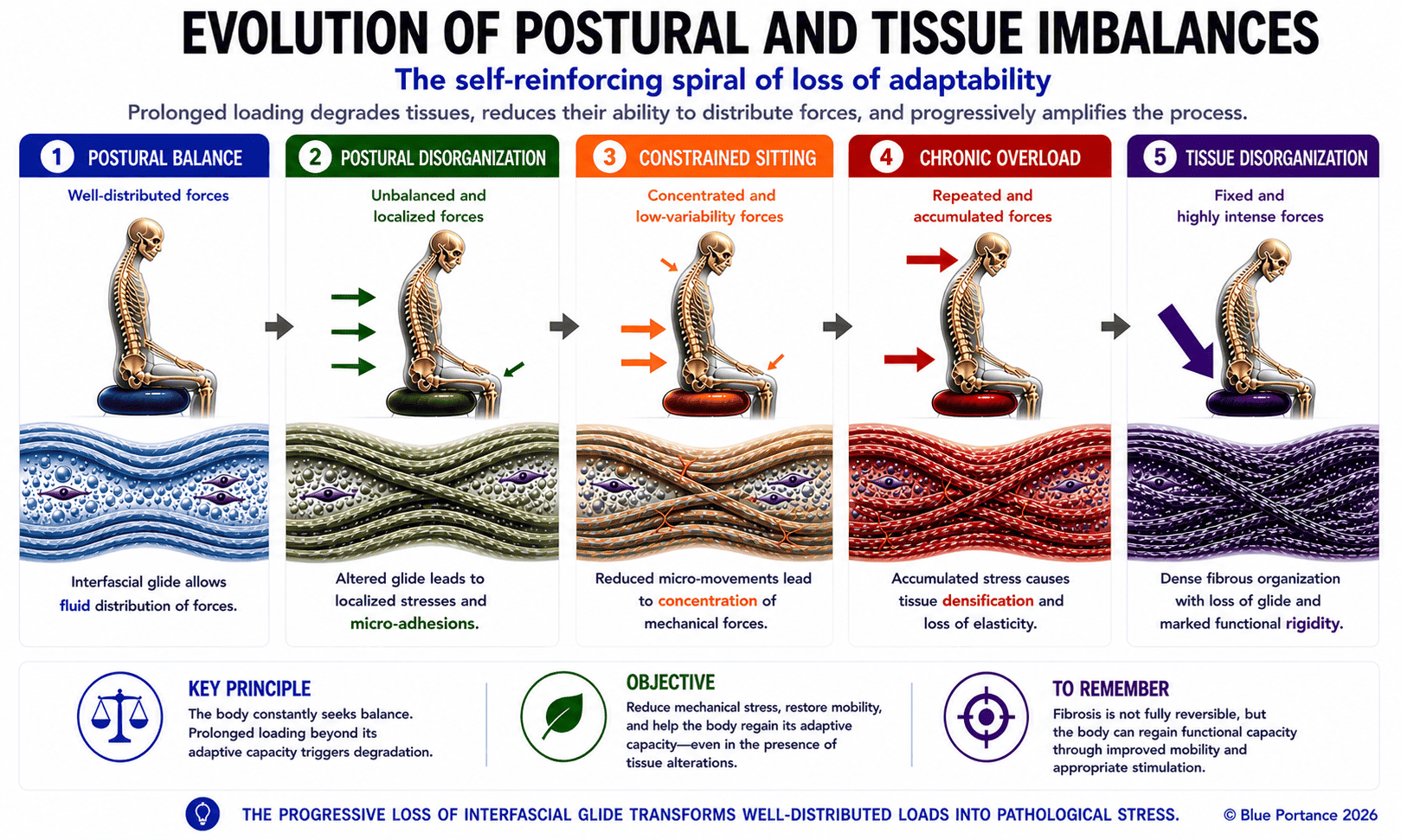
This is where the vicious cycle begins:
- Deep muscles enter hypertonicity to “hold” the posture.
- Fascia lose their sliding capacity.
- Nerves are subjected to indirect mechanical stresses.
- Intervertebral discs undergo prolonged pressure, always in the same spot, thus fixing mechanical stresses on precise zones (McGill, 2002).
This mechanism explains why the classic sitting position causes back pain, even without particular effort.
4. Sitting too long: Immobility + rigid support = a machine for manufacturing MSDs
Sitting too long is today recognized as a major factor in back pain while sitting. When one remains seated on a rigid and immobile support, two things happen simultaneously:
- The postural system is deactivated: The trunk’s stabilizing muscles, accustomed to working in movement, are forced into a static contraction or, conversely, go into “standby.” Fine balance regulation no longer functions.
- Internal stresses accumulate: Blood circulation slows down, tissues dehydrate, ligaments stiffen, fascia adhere and lose their sliding capacity (Langevin, 2006), and nerves become hypersensitive.
In the medium and long term, this translates into:
- Musculoskeletal disorders (MSDs).
- Lumbar, cervical, and interscapular pain.
- Myofascial syndromes (trigger points, “knotted” muscles).
- Pelvic and coccygeal pain.
- General sensation of stiffness, fatigue, and permanent discomfort.
The classic sitting posture becomes pathogenic not because you sit “badly,” but because it imposes immobility and deprives the pelvis of its regulatory function.
5. Back pain while sitting: the real problem is not posture, but the absence of movement
Most ergonomic approaches still search for “the right sitting posture.” With biomechanical hindsight, an observation is clear: There is no ideal sitting posture, sustainably endurable, if it remains immobile.
What makes sitting pathogenic is not only the shape of the seat or the angle of the backrest, but:
- The loss of micro-movements.
- The impossibility for the pelvis to continuously adjust the body’s alignment.
- The deactivation of the natural stabilization system.
- The fixation of stresses in a few over-solicited zones.
In other words: it is not the posture that counts, it is the body’s ability to regulate it through movement. Research shows that dynamic motor control is more crucial than maintaining rigid alignment (O’Sullivan, 2005).
6. Why prolonged sitting fosters MSDs and chronic pain
MSDs (musculoskeletal disorders) are often attributed to “bad postures,” a poorly adjusted desk, or an inadequate seat. These factors play a role, but they do not suffice to explain the scale of the phenomenon. The key is the link between:
- Loss of pelvic mobility (pelvis frozen by the seat).
- Absence of compensation regulation (no more diffusion of tensions).
- Accumulation of mechanical and tissue stresses.
The locomotor system no longer plays its role as an absorber and distributor of loads. Prolonged sitting then becomes ideal ground for MSDs: stresses no longer circulate, they fix and transform into chronic pain.
7. How to reduce back pain while sitting and regain a dynamic seat
To escape this vicious cycle, it is not enough to change a cushion or add lumbar support. One must change the paradigm:
- Move from a frozen posture to a posture regulated in movement.
- Give the pelvis back its mobility and its central role in balance.
- Allow the body to remain in a dynamic stability zone instead of fighting against imposed immobility.
This is precisely where the Aporia® approach and its Bioactive Seating™ logic come in: not correcting a posture, but recreating while sitting the biomechanical conditions of standing balance.
8. Aporia®: a solution to reduce pain while sitting
Classic seats remain passive: they support the body but do not participate in its regulation. Conversely, the Aporia® ExoBase was designed to:
- Restore pelvic micro-movements thanks to a curved base.
- Accompany fine adjustments via four multi-articulated pads.
- Maintain dynamic balance where one can no longer “slump”.
- Preserve tissue sliding and circulation, essential for avoiding chronic inflammation.
This concept of active ergonomics allows for a continuous redistribution of pressures (Mandal, 1982). Thus, the sitting position is no longer a frozen state, but a process of active regulation: the body can move, rebalance, and breathe. Tensions no longer accumulate; they are continually redistributed.
9. Back pain while sitting: understanding to durably escape pain
If you have tried everything – ergonomic chairs, meticulous adjustments, “memory foam” cushions – without obtaining lasting relief, it is not a failure on your part.
The real problem is an ergonomic model founded on immobility.
As long as the pelvis remains frozen, micro-movements are prevented, and postural regulation is deactivated, the sitting posture will continue to be a major source of pain and MSDs.
The solution is not simply to “hold oneself better,” but to reintroduce movement at the heart of the seat, giving the pelvis back its role as conductor. This is exactly the vocation of Aporia®: transforming the sitting position into dynamic balance, where the body can finally do what it is designed for: moving to stay healthy.
Frequently Asked Questions
Why do I have back pain while sitting?
Is there an ideal sitting posture?
Why does immobility promote musculoskeletal disorders (MSDs)?
What is the role of the pelvis in back pain while sitting?
How does Aporia® help reduce back pain while sitting?
Go further
Explore further on Blue Portance
- ➡️ Understanding the Seated Paradigm Shift :
- ➡️ Understanding the role of fascia in pain and movement : “Fascia and Tensegrity Explained: How Your Body Regulates Mechanical Stress, Movement, and Pain”
- ➡️ The role of micro-movements : “Why small movements matter more than large movements for relieving sitting pain”
- ➡️ Pudendal nerve pain and sitting : “Pudendal Neuralgia: Why Can a Simple Sitting Position Become an Ordeal?”
- ➡️ Coccyx pain and prolonged sitting : “Coccygodynia: Why Does Sitting Hurt So Much?”
Scientific References
- Dubousset, J. (1984). Balance cone and postural stability. [Source PubMed]
- Langevin, H. M. (2006). Connective tissue: A body-wide signaling network? [Source PubMed]
- Mandal, A. C. (1982). The seated man: Human sitting posture. [Source PubMed]
- McGill, S. M. (2002). Low Back Disorders. [Source Google Scholar]
- O’Sullivan, P. B. (2005). Diagnosis and classification of chronic low back pain. [Source PubMed]
- Wilke, H. J. (1999). New in vivo measurements of pressures in the intervertebral disc. [Source PubMed]
© Blue Portance. Reproduction and distribution authorized for non-commercial purposes, subject to citation of the source: “Blue Portance – SBNFA™ Doctrine.”
