


Product Benchmark: A Dated Application of the Framework
In brief. Which dynamic seat offers the body the most capabilities? Applied to six reference seats — Haider Bioswing 560 iQ, QOR360 Ariel 2.0, Aeris 3Dee, HÅG Capisco 8106, Tonic Chair Confort and Boréal–Aporia — the SBNFA™ analysis shows that only Aporia®’s segmented architecture is both dynamic and stabilized: 4/4 in postural balance, versus 1.67 to 2.33 for the others.
This fourth chapter applies the SBNFA™ grid to six seating devices — five chairs on the market and Blue Portance’s Boréal–Aporia prototype — using the same criteria and the same rating rules, with a declaration of the author’s interests.
It presents the results by function, what the segmented architecture makes possible with respect to adaptability potential, the four limitations of Blue Portance’s device, and what the benchmark does not say: no clinical conclusion. It also proposes a reading of the structure of interdependencies among the variables, which does not change any score.
Introduction and declaration of interests
This chapter applies the grid from Chapter 3 to six seating devices: five chairs on the market and a prototype designed by Blue Portance, the ExoBase Aporia® paired with the Boréal chair. The situation calls for a prior declaration: the author of this dossier is the cofounder and president of the company developing one of the devices evaluated.
The main result fits in one sentence: as of the date of this evaluation, in this comparison, the ExoBase Aporia® is the only seat that is both dynamic and stabilized, thanks to a patented segmented architecture that leaves the pelvis its three planes of mobility and gives each hip independent mobility in all directions (360°). None of the other architectures in this comparison combines these properties, and Aporia® is the only device in the panel to obtain the maximum rating on four functions — adaptability, pelvic mobility, postural balance and processing of mechanical information; this chapter explains how this result was obtained and what it does not allow one to claim.
This situation is declared so that readers can take it into account. It is governed by methodological rules: the same criteria and the same rating rules for all devices, the limitations of Blue Portance’s device set out at the same level as those of the others, and the status of each result made explicit.
In Part III of the framework, each rating refers to an observation and to an anchor in the grid [2].
1. Four rules for applying the grid
Four rules govern the application of the grid. They determine the value of everything that follows.
| Rule | Content | What it guarantees |
|---|---|---|
| Same criteria, same rating rules | The evaluation uses the same nineteen variables and the same scale. The sources used — technical specifications, user feedback, trials and expert judgment — are specified for each device in its monograph. Rating is based on described and observed behavior, not on the origin of the documentation. | No criterion is adjusted for any one device |
| Criteria that can be examined independently of the product | [SBNFA PROPOSITION] The functions and variables reflect phenomena documented independently of Aporia®. The development and observation of Aporia® helped to better identify and formalize certain state variables; these variables are then defined independently of any technical solution and applied under the same rules to all devices. | The product may help reveal a variable; it determines neither its functional relevance nor its rating rule |
| Multi-criteria analysis | Each device is evaluated on the nineteen variables on the basis of its technical specifications, the available documentation, user feedback and expert judgment, using common rating anchors. | A proven decision-support method, applied identically to all six devices |
| Two separate audits | The method audit (consistency, references, levels of evidence) and the product doctrine audit (compatibility of a product’s concepts with current knowledge) are never merged. | The method is not validated by the product, nor the reverse |
The evaluations of the market chairs are Blue Portance’s own; they do not commit the manufacturers. Blue Portance’s prototype was evaluated in its prototype state, as of August 25, 2026 [2].
2. Six devices, one selection method
The comparators were selected following a systematic scan of the dynamic seating market. This scan separately queried five AI-assisted search engines — ChatGPT, Claude, Gemini, Perplexity and Vibe — and was then supplemented by a literature search conducted by the author to identify devices that none of these engines had found.
Ergonomists were also consulted; they rank the Haider Bioswing 560 iQ first. The five comparators are those that this scan, cross-checked against the parallel searches and the opinion of these practitioners, identified as the reference dynamic seats on the market. They cover the main families of mechanisms (pendulum suspension, multidirectional rocker, three-dimensional tilt, saddle seat with sagittal mechanism, ball-type unstable seat).
The scan is documented and dated; any device not included in it can be reported and will be evaluated using the same grid.
| Device | Architecture | Evaluation status |
|---|---|---|
| Haider Bioswing 560 iQ | Global three-dimensional mechanism with pendulum suspension; seat with no fixed mechanical connection to the base. Ranked first by the ergonomists consulted | Evaluated |
| QOR360 Ariel 2.0 | Active stool with a short seat; multidirectional geometric rocker that frees the thighs and hips | Evaluated |
| Aeris 3Dee | Dynamic chair with vertical suspension and global three-dimensional tilt, slatted backrest | Evaluated |
| HÅG Capisco 8106 | Saddle chair with an open hip angle, mainly sagittal mechanism, alternation between sitting, perching and standing | Evaluated |
| Tonic Chair Confort | Ball-type unstable seat (burst-resistant ball) in a five-star frame | Evaluated |
| Boréal–Aporia (Blue Portance prototype) | Mobile curved base and four independent articulated pads | Evaluated — internal prototype |
The descriptions and ratings below are those of the evaluation carried out by Blue Portance as of August 25, 2026 [2]. The documentary basis for the prototype differs from that of the comparators (architectural analysis, brand documents, user trials and video transcripts); this asymmetry limits comparability and must be taken into account when reading the profiles.
3. The architecture evaluated: ExoBase Aporia®
Before reading the ratings, one needs to know what is being evaluated. The ExoBase Aporia® is a mobile curved base carrying four mechanically independent articulated pads: front right, front left, rear right, rear left. Each pad is mounted on a ball joint that moves in all directions (360°), with a limited but sufficient up–down tilt range to follow the adjustments of the hips, and has its own foam assembly and its own cover.
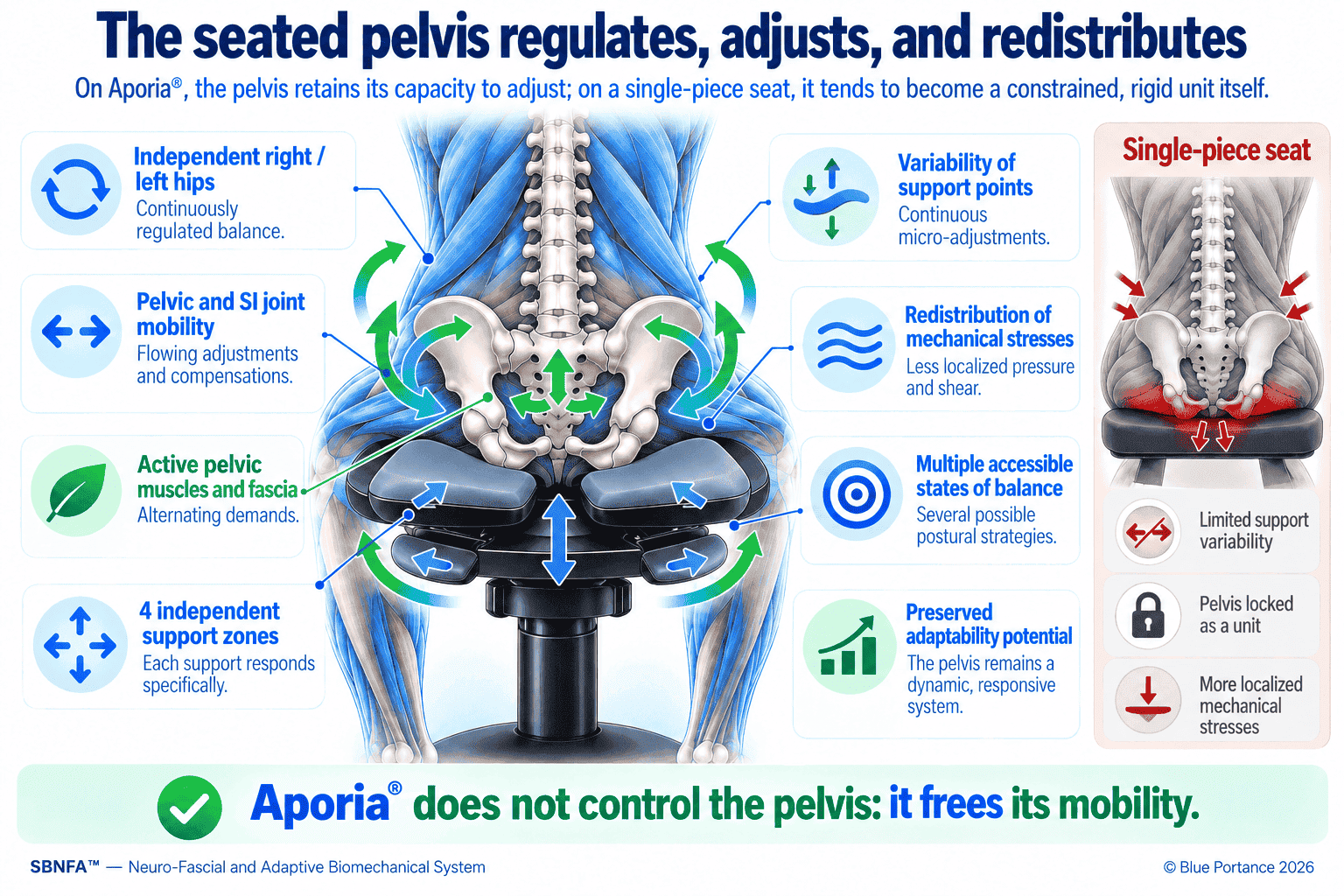
[MECHANICAL] The curved base accompanies the global movement of the pelvis; the four pads respond separately to pelvic shifts and preserve the local origin of the loads. This decoupling, from the ball joint all the way to the cover, is what the evaluation identifies as explaining the maximum ratings for left/right independence (EQU-1) and localized processing (INF-2).
[MECHANICAL] Stability comes not from limiting movement but from coordination. This is the case in standing: range of motion is not restricted, and balance is achieved through continuous regulation. On Aporia®, the hips regulate and the pads adjust; combined with the rolling of the curved base, these adjustments keep the projection of the center of mass directly above the point of contact between the base and the seat, whatever position is reached. The subject can thus move away from the centered position, stop and hold there, then move on again.
[SBNFA PROPOSITION] When standing, the cone of balance rests on an elliptical base, imposed by the support area between the two feet; its opening is estimated at about ±15°. In the seated position, the buttocks–feet base of support forms an approximately square area, about three times larger than in standing: the potential cone of balance of the seated position can thus be estimated at about ±45°. Whereas the elliptical base of standing opens the cone more in one direction than in the other, the square base of the seated position offers a more even opening in all directions. These values remain orders of magnitude. This potential is common to any properly set-up seat.
[MECHANICAL] Aporia® is the only architecture evaluated that makes it possible to truly exploit it: movement in all functional directions, stopping at the position reached, stable holding and then resumption of movement, throughout this cone, including along its slightly more open diagonals. The independent action of each hip, carried by pads on ball joints that swivel through 360° (EQU-1: 4/4), makes it possible to exploit these directions, whereas a one-piece seat pan locks both hips into the same movement. The zero point is adapted to the subject’s sagittal organization by a front, neutral or rear wedge. The ±45° figure is an SBNFA estimate: the limit angle also depends on the height of the center of mass, which is lower in the seated position.
The Boréal chair with which the ExoBase is paired provides peripheral adjustments (headrest, armrests, backrest, lumbar support, tilting seat) that are not the subject of the comparison: it is the seating architecture that is evaluated.
4. The reported functional profiles
[MECHANICAL] The table presents, in alphabetical order, the results of the SBNFA™ multi-criteria analysis, based on the evaluation of technical specifications, user feedback and expert judgment; Figure 6, which follows it, presents the same values by comparative score, with the breakdown of the seven functions.
| Device | ADP | COM | MOB | EQU | CON | INF | PRE |
|---|---|---|---|---|---|---|---|
| Aeris 3Dee | 2.00 | 2.50 | 1.67 | 1.67 | 2.50 | 2.00 | 2.25 |
| Boréal–Aporia (prototype) | 4.00 | 3.00 | 4.00 | 4.00 | 3.50 | 4.00 | 3.75 |
| Haider Bioswing 560 iQ | 3.50 | 3.00 | 3.00 | 1.67 | 2.50 | 2.67 | 2.00 |
| HÅG Capisco 8106 | 2.00 | 1.50 | 1.67 | 1.67 | 2.00 | 2.00 | 1.50 |
| QOR360 Ariel 2.0 | 3.00 | 1.50 | 3.00 | 2.33 | 2.00 | 2.00 | 2.75 |
| Tonic Chair Confort | 2.50 | 1.50 | 1.67 | 1.67 | 2.50 | 1.67 | 1.75 |
SBNFA™ Benchmark: 6 dynamic seats assessed on 7 functions
Comparative score out of 4 · Postural balance (EQU), highlighted, sets the stabilized dynamic seat apart
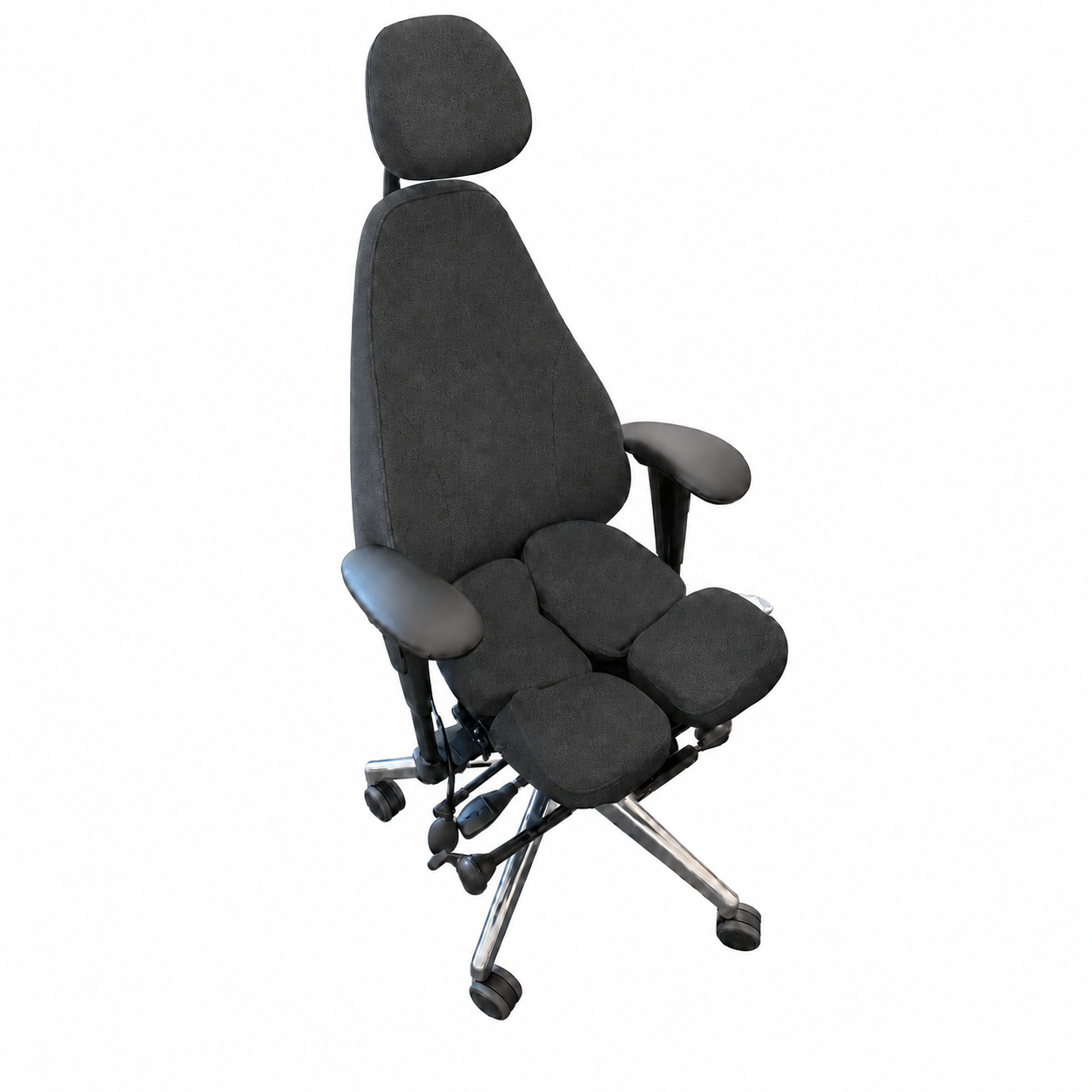
Rank 1
Boréal–Aporia
3.75 / 4 comparative score
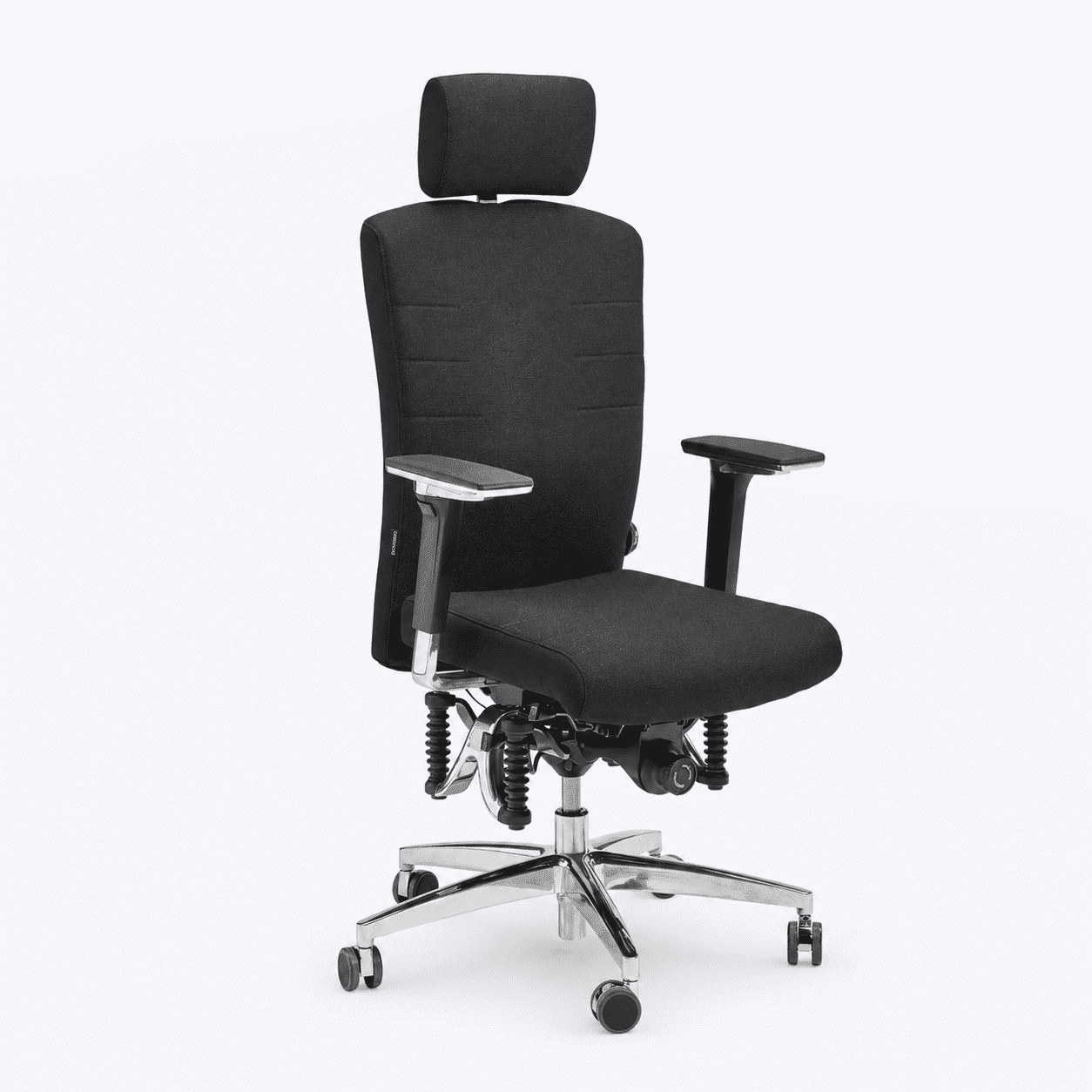
Rank 2
Haider Bioswing 560 iQ
2.62 / 4 comparative score
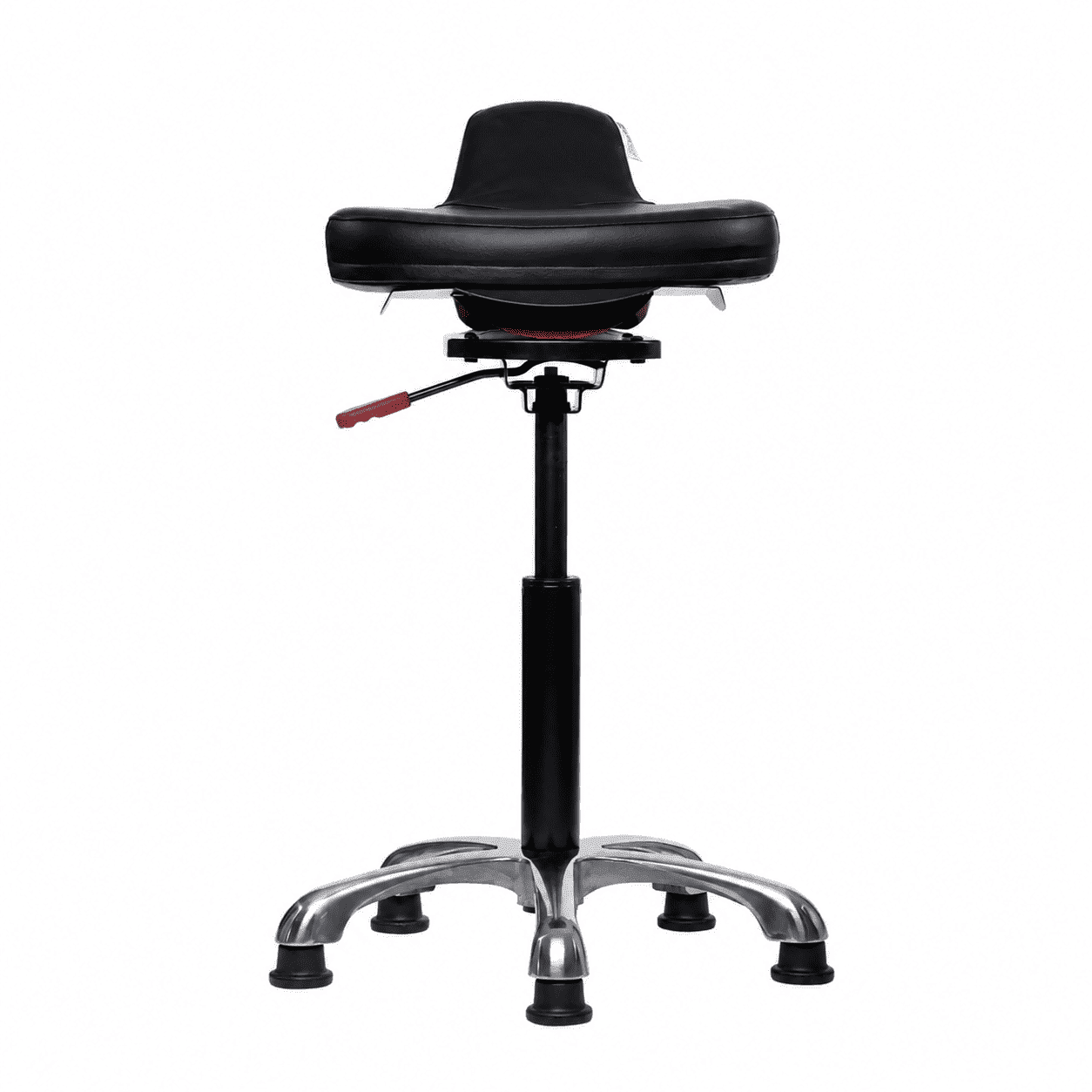
Rank 3
QOR360 Ariel 2.0
2.37 / 4 comparative score
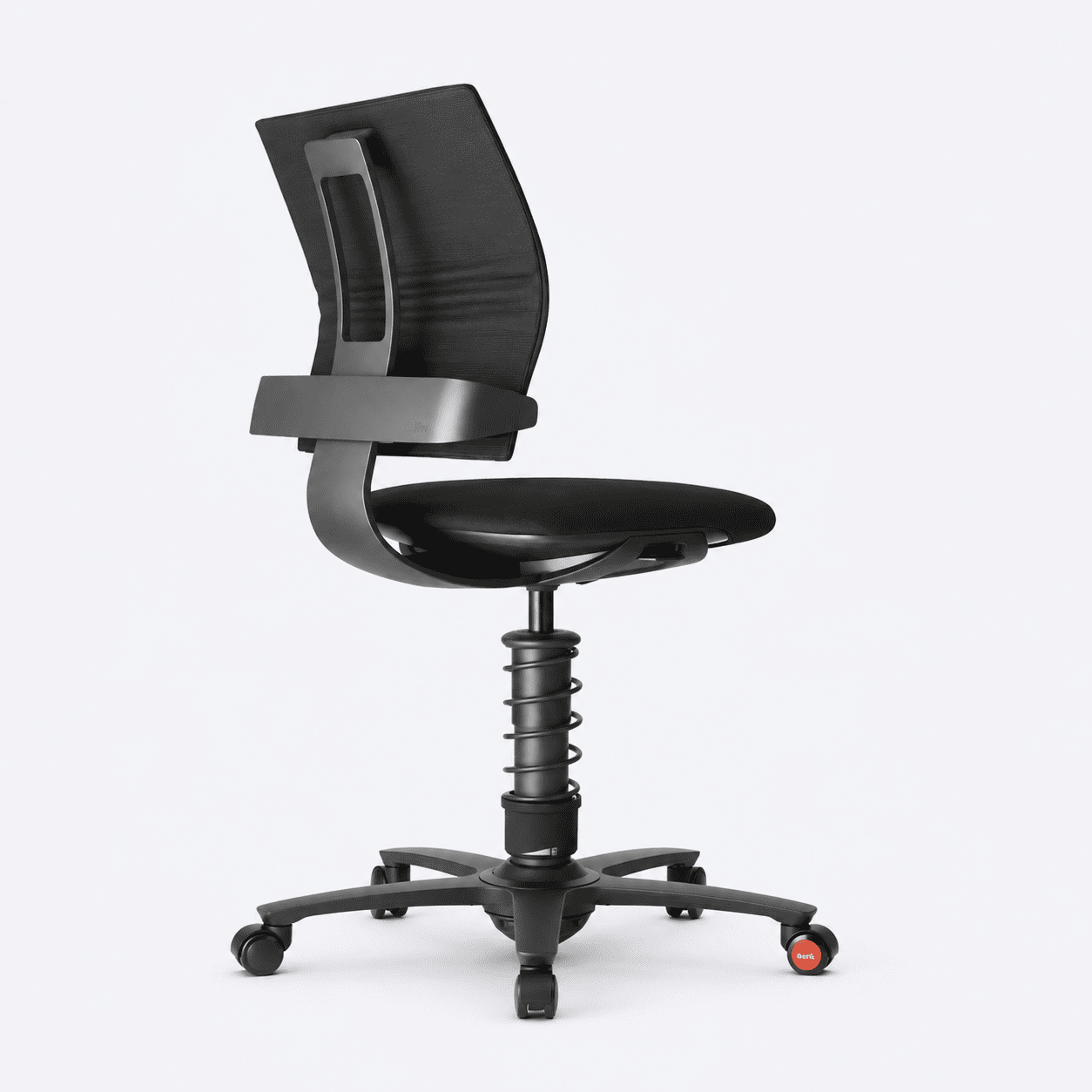
Rank 4
Aeris 3Dee
2.08 / 4 comparative score
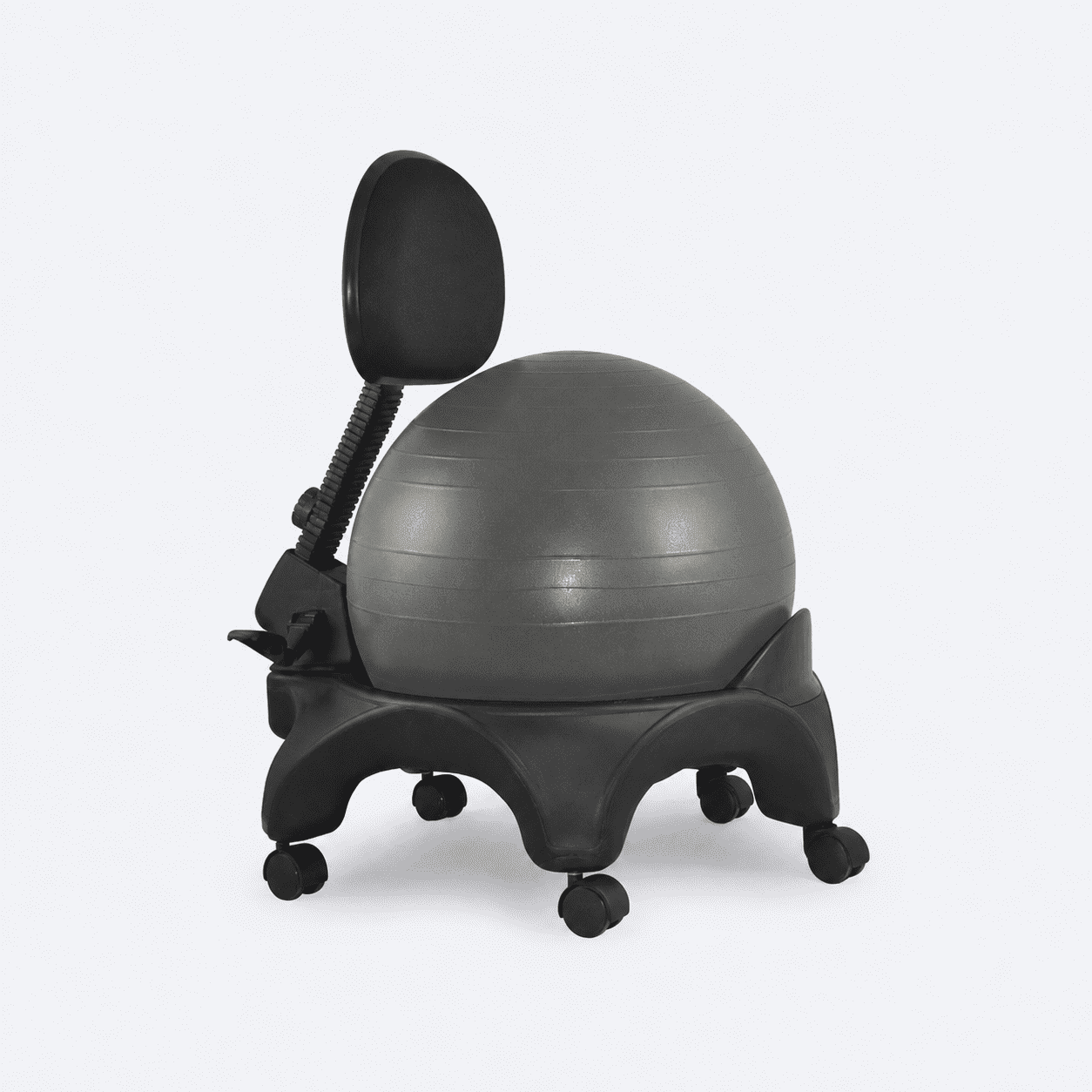
Rank 5
Tonic Chair Confort
1.89 / 4 comparative score
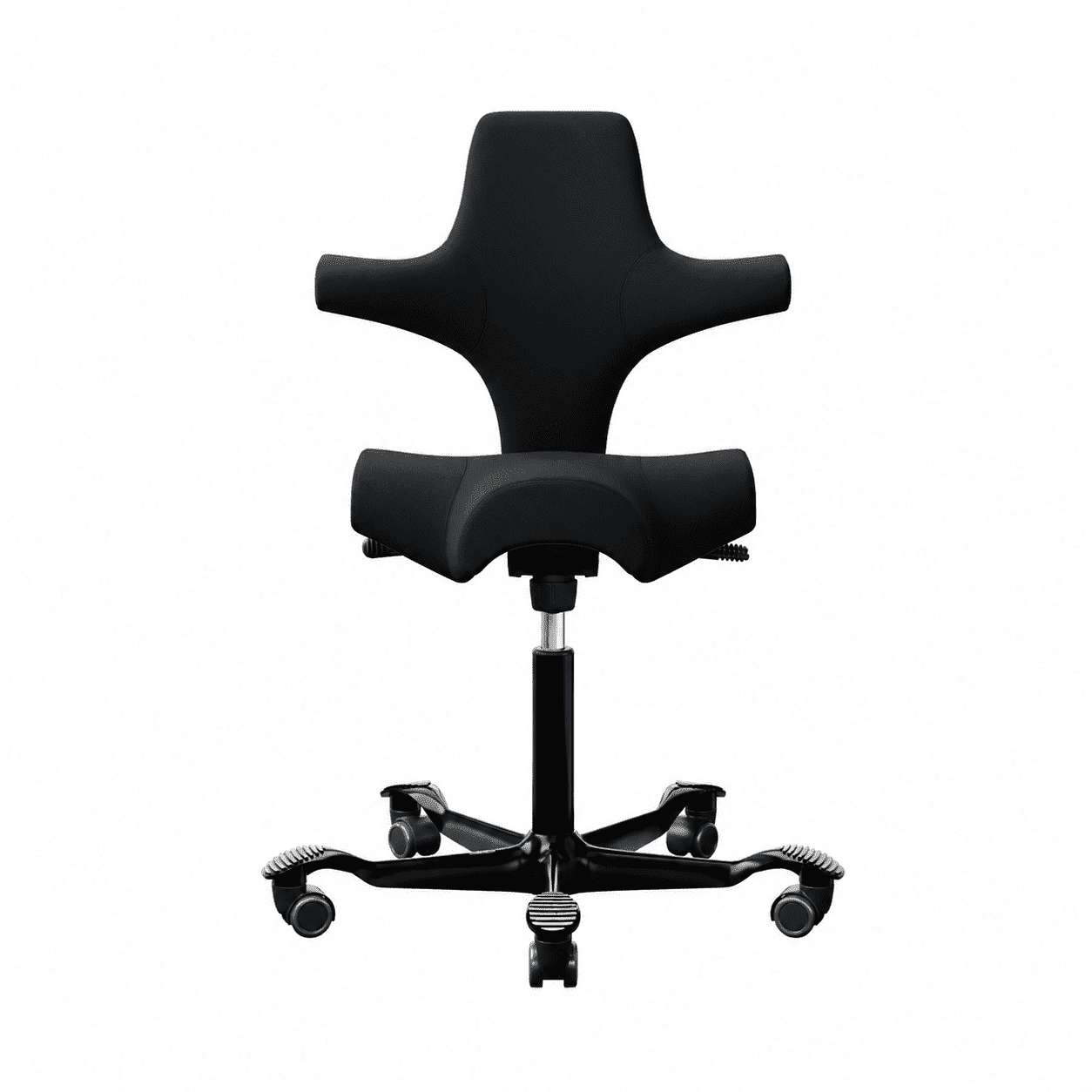
Rank 6
HÅG Capisco 8106
1.76 / 4 comparative score
The two decimal places result from the calculation of means. Read the functional contrasts and the restrictions, without interpreting the hundredths. ADP, COM, MOB, EQU, CON, INF and PRE designate the seven functions of the SBNFA™ seating evaluation framework.
Coverage is complete for all six devices: all nineteen variables are determined, with no ND. The observations, restrictions and justifications for each rating are given in the monographs in Part III of the framework.
Overall aggregates
The overall values are available in the CSV source record. They complement the reading by function.
5. What the benchmark reveals: architectures, not brands
The value of the benchmark lies not in the ranking, but in what it reveals about architectures. Four findings emerge; they explain why the five market chairs, however mobile, remain limited in postural balance and in the local processing of supports. A general-audience summary of these results is presented in the 2026 dynamic chair comparison.
Moving does not mean being balanced
[MECHANICAL] Several so-called dynamic chairs allow the user to move away from a position of balance without allowing the posture reached to be freely stabilized. As soon as the subject leaves the centered position, the hips remain locked together by a one-piece seat and no load-bearing zone can adjust: regulation through displacement no longer works. The projection of the center of mass leaves the zone where the seat exerts its reaction force, which creates a destabilizing torque; the subject must then compensate for it with muscular effort, or the mechanism returns them to the center through a return force. Function 4 remains limited for all five market chairs: their buttock supports rest on a shell, a seat pan or a single volume that mechanically couples both sides of the pelvis. The QOR360 leaves the thighs free and offers strong macromobility, but its one-piece seat, its rear support and the need for active control away from the center do not create a wide space of stabilized positions.
Global mobility and fineness of response are two different things
[MECHANICAL] The Bioswing and the QOR360 both offer global multidirectional mobility (MOB = 3.00), based on different principles. The Bioswing responds more finely to micromovements thanks to its pendulum suspension; the QOR360 favors macromobility, with a threshold effect for very small inputs. Neither mechanically decouples the buttock supports.
Variety of positions is not adaptability
[MECHANICAL] The Capisco allows several ways of sitting and facilitates transitions between high sitting, conventional sitting and a semi-standing position. This versatility relies on the subject’s voluntary repositioning, not on continuous mobility of the interface: in each configuration, the seat remains one-piece and its dynamics mainly sagittal. This versatility of use is not, in itself, a function of the grid; it may have other merits.
Shifting the load is not processing it locally
[MECHANICAL] Dynamic chairs vary the supports because the user as a whole, or the seat as a whole, moves. This global variation guarantees neither the successive unloading of each zone nor local compression–decompression alternation: as long as the load-bearing surface works as a single block, a local input cannot receive a truly differentiated response.
The case of the Bioswing is the most telling. Ranked first by the ergonomists consulted, it obtains good ratings for adaptability (3.50) and pelvic mobility (3.00), but remains at 1.67 for postural balance, compared with 4.00 for Aporia®: its pendulum suspension finely accompanies movement, but its one-piece seat couples both sides of the pelvis and does not allow the user to stabilize freely away from the center. These findings describe architectural trade-offs. A chair that performs very well at accompanying micromovements, like the Bioswing, or at postural activation, like the Tonic Chair, fulfills real functions; the grid simply shows that they do not cover all the functions evaluated.
6. What the architecture makes possible in terms of adaptability potential
Chapter 2 defined adaptability potential as the set of adaptation possibilities accessible to the subject in a given situation. The question for Chapter 4 is therefore a precise one: what does the evaluated architecture make possible, or constrain?
| Component of adaptability potential | What is observed on the Aporia® architecture | Rating (Level 1) | Status |
|---|---|---|---|
| The subject remains the initiator of change | The seat follows adaptations with no imposed trajectory and no dominant return force (ADP-1, ADP-2) | 4 / 4 | [MECHANICAL] |
| The pelvis has its three planes available | Sagittal, frontal and rotational mobility all rated (MOB-1 to MOB-3) | 4 / 4 | [MECHANICAL] |
| Both sides remain mechanically independent | Four articulated pads; independent left/right response in all directions (EQU-1) | 4 / 4 | [MECHANICAL] |
| A stabilized space exists around an adjustable zero point | Cone of balance estimated at about ±45°, used over its full extent; front, neutral or rear wedge (EQU-2, EQU-3) | 4 / 4 | [MECHANICAL] |
| Mechanical information keeps its local origin | Differentiated response per pad (INF-2) | 4 / 4 | [MECHANICAL] |
| Micro-adjustments of the pelvis are accompanied | Horizontal displacement and spine–pelvis pivoting broadly permitted but accompanied, not produced directly (COM-1, COM-2) | 3 / 4 | [MECHANICAL] |
[MECHANICAL] Taken together, these six properties distinguish the Aporia® architecture from all the other architectures evaluated: the pelvis retains its three planes of mobility, each hip moves independently of the other in all directions (360°), the coordination between hips, pads and curved base keeps the center of mass directly above the point of contact, spine–pelvis pivoting at the sacroiliac level is not blocked, and the subject can stop and stabilize at any point in the accessible space. None of the five market chairs combines left/right independence with stabilization: this is the hallmark of stabilized dynamic seating.
[SBNFA PROPOSITION] The SBNFA framework posits that an architecture combining these properties makes possible a greater range of postural organizations accessible to the subject — that is, a broader adaptability potential in the seated position. The grid observes capabilities offered; it does not measure the subject’s potential.
7. The systemic reading remains separate from the product results
[SBNFA PROPOSITION] The matrix describes proposed influences among the nineteen capabilities. It does not prove that a product triggers a chain of physiological effects. Its method is set out in Chapter 3 (structural analysis of the nineteen variables), independently of the benchmark.
In its working version, the matrix retains 39 direct relationships out of 342 ordered pairs, with conventional intensities from 1 to 3. The full matrix and its justification register are not published at this stage; no influence or dependence calculation is presented here.
8. Documented limitations and what the benchmark does not say
The benchmark sets out the limitations of each device, including those of Blue Portance’s prototype.
The four ratings of 3 out of 4
| Variable | Observed limitation |
|---|---|
| COM-1 — Horizontal pelvic displacement | Broadly permitted, but accompanied indirectly by the adaptation of the pads and bounded by the geometry of the assembly; it is not produced directly by the device. |
| COM-2 — Spine–pelvis pivoting | Same limitation: accompanied and not produced directly, bounded by the geometry. |
| CON-1 — Spatial distribution of pressure | Depends on body morphology, adjustment and cushion version; targeted unloading may shift part of the load to other zones. |
| PRE-4 — Appropriate deformability of support surfaces | Varies with the chosen firmness and cannot be adjusted separately for each pad. |
These limitations explain why the prototype does not obtain the maximum rating on every variable; its lowest-rated function is the management of compensations (COM = 3.00).
What this benchmark does not say
- Nothing about health, pain or the incidence of musculoskeletal disorders. The Level 1 grid evaluates mechanical capabilities offered. No clinical trial is reported in this dossier.
- Nothing about comfort or tolerance of prolonged sitting. Informal user feedback exists; it comes from an uncontrolled sample, outside the scope of the benchmark, and is not used here as evidence.
- A multi-criteria analysis, not a measurement campaign. The cone of about ±45° is an SBNFA estimate; the stopping and stabilization capabilities are established through analysis of technical specifications, user feedback and expert judgment.
9. A framework open to application by third parties
The result rests on published criteria, applied under the same rules to all six architectures. The rule “a technical solution meets the criteria; it never defines them” allows any evaluator to apply the grid to other devices, including Aporia®.
The framework keeps its own version; the benchmark keeps its date, its configurations and its sources. Any device can be evaluated using the same grid, and any rating can be challenged on the basis of a reasoned observation.
Frequently asked questions
How do you compare dynamic chairs?
By comparing what they allow the body to do, not their mechanism. Two criteria separate the architectures most clearly: the ability to stop and stabilize away from the centered position (postural balance) and the independence of the right and left sides of the pelvis. They are what set stabilized dynamic seating apart from chairs that move without stabilizing.
Can an exercise ball replace an office chair?
It encourages postural activation and varies the support points, but it allows neither free stabilization away from the center nor dissociation of the two sides of the pelvis: the Tonic Chair Confort, a ball mounted on a frame, scores 1.67/4 in postural balance. It is an activation tool, not stabilized dynamic seating.
Can Blue Portance evaluate its own device?
Blue Portance declares its interest. The phenomena involved are documented independently of Aporia®; the criteria are an SBNFA construct and are applied under the same rules to all devices; the prototype’s limitations are set out at the same level as those of the others; and the variables are intended to be objectified through instrumented measurements (Chapter 5). The framework is, moreover, designed to be applied by third parties.
How should the prototype’s results be read?
By function and by restriction, according to the documentary version evaluated. Overall aggregates are secondary and demonstrate no biological or clinical effect.
Does the interdependency matrix change the scores of the six devices?
No. The matrix describes the structure of the model; it is the same for all devices and was not used to rate them. The scores remain those of the grid: means of the ratings of the seven functions, with no systemic score at this stage.
Why do some very well-known chairs obtain modest scores?
Because the grid evaluates a specific set of seven functions, several of which — left/right independence, localized processing, local load alternation — are not the main focus of most chairs. A modest score does not mean that a chair is bad, but that it covers fewer of the functions evaluated.
Is the Aporia® seat clinically validated?
No. This dossier reports no clinical study. It presents a multi-criteria analysis of the architecture, its limitations, and the planned measurement program.
References
The contribution and scope of each source are specified in Chapter 6 (annotated bibliography). A reference associated with a variable documents a phenomenon; it does not validate the variable.
- Blue Portance, 2026 (a) — SBNFA™ Framework for Evaluating Seating Devices — Part I: Scientific and Methodological Framework. Internal document, version of August 3, 2026.
- Blue Portance, 2026 (c) — SBNFA™ Framework — Part III: Monographs and Comparative Evaluation (V14). Internal document, August 25, 2026.
