


From Fixed Mechanism to Living System
In brief. Is dynamic seating always better? No: movement alone is not enough. A chair can allow movement without allowing the body to stabilize the posture it reaches. The SBNFA™ framework distinguishes three regimes — static, unstable and stabilized dynamic — and evaluates the capabilities a seat offers the body rather than its mechanism or perceived comfort.
This first chapter of the SBNFA™ expert dossier sets out the limits of the traditional seating paradigms — correct posture, dynamic mechanism, reported comfort — and makes the case for moving from evaluation by mechanism to evaluation by function.
It presents the framework’s construction chain, the origin of the criteria — documented phenomena and a distinct SBNFA methodological construction —, the meaning of the model’s four terms (systemic, biomechanical, neuro-fascial, adaptive) and the five methodological principles that govern everything that follows.
Introduction
Is a seat “good” because it moves, because it is adjustable, because it maintains a posture deemed correct, or because the person sitting in it feels good? These four answers have coexisted for decades in the ergonomics literature and on the market. None of them states precisely what the seat allows the body to do over hours of sitting.
This first chapter frames the problem before proposing a method. It reviews what the literature establishes about the limits of the traditional seating paradigms, then explains why the SBNFA™ framework changes the question: no longer “what mechanism does this seat incorporate?” but “what capabilities does it offer, and at what level of evidence can we say so?”
Throughout, this dossier distinguishes what is established by the literature, what is an architectural observation, what constitutes a proposition specific to the SBNFA™ model, and what remains to be measured. It is published by Blue Portance, which also designs a seating device, Aporia®: this interest is declared on the dossier home page.
Guiding principle of the framework: a technical solution meets the criteria; it never defines them. The criteria are an SBNFA translation of documented phenomena; their definition must be open to examination independently of any device, and they apply to every device — including Blue Portance’s own.
1. Three paradigms, three blind spots
Three paradigms share the field of seating evaluation. Each has contributed real knowledge; each leaves a blind spot.
“Correct” posture and adjustment
The first paradigm treats the seat as a support to be adjusted in order to achieve a target posture: backrest, height, depth, lumbar support. The evaluation criteria for work chairs formalized in the 1990s, for example those of Occhipinti and colleagues (La Medicina del Lavoro, 1993), follow this logic of geometric conformity and adjustability [1]. Adjustment remains essential. But it describes what the seat presents to the body, not what it allows the body to do over time.
Dynamic seating defined by mechanism
The second, more recent paradigm values movement: ball joints, rockers, suspensions, balls, saddles. The argument is simple — a body that moves is a less rigid body. It nevertheless suffers from a difficulty the literature itself points out. Comparisons of dynamic chairs with a conventional chair, such as that of Ellegast and colleagues (Applied Ergonomics, 2012) on four office models, address muscle activation, physical activity and posture [2]. Above all, they show that the effects depend on the device studied and on what is measured. [ESTABLISHED] The mere presence of a moving part does not, by itself, guarantee a measurable functional benefit.
The same holds for unstable surfaces. Gregory, Dunk and Callaghan (Human Factors, 2006) compared a stability ball and an office chair in terms of muscle activation and lumbar posture during prolonged sitting [3]. Comparing two surfaces tells us what each produces under the conditions of the study; it does not tell us what adaptive capacity either one leaves to the person.
Reported comfort
The third paradigm relies on sensation: a seat is good if its user judges it comfortable. Comfort matters, but it is not functional evidence. A pleasant sensation can coexist with impoverished adaptation, and vice versa. The SBNFA™ framework states this explicitly in its rating rules: sensations of comfort and preferences do not constitute functional evidence [4].
2. Why a single “ideal” sitting posture does not hold up
Two findings from the literature illustrate why a single, “ideal” sitting posture cannot serve as the measure of a seat’s quality.
The first concerns so-called upright posture. O’Sullivan and colleagues (Spine, 2006) studied, in pain-free subjects, the effect of different ways of sitting upright on spinal-pelvic curvature and on trunk muscle activation [5]. Work of this kind is a reminder that a “correct” sitting posture is not a resting state: it comes at the cost of muscle activity, and the way one straightens up matters as much as the geometric result.
The second concerns seat inclination. Hamaoui and colleagues (PLOS ONE, 2015) conclude, in the very title of their article, that a sloping seat does not reduce the strain sustained by the postural chain [6]. Changing an angle is therefore not enough to resolve the question.
Finally, inter-individual variability is substantial. Roussouly and colleagues (Spine, 2005) described, in the standing position, several types of normal lumbopelvic sagittal alignment, organized around pelvic incidence [7]. This work concerns standing, but it sets out a principle useful for sitting: there is no single “normal” organization of the pelvis and spine to which all subjects should be brought back.
The framework applies this caution to one specific point. The 90° pelvis–femur relationship is not adopted as an established norm: it is only a functional hypothesis, to be individualized according to pelvic incidence. That is why the grid evaluates the ability to adjust the reference point (variable EQU-3), not the attainment of a prescribed angle.
3. Moving is not enough: three balance regimes
A common criterion for calling a seat “dynamic” is that it allows movement. The framework considers this too weakly discriminating, because it groups under a single word architectures that leave very different possibilities for the regulation of balance.
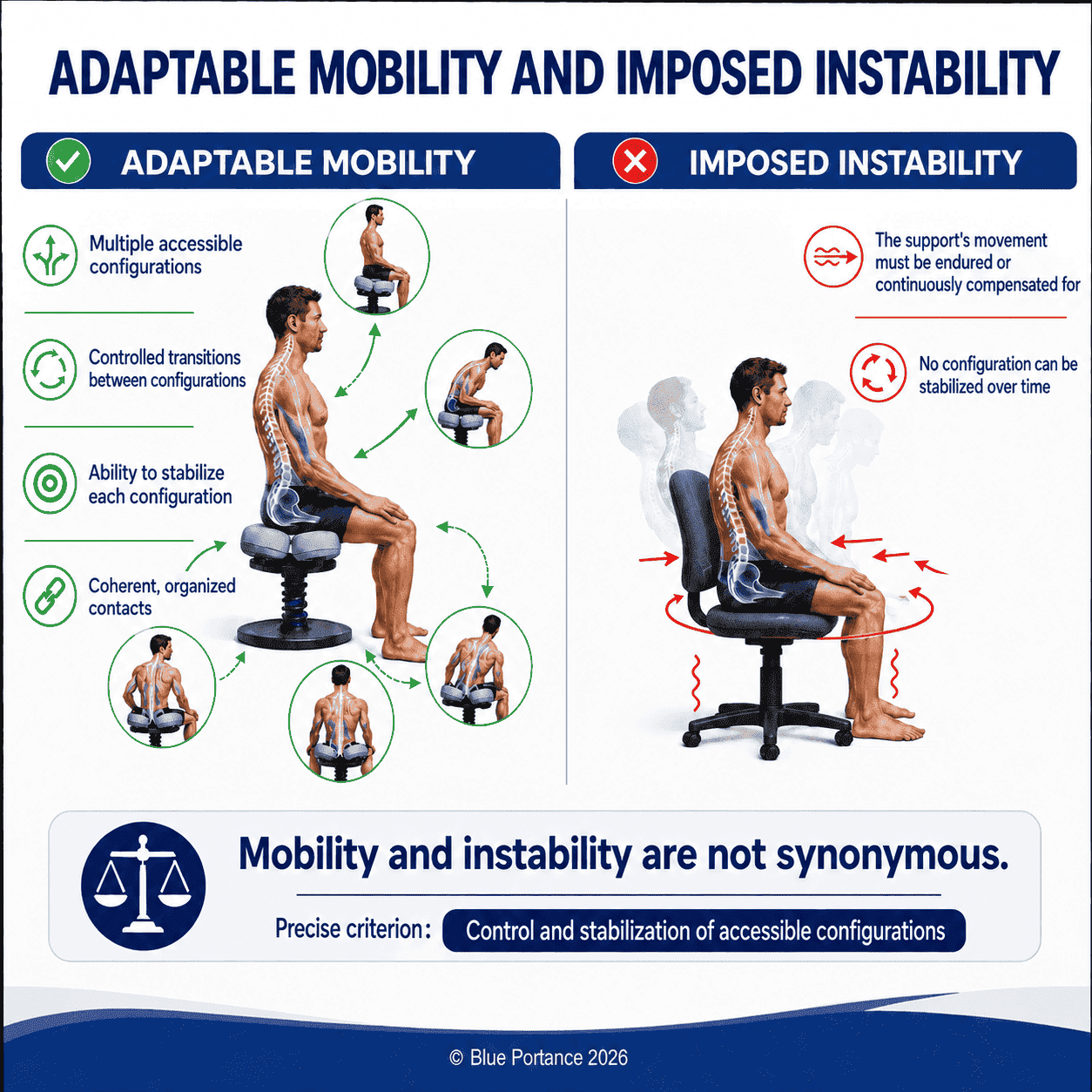
[SBNFA PROPOSITION] Three regimes can be distinguished. They describe architectures, not brands: they do not sort products into good or bad; they state which balance capabilities each architecture leaves to the subject.
| Regime | What the architecture offers | Consequence for the regulation of balance |
|---|---|---|
| Static seating | A single support organization, fixed or locked. | Regulation is restricted by the locking: outside this organization, the subject has only precarious balance positions available. |
| Unstable seating | Movement, but with a return force or an instability imposed by the way the seat works. | The subject can move away from the balance position without being able to freely stabilize the posture reached: away from that point, they must expend energy to counter the imbalance. |
| Stabilized dynamic seating | A continuous space of movement in which several balance configurations are available. | The subject can move, stop, hold the position reached and then move again, without systematic return to an imposed zero point. |
Chapter 4 (benchmark of six dynamic seats) shows that this third regime remains exceptional: in this comparison, only one seat achieves it.
The notion of a functional cone of balance extends this distinction. It is transposed from the “cone of economy” of Hasegawa and Dubousset (Spine Surgery and Related Research, 2022), described for standing: the model links balance to the economy of muscle activity within a space of adaptive movements [8]. [SBNFA PROPOSITION] Applied to sitting, it prompts us to examine whether the interface offers a perimeter of stability within which the subject can move without a disproportionate control cost. The framework specifies that this is a functional transposition, not a direct validation.
This formulation opens the way to the architectural evaluation in Chapter 3: it requires distinct observables for subject-led control, right–left independence of the hip–ankle chains, the extent of the stabilized space, and zero-point adjustment. These observables are variables in the grid (EQU-1, EQU-2, EQU-3), not slogans.
4. From function to variable: the construction chain
Moving from evaluation by mechanism to evaluation by function rests on an explicit construction chain, which runs from the living body to the product and never the other way around.
| Step | Question asked | Example |
|---|---|---|
| 1. Foundational principles | What organizational properties does the living body retain in its natural positions? | Motor variability, tissue flows, segmental independence, autonomous regulation |
| 2. Observable functions | What must the seated body be able to do to remain consistent with these principles? | Preservation of adaptability potential, pelvic mobility, balance… |
| 3. Mechanisms | Through which physiological or mechanical mechanisms is this function performed? | Fascial gliding, compression–decompression alternation, hip–ankle control |
| 4. Requirements | What should be required of a seating interface, regardless of its technology? | Respond to micromovements without a threshold; do not lock the right and left sides together |
| 5. Variables and observable states | How is each requirement observed and rated? | 19 variables, scale from 0 to 4 or ND |
| 6. Benchmark | What does each device actually make possible? | Comparative evaluation of six devices |
This architecture has a strong methodological consequence: a ball joint, a spring, a foam, a tilting platform or segmented zones do not in themselves constitute a function. They are evaluated according to the functional state actually permitted within the subject–seat system [9]. A device can therefore be highly sophisticated mechanically and receive a modest score if what it allows the body to do is limited — and vice versa.
The framework’s core rule follows from this: the benchmark evaluates the capabilities actually offered by the seat, not the use a given subject makes of them. An available capability is not marked down because the subject does not use it spontaneously; conversely, the subject’s personal compensations cannot improve the device’s score [4].
5. Documented phenomena, constructed functions and variables
[ESTABLISHED] The literature drawn on describes phenomena of motor control, load transfer and tissue behavior under defined conditions. Findings on standing, low back pain or a particular tissue retain that scope.
[SBNFA PROPOSITION] The selection of these phenomena, their translation into requirements for seating and their organization into seven functions and nineteen variables belong to the model. The development of Aporia® provided an engineering testing ground for the framework; its criteria apply to any device.
The rule that a technical solution meets the criteria without defining them carries requirements: definitions applicable to other architectures, accessible anchors and open, adversarial discussion.
[OUTLOOK] The framework is versioned: inter-rater reproducibility and discriminating power will be documented as it is applied, and a variable may be refined when measurements warrant it.
6. What does SBNFA™ mean, and what is it built on?
SBNFA™ stands for Biomechanical, Neuro-Fascial and Adaptive System. Its approach is systemic. Each of these four terms corresponds to a body of knowledge and to a specific use in the framework.
- Systemic: the seated body is treated as a coordinated whole rather than as a sum of segments. This approach draws in particular on the “chain of balance” of Hasegawa and Dubousset, described for standing [8]; the framework applies it to sitting by functional transposition [SBNFA PROPOSITION].
- Biomechanical: movements, points of support and loads are described in observable terms. At Level 1 they are observed; Level 2 will measure them (Chapter 5).
- Neuro-fascial: connective tissue is considered as a network that transmits and integrates mechanical information. Langevin proposed (Medical Hypotheses, 2006), as a hypothesis rather than a demonstrated global mechanism, this reading of a body-wide signaling network [11], and studies have reported reduced thoracolumbar fascial gliding in chronic low back pain [12]. The very definition of fascia remains debated in the literature [13].
- Adaptive: the quality of a seat is judged by the extent to which it leaves the subject able to modify their postural organization. Adaptability potential is the central concept of the SBNFA framework; the variables of Function 1 operationalize it [SBNFA PROPOSITION]. Adaptability has two expressions within it, postural and tissue, detailed in Chapter 2.
These four terms set the frame: a model that links documented knowledge to observable requirements for seating, with each component accompanied by its level of evidence. This is what makes it possible to distinguish an evaluation result from a promotional claim.
7. Five methodological principles
Five methodological principles, set down in the framework documents, structure the reading of everything that follows.
| Principle | Statement | What it prevents |
|---|---|---|
| Analogy ≠ evidence | An analogy with natural positions is not evidence: it identifies functions to be investigated; each mechanism and each expected effect must be documented according to its own level of evidence. | Inferring a benefit from mere resemblance to squatting or walking |
| Capability ≠ use | We rate what the seat allows, not what the subject does with it. | Crediting the device with the subject’s compensations, or penalizing it for them |
| Comfort ≠ evidence | Sensations and preferences are not functional evidence. | Substituting a favorable impression for an observation |
| ND ≠ 0 | When observation does not allow a conclusion, the variable is rated ND; it is never converted to zero. | Penalizing a device for lack of data, or filling gaps with a favorable score |
| Two separate audits | The method audit (consistency, references, levels of evidence) follows the framework’s cycle; the product doctrine audit (compatibility of a product’s concepts with current knowledge) follows the product’s cycle. They are never merged. | Having the method validated by the product, or the product by the method |
The framework also recognizes that its families of functions are not statistically independent: adaptability, micro-adjustments, stress variability, sensorimotor response and tissue preservation interact. Double counting is avoided through boundary rules between variables, presented in Chapter 3 [9].
8. What this dossier does — and does not do
The next chapter presents the four foundational principles on which the entire grid rests, with, for each one, the literature that supports it and the limits of its transposition to sitting.
Two reference points for what follows. First, this dossier says nothing about people’s health or pain: the level of evaluation it reports concerns the mechanical capabilities offered, not clinical effects. Second, Blue Portance’s device, Aporia®, is treated like any other: it appears only in Chapter 4, evaluated with the same grid, with its limits, after the method has been set out.
To follow the reading path: Chapter 2, the four foundational principles, then Chapter 3 (dynamic seating evaluation grid).
Frequently asked questions
Is a chair that moves better for your back?
Not necessarily. What matters is not that the chair moves, but what it allows the body to do: change posture on its own initiative, stop, stabilize in the position reached, then move on again. A chair that imposes its own trajectory or keeps pulling back toward the center forces the body to compensate. That is the difference between unstable seating and stabilized dynamic seating. Published comparisons between dynamic and conventional chairs also show effects that vary with the device and the criteria measured (Ellegast et al., Applied Ergonomics, 2012).
Is there an ideal sitting posture?
No. An “upright” posture comes at a cost in muscle activity (O’Sullivan et al., Spine, 2006), and the normal organization of the pelvis and spine varies from person to person according to pelvic incidence (Roussouly et al., Spine, 2005). Good seating does not aim at a target posture: it keeps a wide range of postures accessible, around a reference point that can be adjusted to the person’s morphology.
Why not evaluate a seat directly on perceived comfort?
Because comfort is useful but subjective, non-functional information: it says nothing about the mechanical capabilities offered by the seat. The SBNFA™ framework makes this explicit in its rating rules, and evaluates what the seat allows the body to do, independently of preferences.
What does “SBNFA™” stand for?
The acronym stands for Biomechanical, Neuro-Fascial and Adaptive System; it refers to the systemic model of seating on which Blue Portance’s framework is based. It is a Blue Portance working framework, each component of which is linked to scientific references and accompanied by its limits.
Does this dossier prove that sitting posture should be dynamic?
No. It is not a clinical demonstration. The dossier establishes a framework for evaluating the capabilities offered by seats, specifies what is established, transposed or hypothetical, and indicates the instrumented measurements planned to go further.
Bibliographic references
The contribution and scope of each source are detailed in Chapter 6 (annotated bibliography). A reference associated with a variable documents a phenomenon; it does not validate the variable.
- Occhipinti et al., 1993 — Criteria for the ergonomic evaluation of work chairs. La Medicina del Lavoro, 84(4), 274–285.
- Ellegast et al., 2012 — Comparison of four specific dynamic office chairs with a conventional office chair: impact upon muscle activation, physical activity and posture. Applied Ergonomics, 43(2), 296–307.
- Gregory, Dunk & Callaghan, 2006 — Stability ball versus office chair: comparison of muscle activation and lumbar spine posture during prolonged sitting. Human Factors, 48(1), 142–153.
- Blue Portance, 2026 (b) — SBNFA™ Framework — Part II: Rating Procedures. Internal document, version of August 3, 2026.
- O’Sullivan et al., 2006 — Effect of different upright sitting postures on spinal-pelvic curvature and trunk muscle activation in a pain-free population. Spine, 31(19), E707–E712.
- Hamaoui et al., 2015 — Sitting on a sloping seat does not reduce the strain sustained by the postural chain. PLOS ONE, 10(2), e0116353.
- Roussouly et al., 2005 — Classification of the normal variation in the sagittal alignment of the human lumbar spine and pelvis in the standing position. Spine, 30(3), 346–353.
- Hasegawa & Dubousset, 2022 — Cone of economy with the chain of balance: historical perspective and proof of concept. Spine Surgery and Related Research, 6(4), 337–349.
- Blue Portance, 2026 (a) — SBNFA™ Framework for Evaluating Seating Devices — Part I: Scientific and Methodological Framework. Internal document, version of August 3, 2026.
- Vleeming et al., 2012 — The sacroiliac joint: an overview of its anatomy, function and potential clinical implications. Journal of Anatomy, 221(6), 537–567.
- Langevin, 2006 — Connective tissue: a body-wide signaling network?. Medical Hypotheses, 66(6), 1074–1077. Network hypothesis, with no validation of any seating effect.
- Langevin et al., 2011 — Reduced thoracolumbar fascia shear strain in human chronic low back pain. BMC Musculoskeletal Disorders, 12, 203.
- Schleip, Jäger & Klingler, 2012 — What is “fascia”? A review of different nomenclatures. Journal of Bodywork and Movement Therapies, 16(4), 496–502.
