


Four Foundational Principles
In brief. What is the biomechanical evaluation of seating based on? On four principles observed in natural positions: motor variability, tissue flows, segmental independence and autonomous regulation of balance. Good seating preserves adaptability potential: the full range of postural and tissue adjustments that remain accessible to the seated person.
This second chapter of the expert dossier presents the four foundational principles of the SBNFA™ framework — motor variability, tissue flows, segmental independence, autonomous regulation — setting out, for each one, the literature drawn upon, what it establishes, and the limits of its transposition to seating.
It defines adaptability potential in the seated position, distinguishes it from adaptability (postural and tissue) and from the postural adaptive reserve, presents the sensory and proprioceptive loop, and shows how the principles translate into seven functions, through a system of evidence-status labels.
Introduction
Every evaluation grid rests on principles that are not themselves evaluated. The SBNFA™ framework has four: motor variability, tissue flows, segmental independence, and autonomous regulation. This chapter presents them as foundational principles [SBNFA PROPOSITION]: a functional reading of documented phenomena, whose transposition to seating must be discussed and tested.
These principles do not replace the grid. They guide its SBNFA construction: each of the seven functions and nineteen variables presented in Chapter 3 (dynamic seating evaluation grid) is tied to one of them, or to the specific constraint of prolonged compression. Their formulation evolves with the literature; their role is to explain why a capacity is evaluated, before stating how it is rated.
For each principle, this chapter identifies the literature drawn upon, what it establishes in its study context, and what the framework draws from it for seating [1].
1. Natural positions: a starting point, not proof
The framework takes as its starting point the comparison between the seated position and natural positions: standing, squatting, kneeling, cross-legged, in motion. These are configurations in which the body retains a capacity for adjustment, load redistribution, and active regulation.
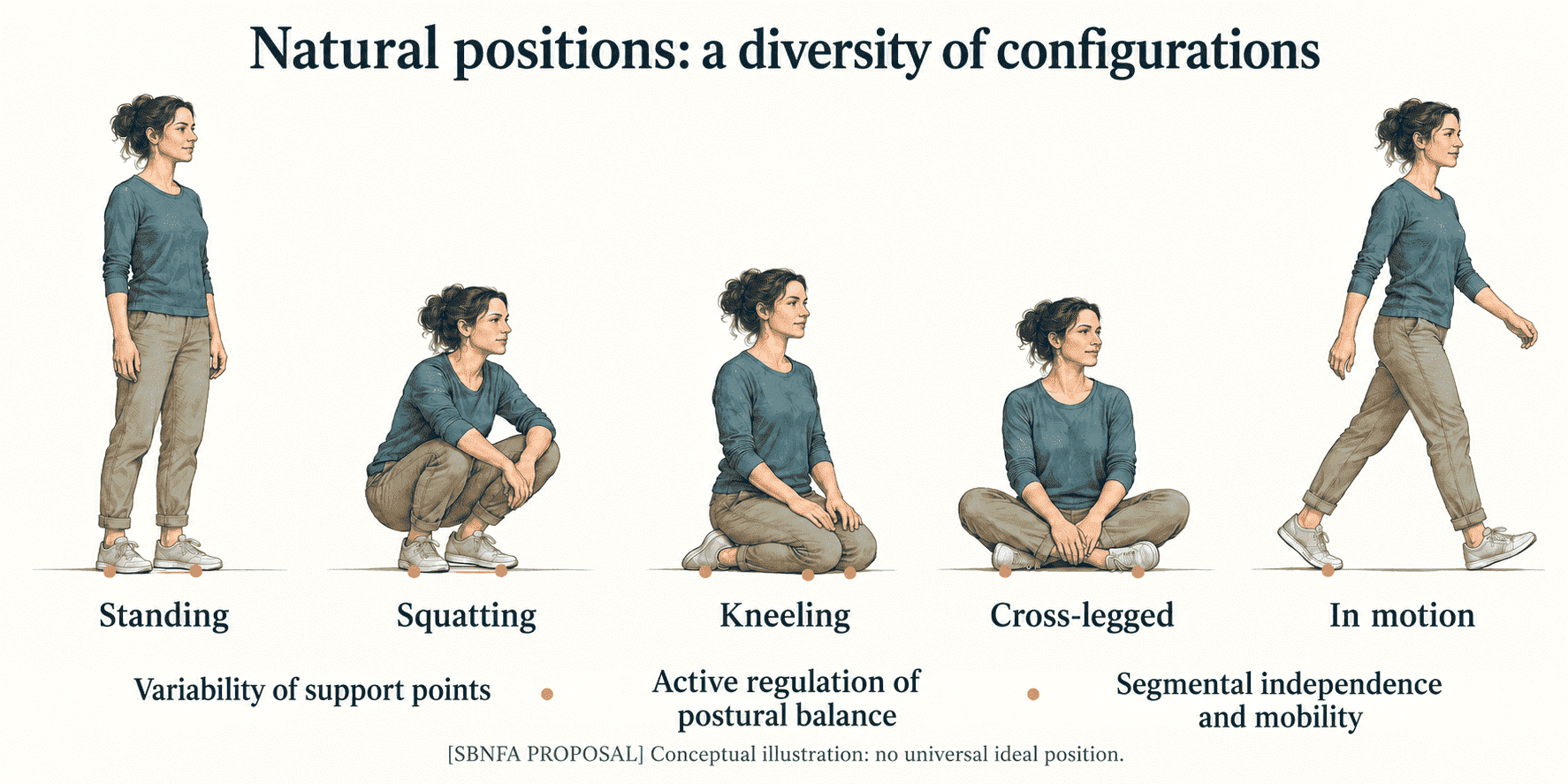
A natural position is not a stable geometric shape. It relies on continuous adjustments, relative freedom of the segments, and a distribution of stresses that is not concentrated on a single point of support. It is this definition — functional rather than geometric — that serves as the consistency check for the entire benchmark.
The study by Raichlen and colleagues (PNAS, 2020) on the Hadza of Tanzania illustrates the difference between rest and immobility: adults spend a notable share of their non-ambulatory rest time squatting, a posture in which muscle activity remains higher than that observed on a chair [2]. [ESTABLISHED] This observation describes resting postures in a given population. It does not establish that a seat should reproduce squatting.
Bernstein, for his part, showed more broadly that postural coordination relies on the dynamic management of the body’s degrees of freedom rather than on locking them [3].
2. Principle 1 — Motor variability
Living systems do not function through prolonged immobility, but through adjustments, micro-corrections, and changes in postural strategy. Transposed to seating, this first principle means that a device should not impose a fixed geometry, but should allow discreet movement of the pelvis, trunk, and limbs without demanding excessive control effort.
Stergiou and colleagues (Journal of Neurologic Physical Therapy, 2006) proposed viewing movement variability not as noise to be eliminated, but as a characteristic of healthy systems, operating within an optimal range: too little variability, like too much disorder, would be associated with reduced adaptive capacity [4, 5]. [ESTABLISHED] This theoretical framework is discussed in the human movement literature, mainly for gait and motor control.
[SBNFA PROPOSITION] Its transposition to seating leads to four requirements: maintaining sufficient degrees of freedom, allowing spontaneous micromovements, enabling postural readjustment without loss of stability, and diversifying support over time.
This principle informs Function 1 (Preservation of Adaptability Potential) and Function 2 (Management of Compensations). The decisive point is the governance of movement: who initiates it, who chooses its direction, amplitude, speed, and stopping point? Pynt (Journal of Bodywork and Movement Therapies, 2015) proposes defining dynamic seating as an action supplied by the seated person and accompanied by the seat’s mechanism [6]. This definition underpins the distinction, central to the framework, between movement led by the subject and movement produced or directed by the seat.
In the grid, this definition grounds the distinction between ADP-1 (subject-led control of change) and ADP-2 (mechanical resolution of the interface).
3. Principle 2 — Tissue flows
Living tissues need circulation, oxygenation, mechanical stimulation, and alternation between compression and decompression. Continuous pressure on the support areas — ischial tuberosities, coccyx, thighs, pelvic floor — slows these flows and can cause local overload.
This principle translates into offloading sensitive structures, distributing pressure, reducing peak loads, and functionally alternating load-bearing areas. The quality of a seat therefore depends on how it distributes load in space, but also over time. Criteria for the ergonomic evaluation of work chairs have long incorporated the distribution of support [7].
Two sources document the biological basis. Landis measured capillary pressure in human skin by micro-injection as early as 1930 [8]: this is the historical foundation for studying the effects of prolonged compression on tissue perfusion. Lengsfeld and colleagues (Clinical Biomechanics, 2000) examined variations in spinal load during rotatory dynamic sitting [9]; this is an exploratory study of a single subject. Finally, Langevin and colleagues (BMC Musculoskeletal Disorders, 2011) reported reduced thoracolumbar fascial gliding in people with chronic low back pain [10], a correlational study.
[ESTABLISHED] These studies establish that compression, perfusion, and tissue gliding are relevant parameters for load tolerance. [SBNFA PROPOSITION] The framework draws from them the requirement to distribute pressure in space and over time. It derives no ischemia threshold from them: no universal threshold can be derived from a multi-criteria analysis, and any claim about a user’s perfusion or tissue health falls within the scope of specific biological studies.
4. Principle 3 — Segmental independence
The human body is a kinematic chain, not a monolithic block. The pelvis, hips, trunk, and spine must be able to cooperate without being mechanically fused by the seat. This is the subject of the third principle, segmental independence.
Hasegawa and Dubousset (Spine Surgery and Related Research, 2022) describe a “chain of balance” linking the lower limbs, the pelvis — regarded as a “pelvic vertebra” —, the spine, and the head [11]. Barrey and colleagues (European Spine Journal, 2013), for their part, analyze the compensatory mechanisms by which the pelvis and spine maintain sagittal balance [12]. Vleeming and colleagues (Journal of Anatomy, 2012) synthesize the anatomy and function of the sacroiliac joint [13].
[ESTABLISHED] For standing posture and spinal surgery, these studies describe the pelvis as the central relay of the compensation chain; they also describe the sacroiliac joint as a low-amplitude joint with an important functional role in load transfer. [SBNFA PROPOSITION] By functional transposition, the framework concludes that an interface should allow cooperation between segments to express itself rather than fixing the pelvis as an inert base.
A point of principle: pelvic incidence is a morphological parameter of the subject. Seating can modify the functional orientation of the pelvis, not the anatomical incidence. This is why the 90° pelvis–femur relationship is not adopted as a norm: it is a functional hypothesis, to be individualized.
This principle informs Function 3 (pelvic mobility in all three planes) and sheds light on Functions 2 and 7, where segmental independence translates into observables: spine–pelvis pivoting, independent accommodation of load-bearing regions.
5. Principle 4 — Autonomous regulation
[SBNFA PROPOSITION] “Autonomous” refers here to the subject’s postural regulation, with no trajectory imposed by the support. The term does not demonstrate activation of the autonomic nervous system, nor a subcortical benefit induced by the seat.
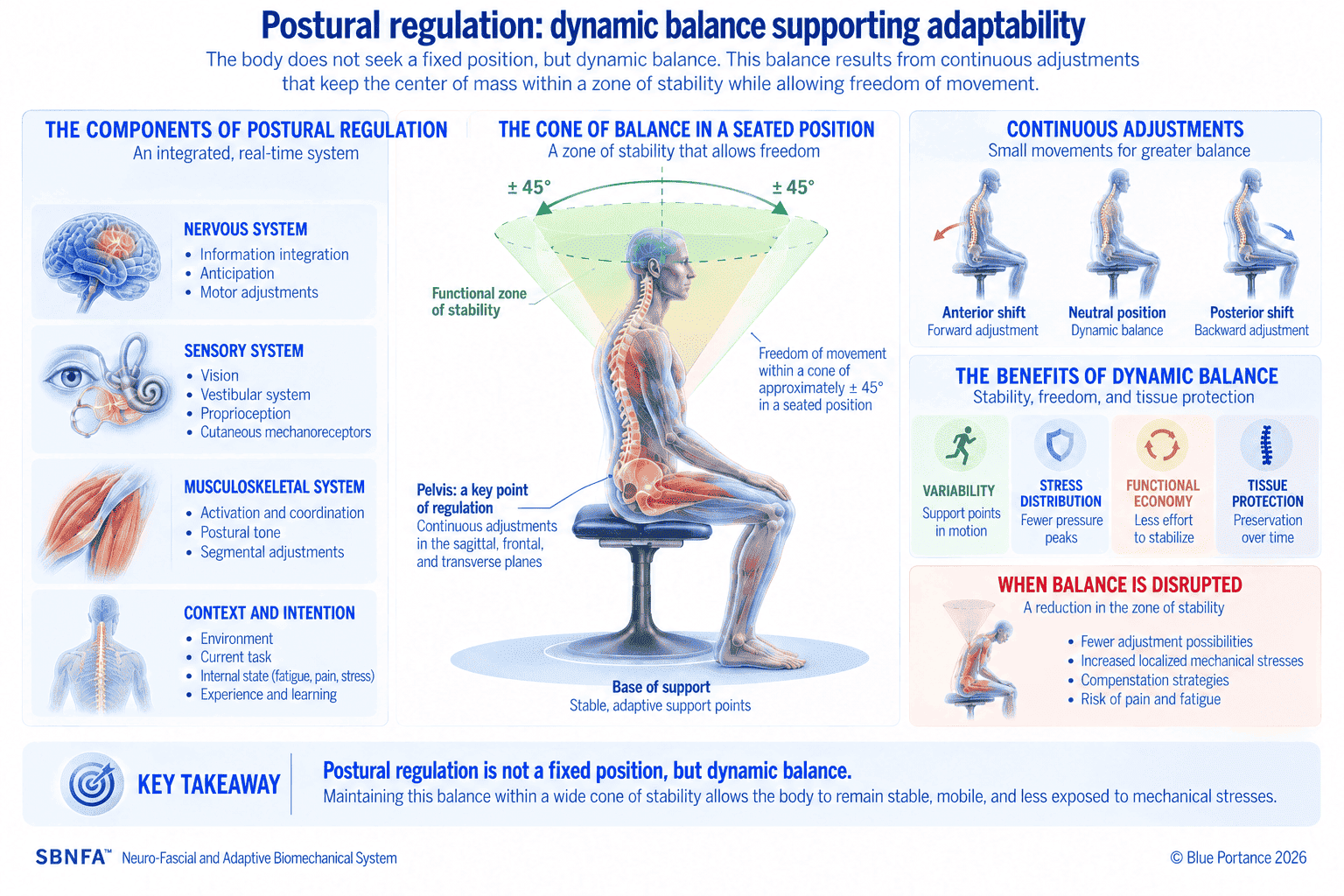
The body constantly adjusts its posture based on sensory feedback. A seat should therefore offer a zone of dynamic stability: enough support to prevent postural collapse, enough freedom to allow the nervous system to correct and reorganize posture without overload.
Peterka (Journal of Neurophysiology, 2002) proposed a sensorimotor integration model of postural control [14], complemented by the posture control model of Mergner, Maurer, and Peterka [15]. Boonstra, Schouten, and van der Kooij (Journal of NeuroEngineering and Rehabilitation, 2013) identified the differentiated contribution of the ankle and hip joints to multi-segmental balance control [16]. Horak (Age and Ageing, 2006) distinguishes, within postural control, postural orientation from balance proper [17].
[ESTABLISHED] These models describe balance control while standing or under perturbation. [SBNFA PROPOSITION] The framework draws from them a requirement for seating: that the left and right hip–ankle chains can act independently, that the subject has a perimeter within which to move, stop, stabilize, and move again, and that the reference position is adjustable.
This principle informs Function 4 (Regulation of Postural Balance) and Function 6 (Processing and Feedback of Mechanical Information). On this second point, the framework is explicit: proprioception is not “produced” by the seat. The functional question is how the seat processes the mechanical information the body gives it — blocking it, absorbing it, processing it globally, or responding to it locally, in a differentiated and proportionate way. The subject remains the initiator of change.
Principle of wording: a seat neither “stimulates” nor “controls” a user’s proprioception. It may, or may not, let the user’s sensorimotor loop function without blocking it or substituting for it.
6. Adaptability potential in the seated position
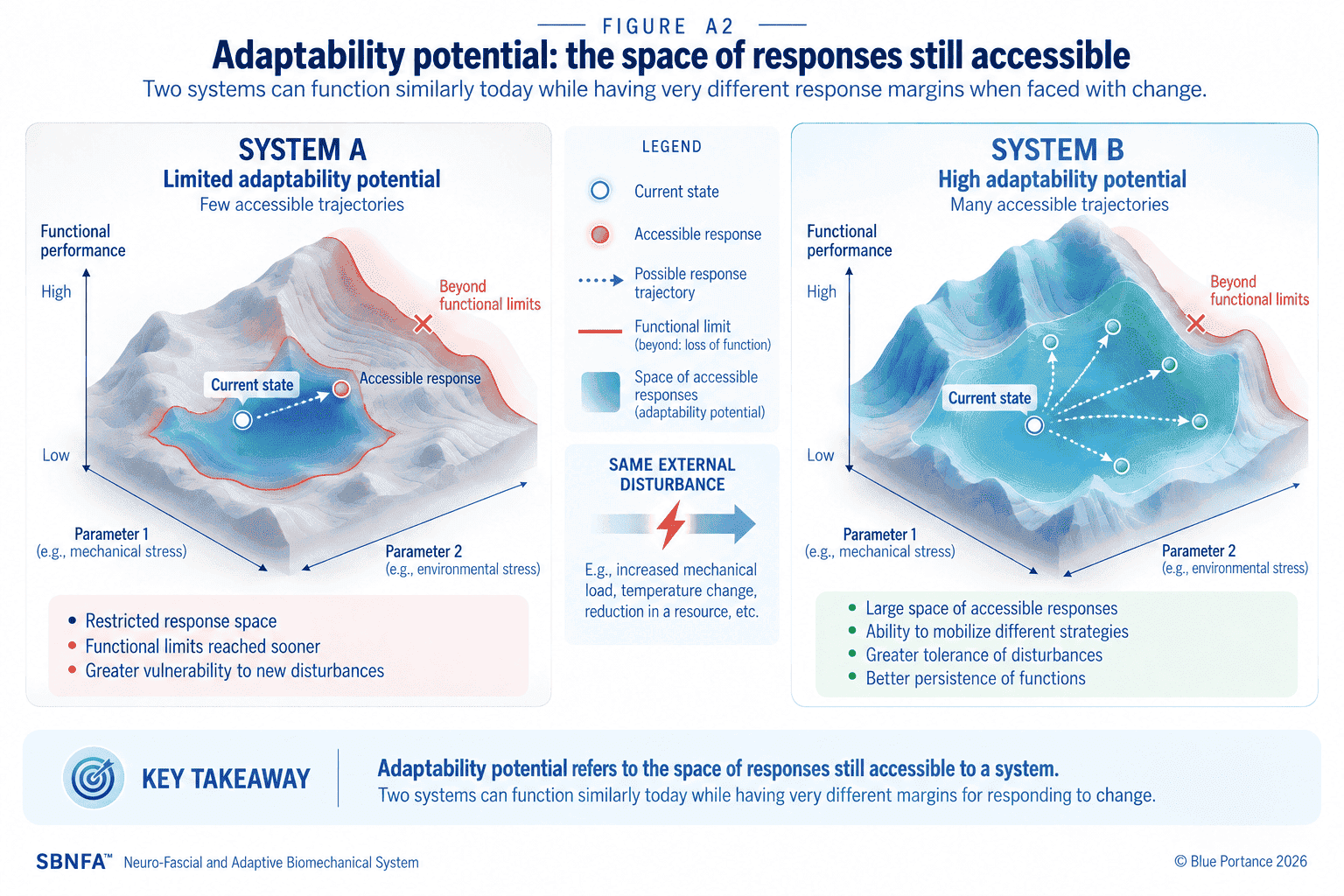
The four principles converge on a notion that Blue Portance places at the center of its approach: adaptability potential in the seated position. Three related terms must be distinguished.
| Term | Definition in this dossier | Status |
|---|---|---|
| Adaptability | The subject’s capacity to change their postural organization according to their state, the task, pain, duration, and the constraints encountered. It is expressed in context, in a postural form and a tissue form (see below). | Descriptive concept |
| Adaptability potential | The full set of adaptation possibilities actually accessible to the subject in a given situation, given what the seat allows or constrains: postural organization, balance, and variation of the stresses applied to tissues. | [SBNFA PROPOSITION] Central concept of the SBNFA framework; operationalized primarily by variables ADP-1 and ADP-2 |
| Postural adaptive reserve | The functional margin remaining before compensations are exhausted. | [SBNFA PROPOSITION] Concept of the SBNFA framework |
Adaptability potential is therefore what the seat makes possible or what it reduces. It is not the same as comfort, nor as the subject’s actual use: a capacity offered is not discounted because the subject does not use it. Function 1 of the framework evaluates it through two variables: ADP-1, which examines control of change (does the seat follow the subject without blocking, steering, or substituting for them?), and ADP-2, which examines the mechanical resolution of the interface (does it respond to very low-amplitude adaptations, with no threshold, dead zone, detent, or dominant return force?).
Two people use two seats. The first is fitted with a mechanism that systematically returns it to a central point: the person moves, but follows the seat’s trajectory. The second can change postural organization in several directions, stop wherever they wish, and move again. The observed movement may be comparable; the adaptability potential offered is not.
Postural adaptability, tissue adaptability, and the sensory loop
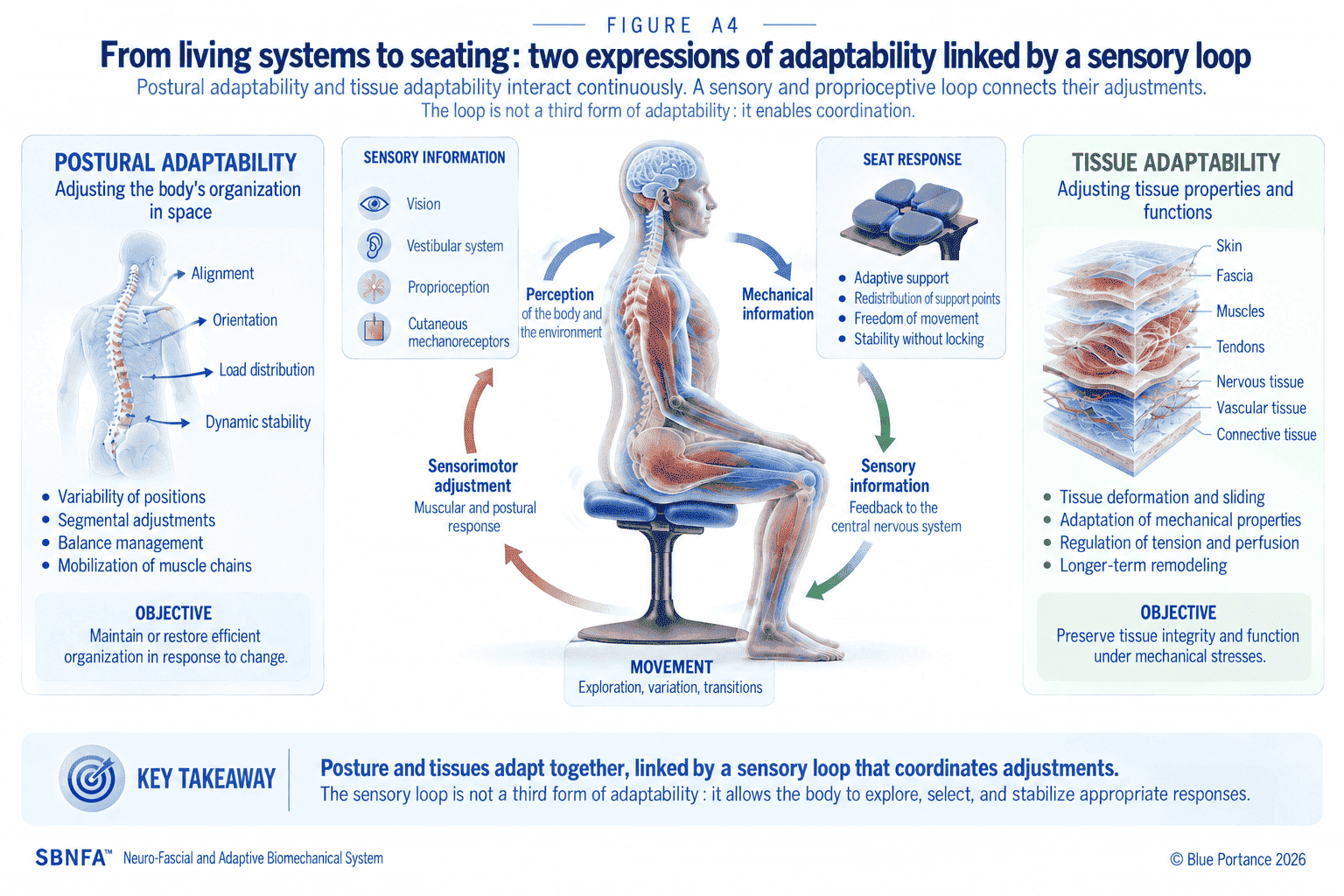
In the framework, adaptability is the integrating concept: the body’s capacity to adjust its postural organization and tissue responses to constraints while preserving balance, mobility, and load distribution. It has two expressions to be distinguished: postural adaptability, the adjustment of the body’s organization, and tissue adaptability, the response of tissues to mechanical loading. Immediate postural adjustment and longer-term tissue adaptation must not be confused.
A sensory, informational, and proprioceptive loop takes part in the process that enables adaptation: body movement, mechanical information transmitted to the seat, the seat’s response, sensory feedback to the body, sensorimotor adjustment. The seat does not produce proprioception: it processes the mechanical information the body gives it, micromovements included, and may respond to it without delay — or not. This dimension is therefore not a third adaptability: it is a cross-cutting mechanism of adjustment. Function 6 is its most direct expression, and the fourth principle, autonomous regulation, is its foundation: the body constantly adjusts its posture based on sensory feedback.
Three cross-cutting dimensions of interpretation
Three cross-cutting dimensions of interpretation make it possible to read the seven functions without replacing or redistributing them: the postural or biomechanical dimension (organization of the body, degrees of freedom, accessible balance states), the sensory, informational, and proprioceptive dimension, and the tissue dimension (stresses, variation and redistribution, tissue responses). A function may draw on several: Function 1 spans them all, since adaptability potential concerns postural organization, balance, and the variation of stresses applied to tissues alike.
| Level | Question | Content |
|---|---|---|
| Integrating concept | What are we seeking to preserve? | Adaptability: the capacity to keep adjusting to constraints |
| Two expressions | What adapts? | Postural organization (postural adaptability); load-bearing tissues (tissue adaptability) |
| Three dimensions of interpretation | Through which functional processes? | Postural or biomechanical; sensory, informational, and proprioceptive; tissue |
| Operational structure | How is it observed and rated? | Seven functions, nineteen state variables, scale from 0 to 4 or ND — unchanged |
[SBNFA PROPOSITION] These levels of interpretation add, remove, or redistribute no function or variable, and are not rated: they serve as an explanatory guide to the framework.
Chapter 4 (benchmark of six dynamic seats) applies this notion to a specific seating architecture, the ExoBase Aporia®, and indicates what this architecture makes possible, along with its limits. How these capacities condition one another is described in Chapter 3 (structural analysis of the nineteen variables) and interpreted in Chapter 4 (systemic reading of the benchmark). The link between tissue adaptability and low back pain is discussed more broadly in the article Tissue Adaptability and Back Pain.
7. From principles to functions
Each of the framework’s seven functions is tied to the principle of which it is the main operational translation. It may contribute to other principles, but it is described and evaluated only once, to avoid any double counting.
| Foundational principle | Associated function(s) | Grid variables |
|---|---|---|
| Motor variability | 1. Preservation of Adaptability Potential; 2. Management of Compensations | ADP-1, ADP-2; COM-1, COM-2 |
| Tissue flows | 5. Management and Variability of Mechanical Stresses | CON-1, CON-2 |
| Segmental independence | 3. Pelvic Mobility | MOB-1, MOB-2, MOB-3 |
| Autonomous regulation | 4. Regulation of Postural Balance; 6. Processing and Feedback of Mechanical Information | EQU-1, EQU-2, EQU-3; INF-1, INF-2, INF-3 |
| Prolonged external compression (specific category) | 7. Tissue Preservation | PRE-1, PRE-2, PRE-3, PRE-4 |
The seventh function does not derive from any of the four principles: it addresses the constraint specific to seating, which imposes sustained external compression. It is built exclusively from what the seat offers; biological phenomena — mechanotransduction, creep, reperfusion, ischemia, gliding between tissue planes — are its expected effects or explanatory mechanisms, and do not become additional variables [1].
8. What the literature establishes, what the framework draws from it
This table summarizes, for each principle, what the literature establishes and what the framework draws from it for seating.
| Principle | Documented basis | What the literature establishes | What the framework draws from it for seating |
|---|---|---|---|
| Motor variability | Bernstein; Stergiou; Pynt | [ESTABLISHED] Human movement is coordinated through the management of degrees of freedom; variability is studied as a characteristic of healthy systems | [SBNFA PROPOSITION] Requirements for degrees of freedom, micromovements, and subject-led control (Functions 1 and 2) |
| Tissue flows | Landis; Occhipinti; Langevin 2011; Lengsfeld | [ESTABLISHED] Compression, perfusion, and tissue gliding are relevant parameters | [SBNFA PROPOSITION] Requirements for pressure distribution and variation (Function 5) and for tissue preservation under load (Function 7); no ischemia threshold is derived |
| Segmental independence | Hasegawa & Dubousset; Barrey; Vleeming | [ESTABLISHED] The pelvis is a central relay of the compensation chain; the sacroiliac joint plays a functional role in load transfer | [SBNFA PROPOSITION] Requirements for pelvic mobility in all three planes (Function 3) and for spine–pelvis pivoting (COM-2); pelvic incidence cannot be modified by the seat |
| Autonomous regulation | Peterka; Mergner; Boonstra; Horak; Hasegawa & Dubousset | [ESTABLISHED] Postural control integrates multiple sensory sources and hip–ankle chains | [SBNFA PROPOSITION] Requirements for left/right independence, a latitude perimeter, and an adjustable zero point (Functions 4 and 6); cone of economy transposed functionally |
Frequently asked questions
Why is sitting still for long periods a problem?
Because the living body works through continuous adjustments. When you sit still, the same support zones stay compressed, micro-adjustments become rare and the alternation between tissue compression and decompression disappears. Seating that lets the pelvis move and the support points vary restores part of this variability, without imposing movement.
Is squatting or sitting cross-legged more natural?
These natural positions retain more capacity for adjustment: the Hadza of Tanzania spend a notable share of their rest squatting, with higher muscle activity than on a chair (Raichlen et al., PNAS, 2020). The framework does not conclude that seating should reproduce them, but that it should preserve their properties: variability, segmental independence and active regulation.
Why speak of “foundational principles”?
It is the SBNFA™ framework’s term for four organizing principles observed in natural positions: motor variability, tissue flows, segmental independence, autonomous regulation. They are foundational principles that explain why each function is evaluated; they are not themselves rated.
Do natural positions prove that a seat should be modeled on them?
No. The framework holds that an analogy with natural positions is not proof: it identifies functions to be investigated, each of whose mechanisms and expected effects must be documented according to its own level of evidence.
What are postural adaptability, tissue adaptability, and the sensory loop?
Adaptability is the integrating concept: the body’s capacity to adjust its postural organization and tissue responses to constraints. Postural adaptability concerns the organization of the body; tissue adaptability, the response of load-bearing tissues. The sensory and proprioceptive loop is not a third adaptability: it is the mechanism through which mechanical information enables adjustment. The seat does not produce proprioception; it processes the information the body gives it.
What is adaptability potential in the seated position?
It is the full set of postural adaptation possibilities actually accessible to the subject in a given situation, given what the seat allows or constrains. It is the central concept of the SBNFA framework, operationalized by the variables of Function 1.
Can a seat improve proprioception?
The framework does not frame it that way. Proprioception is not produced by the seat: the seat processes the mechanical information the body gives it, by blocking it, absorbing it, or responding to it locally. The grid evaluates this fidelity of processing, not an effect on proprioception.
Is the 90° pelvis–femur relationship a norm?
No. It is not adopted as an established norm: it is a functional hypothesis to be individualized according to pelvic incidence, a morphological parameter that seating does not modify.
References
The contribution and scope of each source are detailed in Chapter 6 (annotated bibliography). A reference associated with a variable documents a phenomenon; it does not validate the variable.
- Blue Portance, 2026 (a) — SBNFA™ Framework for Evaluating Seating Devices — Part I: Scientific and Methodological Framework. Internal document, version of August 3, 2026.
- Raichlen et al., 2020 — Sitting, squatting, and the evolutionary biology of human inactivity. Proceedings of the National Academy of Sciences, 117(13), 7115–7121.
- Bernstein, 1967 — The co-ordination and regulation of movements. Pergamon Press.
- Stergiou et al., 2006 — Optimal movement variability: a new theoretical perspective for neurologic physical therapy. Journal of Neurologic Physical Therapy, 30(3), 120–129.
- Stergiou & Decker, 2011 — Human movement variability, nonlinear dynamics, and pathology: is there a connection?. Human Movement Science, 30(5), 869–888.
- Pynt, 2015 — Rethinking design parameters in the search for optimal dynamic seating. Journal of Bodywork and Movement Therapies, 19(2), 291–303.
- Occhipinti et al., 1993 — Criteria for the ergonomic evaluation of work chairs. La Medicina del Lavoro, 84(4), 274–285.
- Landis, 1930 — Micro-injection studies of capillary blood pressure in human skin. Heart, 15, 209–228.
- Lengsfeld et al., 2000 — Spinal load changes during rotatory dynamic sitting. Clinical Biomechanics.
- Langevin et al., 2011 — Reduced thoracolumbar fascia shear strain in human chronic low back pain. BMC Musculoskeletal Disorders, 12, 203.
- Hasegawa & Dubousset, 2022 — Cone of economy with the chain of balance: historical perspective and proof of concept. Spine Surgery and Related Research, 6(4), 337–349.
- Barrey et al., 2013 — Compensatory mechanisms contributing to keep the sagittal balance of the spine. European Spine Journal, 22(Suppl. 6), S834–S841.
- Vleeming et al., 2012 — The sacroiliac joint: an overview of its anatomy, function and potential clinical implications. Journal of Anatomy, 221(6), 537–567.
- Peterka, 2002 — Sensorimotor integration in human postural control. Journal of Neurophysiology, 88(3), 1097–1118.
- Mergner, Maurer & Peterka, 2002 — Sensory contributions to the control of stance: a posture control model. Advances in Experimental Medicine and Biology, 508, 147–152.
- Boonstra, Schouten & van der Kooij, 2013 — Identification of the contribution of the ankle and hip joints to multi-segmental balance control. Journal of NeuroEngineering and Rehabilitation, 10, 23.
- Horak, 2006 — Postural orientation and equilibrium: what do we need to know about neural control of balance to prevent falls?. Age and Ageing, 35(Suppl. 2), ii7–ii11.
