


Seven Functions, Nineteen Variables
In brief. How do you evaluate an ergonomic or dynamic chair? With a grid of seven functions and nineteen variables: adaptability, compensations, pelvic mobility, postural balance, mechanical stresses, mechanical information and tissue preservation. Each variable is rated 0 to 4 according to what the architecture allows, regardless of the technology used.
This third chapter presents the core of the SBNFA™ framework: the seven functions and nineteen state variables used to evaluate what a seating architecture enables or constrains, with, for each variable, what is observed and the interpretation pitfall to avoid.
It sets out the 0-to-4 scale and the status of ND, the boundary rules that prevent double counting, how the score is calculated, and the limits of the method, including those of the weighting. It explains how to read these seven functions through postural and tissue adaptability without redistributing them, then presents the structural analysis method that sheds light on the interdependencies among the nineteen variables without changing any rating.
Introduction
This is where the framework becomes an operational grid. The principles of Chapter 2 serve no purpose unless they translate into precise questions that can be put to a seating device, observed and rated. The SBNFA™ grid comprises seven functions, broken down into nineteen state variables, each rated from 0 to 4 or ND.
This chapter is the core of the dossier. It presents each variable with what is observed and the interpretation pitfall to avoid, followed by the rules governing the rating: a common scale, the status of ND, boundaries between variables, and score calculation. The functions and variables are those defined in Part II of the framework [1].
One methodological point governs the entire chapter: the grid rates the capacities offered by the seating architecture. It rates neither how a subject uses them, nor reported comfort, nor the presence of any given mechanism. For each variable, the evaluator must be able to state why the selected state is fully demonstrated and why the next state up is not.
1. Overview: seven functions, nineteen variables
The seven functions are the operational translation of the principles of Chapter 2. Each has a functional purpose, associated scientific sources and constituent variables.
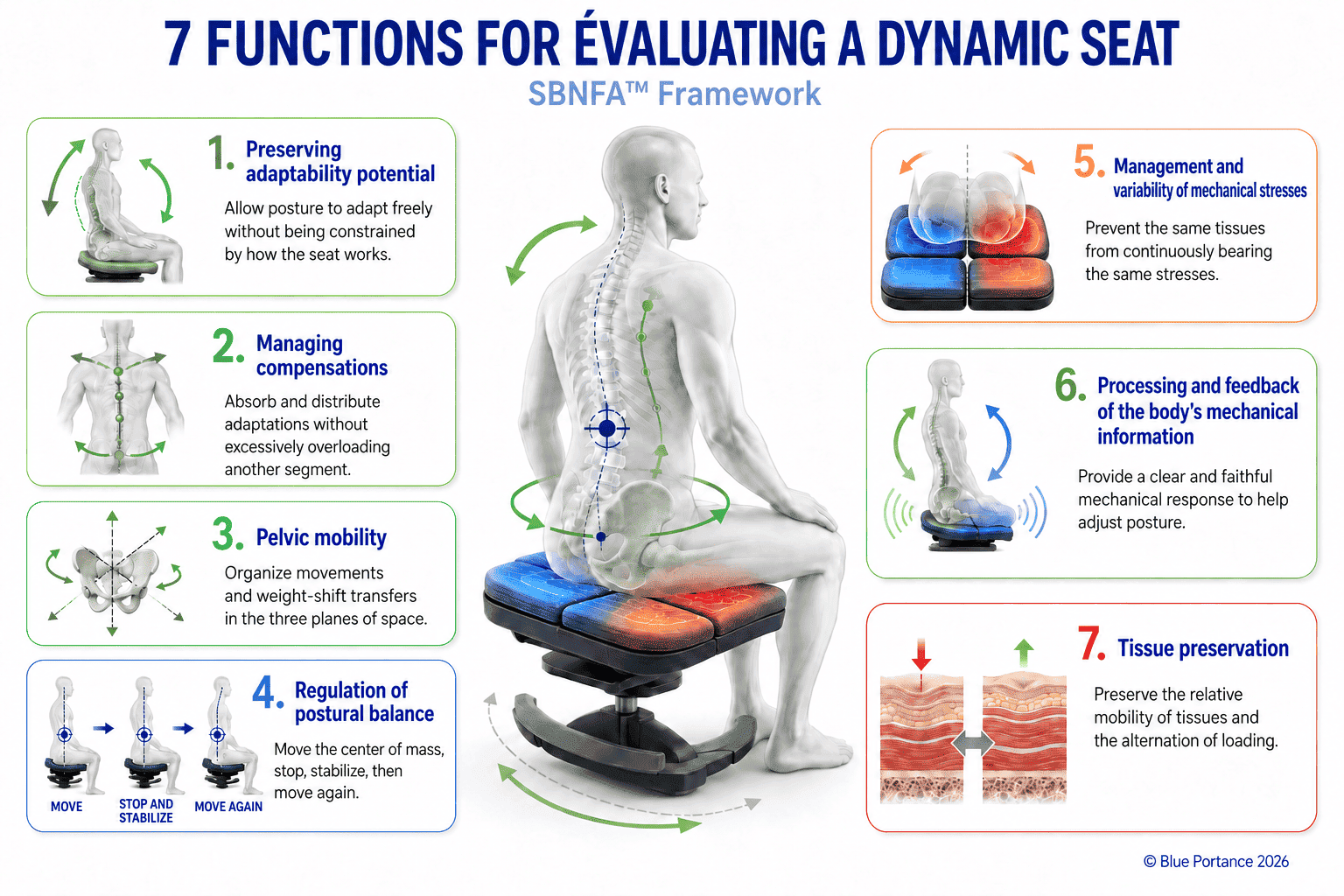
| Function | Purpose | Variables | Associated sources |
|---|---|---|---|
| 1. Preservation of Adaptability Potential | Allow the body to adapt its posture freely to internal and external constraints, without being subjected to the way the seat operates. | ADP-1, ADP-2 | Bernstein [2] |
| 2. Management of Compensations | Allow the musculoskeletal system to absorb and distribute the necessary adaptations, without shifting excessive stress onto another segment. | COM-1, COM-2 | Vleeming [3]; Hasegawa & Dubousset [4] |
| 3. Pelvic Mobility | Allow the pelvis, the junction between the trunk and lower limbs, to organize movements and weight transfers in all three planes. | MOB-1, MOB-2, MOB-3 | Hasegawa & Dubousset [4]; Barrey [5] |
| 4. Regulation of Postural Balance | Allow the subject to shift their center of mass, stop, stabilize and move off again, without blockage or imposed instability. | EQU-1, EQU-2, EQU-3 | Peterka [6]; Boonstra [7]; Mergner [8] |
| 5. Management and Variability of Mechanical Stresses | Prevent the same tissues from bearing the same stresses over long periods. | CON-1, CON-2 | Landis [9]; Lengsfeld [10] |
| 6. Processing and Feedback of Mechanical Information | Provide the body with a readable, faithful mechanical response so that it can adjust its posture effectively. | INF-1, INF-2, INF-3 | Langevin [11] |
| 7. Tissue Preservation | Preserve the relative mobility of tissues and their load alternation, to limit prolonged compression, shear and forced gliding. | PRE-1, PRE-2, PRE-3, PRE-4 | Langevin et al. [12]; Schleip et al. [13] |
[SBNFA PROPOSITION] The associated sources document phenomena; they do not validate these dimensions as an instrument. The number of variables differs from one function to another and does not, on its own, justify a scientific weighting.
Reading the seven functions through adaptability
Adaptability, the integrating concept of the framework, takes a postural form and a tissue form. Three cross-cutting reading dimensions — postural or biomechanical; sensory, informational and proprioceptive; tissue — make it possible to read the seven functions without replacing or redistributing them. [SBNFA PROPOSITION] These reading levels are not rated; they are defined in Chapter 2 (seated adaptability potential).
2. Adaptability, compensations and pelvic mobility (Functions 1 to 3)
The first three functions concern what the subject can initiate, what the musculoskeletal system can absorb and what the pelvis can do in all three planes.
Function 1 — Preservation of Adaptability Potential
[SBNFA PROPOSITION] Definition and choice of observable. [MECHANICAL] Nature of the capacity to look for; attributing it to a product requires documented observation.
| Variable | What is observed | What not to conclude |
|---|---|---|
| ADP-1 — Subject-led control | Gradual changes in postural organization are elicited in several directions, and the evaluator determines whether the movement is initiated and controlled by the subject, or produced, steered or pulled back by the seat. | A mobile seat does not necessarily earn a good rating: if it imposes its own trajectory, it reduces the potential for adaptation. |
| ADP-2 — Response to micromovements | Voluntary inputs of very small amplitude are applied, and the evaluator looks for an activation threshold, a dead zone, a discontinuity or a dominant return force. | What is rated is not how often the subject makes micromovements, but the seat’s capacity to respond to them when they occur. |
Function 2 — Management of Compensations
The basis for this function is documented. The sacroiliac joint is described as a low-amplitude joint with an important functional role in load transfer and postural regulation of the pelvis [3], the pelvis itself being described as the central relay of the compensation chain [4]. [ESTABLISHED] COM-1 and COM-2 derive from this a mechanical question put to the seat: does it allow these micro-adjustments to occur, or does it block them and shift the stress onto another segment?
[SBNFA PROPOSITION] Definition and choice of observable. [MECHANICAL] Nature of the capacity to look for; attributing it to a product requires documented observation.
| Variable | What is observed | What not to conclude |
|---|---|---|
| COM-1 — Horizontal pelvic displacement | The evaluator looks for a small-amplitude pelvic displacement forward, backward, to the right, to the left and in intermediate directions. | The body sliding over a fixed surface does not demonstrate this capacity; this is not macroscopic pelvic mobility. |
| COM-2 — Spine–pelvis pivoting | The evaluator observes whether small relative reorganizations between spine and pelvis remain possible without a mandatory global displacement or the two moving as a single block. | The variable evaluates neither the anatomical range of the sacroiliac joint nor the movement actually produced: it evaluates the absence of blockage by the support. |
Function 3 — Pelvic Mobility
The three planes are tested separately. Substantial mobility in one plane does not compensate for a restriction in another.
[SBNFA PROPOSITION] Definition and choice of observable. [MECHANICAL] Nature of the capacity to look for; attributing it to a product requires documented observation.
| Variable | What is observed | What not to conclude |
|---|---|---|
| MOB-1 — Sagittal mobility | Anteversion and retroversion checked separately, including their continuity, their control and the absence of an imposed trajectory. | A global tilt of the seat does not prove that the pelvis has its own sagittal mobility. Pelvic incidence is morphological and cannot be modified by the seat. |
| MOB-2 — Frontal mobility | Right/left tilts and weight transfers, and the absence of mandatory coupling of the two sides. | A global oscillation of the seat pan does not, on its own, demonstrate this capacity. |
| MOB-3 — Rotational mobility | Pelvic rotations in both directions, right/left dissociation, possibility of trunk counter-rotation. | A rotation obtained by sliding is not mobility offered by the architecture; it cannot be inferred from the other two planes. |
3. Postural balance (Function 4)
Function 4 is the one that most clearly distinguishes between architectures, because it concerns what movement makes it possible to stabilize. It does not reward instability: it evaluates the ability to move within a useful space, stop, stabilize and move off again.
[SBNFA PROPOSITION] Definition and choice of observable. [MECHANICAL] Nature of the capacity to look for; attributing it to a product requires documented observation.
| Variable | What is observed | What not to conclude |
|---|---|---|
| EQU-1 — Independent left/right mobility of the hip–ankle chains over 360° | Each side is loaded separately in all directions, feet on the floor, and the evaluator checks whether the support forces the other side to move along with it. | What is evaluated is the mechanical independence permitted by the seat, not an absence of anatomical coordination between the chains, which remains natural. |
| EQU-2 — Postural latitude perimeter | The functional directions are explored, and the evaluator successively checks displacement, stopping, stable holding and resumption of movement. | Range alone is not enough: a highly mobile seat that does not allow the user to stop or stabilize cannot receive the maximum rating. |
| EQU-3 — Zero-point adjustment | The accessible reference mechanical organizations are inventoried, and the evaluator assesses the range, continuity and, where applicable, differentiation of the adjustment. | Adapting to the user’s morphology is the purpose of the adjustment, not an additional function: no “morphological adaptability” rating is created. |
This function carries into the grid the distinction made in Chapter 1 between static, unstable and stabilized dynamic seating. An architecture with an imposed return force is penalized under EQU-2; an architecture that couples the two sides of the pelvis is penalized under EQU-1; an architecture that imposes a single pelvic orientation is penalized under EQU-3. None of these penalties rests on a technological preference: each is justified by an observable.
[SBNFA PROPOSITION] The “zero point” refers to the reference mechanical organization around which balance regulation takes place. Its adjustment must remain individualizable: the 90° relationship between pelvis and femur is not an established norm, only a functional hypothesis to be modulated according to the subject’s pelvic incidence.
4. Mechanical stresses and mechanical information (Functions 5 and 6)
Functions 5 and 6 concern what the seat does with the contact areas and with the mechanical information the body transmits to it.
Function 5 — Management and Variability of Mechanical Stresses
[SBNFA PROPOSITION] Definition and choice of observable. [MECHANICAL] Nature of the capacity to look for; attributing it to a product requires documented observation.
| Variable | What is observed | What not to conclude |
|---|---|---|
| CON-1 — Spatial distribution of pressure | The extent of the load-bearing surfaces and the presence of unsupported zones, concentrations or hard spots; pressure mapping can reinforce the observation. | The rating is not the lowest mean pressure. No universal ischemia threshold can be inferred from an expert observation. |
| CON-2 — Temporal variability of pressure | Movements of different amplitudes are applied, and the evaluator checks whether they cause pressure to be redistributed between contact zones. | Do not count here the continuous load alternation, which is evaluated under PRE-3. |
Function 6 — Processing and Feedback of Mechanical Information
Proprioception is not “produced” by the seat. The loop considered is: body movement, mechanical information transmitted to the seat, the seat’s response, sensory feedback to the body, sensorimotor adjustment. The function evaluates the fidelity of processing and feedback, not merely the range of mobility. Three variables are kept separate: a response can be consistent without being localized, or localized without being proportionate.
[SBNFA PROPOSITION] Definition and choice of observable. [MECHANICAL] Nature of the capacity to look for; attributing it to a product requires documented observation.
| Variable | What is observed | What not to conclude |
|---|---|---|
| INF-1 — Consistency of the mechanical response | The same input is applied several times, and the evaluator compares the direction, timing, continuity and reproducibility of the response. | What is evaluated is the mechanical response, not the subject’s proprioception or reported perception. |
| INF-2 — Localized and differentiated processing | Different load-bearing zones are loaded separately, and the evaluator checks whether the local origin is preserved or whether the whole seat responds as a block. | High global mobility can receive a low rating if every local input moves the entire support. |
| INF-3 — Proportionality of the response | A progression of inputs is applied, from the weakest up to the useful functional range, and their amplitude is compared with that of the response. | Mathematical proportionality is not required, but rather a consistent progression with no all-or-nothing effect, abrupt threshold or early saturation. |
5. Tissue preservation (Function 7)
Function 7 is built exclusively on what the seat offers. It addresses the constraint of prolonged contact with an interface, which reduces micro-unloading, limits the variability of contact and can force tissues to glide or deform during movement.
[SBNFA PROPOSITION] Definition and choice of observable. [MECHANICAL] Nature of the capacity to look for; attributing it to a product requires documented observation.
| Variable | What is observed | What not to conclude |
|---|---|---|
| PRE-1 — Freedom and independence of movement of each segment | The different load-bearing regions are loaded separately, and the evaluator looks for coupled movement, forced gliding or dominant shear. | Segmentation is one possible technical means, not a condition for the rating: another architecture can achieve the same functional result. |
| PRE-2 — Localized micromovements | Very small inputs are applied to different zones, and the evaluator observes whether local relative movements are possible without a mandatory global displacement. | What is evaluated is the surface’s own capacity, not the movements made by the subject; the variable is distinct from ADP-2. |
| PRE-3 — Continuous load alternation | The evaluator checks whether movements, even minimal ones, produce repeated phases of loading and unloading across the different tissue zones. | What is evaluated is the capacity offered by the interface; the effect on perfusion requires separate biological evidence. |
| PRE-4 — Appropriate deformability of support surfaces | Local conformity to body shapes, maintenance of support, and the absence of hard spots and overall sagging are assessed together. | A very soft surface does not automatically receive a good rating: softness alone is not a functional quality. |
The framework specifies that the associated biological phenomena — mechanotransduction, creep, reperfusion, ischemia, gliding between tissue planes — are the expected effects or explanatory mechanisms of this function, not additional variables [14]. The grid evaluates the capacities offered by the interface; these effects fall within the scope of dedicated biological studies.
6. The 0-to-4 scale, ND and rating rules
Each variable is rated on a common scale, whose precise anchors are specific to each variable in Part II of the framework.
| Rating | General meaning |
|---|---|
| 0 | Capacity absent or prevented by the seat. |
| 1 | Very limited capacity, mainly constrained or produced by an imposed mechanism. |
| 2 | Capacity present, but limited to certain directions, amplitudes or conditions. |
| 3 | Capacity broadly offered, with a few identifiable restrictions. |
| 4 | Capacity fully offered across the entire functional range evaluated. |
| ND | Insufficient data or observations to assign a rating. |
Seven general rules govern the rating [1]:
- an available capacity is not downgraded because the subject does not use it spontaneously;
- the subject’s personal compensations cannot improve the device’s rating;
- feelings of comfort or preferences do not constitute functional evidence;
- the rating corresponds to the highest fully demonstrated level;
- if the observation does not support a conclusion, the variable is rated ND, not 0;
- directional restrictions, asymmetries, couplings and special conditions must be recorded;
- an ND is never implicitly converted to 0 in an overall comparison.
The “highest fully demonstrated level” rule is deliberately conservative: when in doubt, the rating is low or ND. It applies to all devices, including Blue Portance’s own device. A data collection sheet, prepared for each seat, records the configuration tested, the observation, the restriction found, the rating and its justification.
A seat oscillates widely in all directions, but every deviation triggers a return toward the center. On ADP-1, the evaluator cannot assign 4 (“no imposed trajectory or substitution”) since the return force steers the adaptation; the evaluator assigns the rating whose state is fully demonstrated and records the return force as a restriction. If the presence of a return force could not be tested, the variable remains ND.
7. Boundary rules: avoiding double counting
Some variables address closely related objects. The framework sets boundary rules to avoid double counting: the same property must not be counted successively as a function, a variable and an indicator.
| Related variables | Specific object of each rating |
|---|---|
| ADP-2 / INF-3 | ADP-2 evaluates the response to very small movements; INF-3 evaluates proportionality across several levels of input and response. |
| COM-1, COM-2 / MOB-1 to MOB-3 | COM evaluates compensatory micro-adjustments; MOB evaluates the macroscopic mobility of the pelvis in all three planes. |
| MOB / INF-2 | MOB evaluates the movements permitted; INF-2 evaluates whether the local origin of the input is preserved. |
| CON-2 / PRE-3 | CON-2 evaluates the temporal redistribution of pressure; PRE-3 evaluates the continuous alternation of loading and unloading produced by the interface. |
| EQU-3 / morphological adaptation | Zero-point adjustment carries the adaptation of the reference organization; no additional function is created. |
The framework also acknowledges a fundamental limit: its function families are not statistically independent, because adaptability, micro-adjustments, stress variability, sensorimotor response and tissue preservation interact. It therefore does not claim to measure seven orthogonal dimensions. Its aim is to prevent the same capacity from being rewarded more than once.
8. Reading profiles before any numerical summary
[SBNFA PROPOSITION] The 0–4 scale is ordinal. The profile of the nineteen variables is the primary reading: observed capacities, restrictions, directions tested, configuration, justification, coverage and confidence. The seven families make it possible to group this reading without erasing local restrictions.
A mean of a function’s determined variables can serve as a descriptive summary. An equally weighted mean of the seven summaries can be kept as a conventional secondary indicator, with no overall ranking and no interpretation of hundredths. The sum of the determined ratings and their mean are separate calculations: a total “out of 76” is meaningful only if all nineteen variables are determined.
ND stays out of the calculation and is never replaced by zero. Each function must display its coverage in the form “n/N variables determined.” If the missing data or the conditions differ, a mean does not make the profiles comparable; an ND can conceal a decisive restriction.
[OUTLOOK] The weightings and anchors will be refined over successive versions of the framework. A strong capacity in one function does not automatically offset a restriction in another. No systemic score derived from the matrix is adopted.
The benchmark of six dynamic seats is a separate, dated application. A change in a product rating does not change the definition of the framework.
9. Reading interdependencies: structural analysis of the nineteen variables
The framework acknowledges that its function families are not independent (Section 7). Rather than ignore this, it proposes representing these interdependencies through a MICMAC-type structural analysis [15], without touching the ratings.
The principle is simple. A matrix is built that crosses the nineteen variables with one another, recording for each pair whether a direct relationship exists. The sum of a row indicates what the variable conditions (its influence); the sum of a column indicates what conditions it (its dependence). The analysis then examines how relationships extend through indirect paths.
What a relationship between two variables is
The variables are capacities offered by the architecture, not states of the body. A relationship from A to B therefore reads as follows: a variation in capacity A can directly modify the functional expression of capacity B, without requiring a third variable of the grid as an intermediary. Each relationship adopted is recorded with its mechanism and its level of evidence. The default value is 0: a relationship is entered only if a proposed mechanism can be formulated, traced and discussed.
| Value | Reading |
|---|---|
| 0 | No direct influence adopted in this version of the model; this code does not prove the absence of a relationship |
| 1 | Secondary, non-necessary contribution |
| 2 | Significant direct contribution |
| 3 | Structuring mechanical condition, quasi-necessary |
Three filters to avoid inventing relationships
| Filter | Question | Consequence |
|---|---|---|
| Mediation | Does the effect of A on B pass through another variable of the grid? | The relationships via the intermediary are entered, not the direct relationship. |
| Overlap | Do A and B partly describe the same object (boundary rules, Section 7)? | No relationship: this would be double counting. |
| Common cause | Do A and B depend on the same architectural choice without A acting on B? | No relationship. |
What remains outside the matrix
The subject is not one of the nineteen variables. The sensory and proprioceptive loop described in Chapter 2 (foundational principles of biomechanical evaluation) runs through the subject’s body: it is therefore not represented by additional relationships between information variables and mobility variables, which would be artificial. It remains part of the explanatory model. Likewise, the matrix says nothing about what the subject does with the capacities offered.
How to read the result
Four profiles emerge: driving variables (they condition a great deal and depend little), relay variables (they receive and transmit), dependent variables (they depend a great deal and condition little) and autonomous variables (few relationships). The separation thresholds are the means of the sums: the reading is relative, and a profile can change when a relationship is added. The major contrasts should therefore be read, not the variables close to a threshold.
Safeguards
- A single matrix for all devices. It is established before, and independently of, the application of the grid to the six devices.
- No rating changed. It adds, removes or redistributes no function and no variable, and changes neither the function ratings nor the comparative score. No systemic score is adopted at this stage.
- Traceable expert judgment. Each relationship is coded with its mechanism, based on expert cross-reviews.
A reading of the matrix is proposed in Chapter 4 (systemic reading of the benchmark).
Frequently asked questions
What criteria should you use to choose an ergonomic or dynamic chair?
Beyond adjustments, seven questions: Does the chair follow your posture changes without imposing them? Does it let the pelvis shift and pivot in all three planes? Can you stop and stay stable away from the center? Are the two sides of the pelvis independent? Do the support points vary over time? Is the chair’s response local and proportionate? Are the tissues under load preserved? These are the seven functions of the SBNFA™ grid.
How many functions and variables does the SBNFA™ grid comprise?
Seven functions and nineteen state variables: adaptability (2 variables), compensations (2), pelvic mobility (3), balance (3), mechanical stresses (2), processing of mechanical information (3) and tissue preservation (4). Each variable is rated from 0 to 4 or ND. This structure remains the same whichever reading is adopted (postural adaptability, tissue adaptability, sensory dimension).
What does ND mean in the grid?
ND means that the observation does not support a conclusion. This value is never converted to 0: the variable is excluded from the calculation and coverage is reported, so that a device is never penalized for lack of data and a gap is never filled with a favorable rating.
Does the grid favor any particular seating technology?
No. The grid rates capacities offered, not mechanisms. It specifies, for example, that segmentation is one possible technical means, not a condition for the rating under PRE-1. A ball joint, a spring, foam or an oscillating seat pan do not in themselves constitute a function.
Why do all the criteria carry the same weight?
It is a conventional choice made for the readability of the score. An equally weighted mean of the seven functions is a secondary convention; it does not provide a basis for an overall ranking. Other weightings are conceivable and remain to be studied.
Are the nineteen variables independent of one another?
No, and the framework does not claim they are: it does not measure seven orthogonal dimensions. The boundary rules prevent double counting at the rating stage; the structural analysis in Section 9 additionally describes how the capacities condition one another.
Does the structural analysis change a device’s rating?
No. The matrix is established independently of the six devices and changes neither the ratings, nor the function ratings, nor the comparative score. It sheds light on the structure of the model; no systemic score is adopted at this stage.
Does the grid measure an effect on pain or health?
No. It evaluates the mechanical capacities offered by the seating architecture, as observed by an expert evaluator. Effects on perfusion, pain or health require separate evidence that the Level 1 grid does not provide.
Bibliographic references
The contribution and scope of each source are detailed in Chapter 6 (annotated bibliography). A reference associated with a variable documents a phenomenon; it does not validate the variable.
- Blue Portance, 2026 (b) — SBNFA™ Framework — Part II: Rating Procedures. Internal document, version of August 3, 2026.
- Bernstein, 1967 — The co-ordination and regulation of movements. Pergamon Press.
- Vleeming et al., 2012 — The sacroiliac joint: an overview of its anatomy, function and potential clinical implications. Journal of Anatomy, 221(6), 537–567.
- Hasegawa & Dubousset, 2022 — Cone of economy with the chain of balance: historical perspective and proof of concept. Spine Surgery and Related Research, 6(4), 337–349.
- Barrey et al., 2013 — Compensatory mechanisms contributing to keep the sagittal balance of the spine. European Spine Journal, 22(Suppl. 6), S834–S841.
- Peterka, 2002 — Sensorimotor integration in human postural control. Journal of Neurophysiology, 88(3), 1097–1118.
- Boonstra, Schouten & van der Kooij, 2013 — Identification of the contribution of the ankle and hip joints to multi-segmental balance control. Journal of NeuroEngineering and Rehabilitation, 10, 23.
- Mergner, Maurer & Peterka, 2002 — Sensory contributions to the control of stance: a posture control model. Advances in Experimental Medicine and Biology, 508, 147–152.
- Landis, 1930 — Micro-injection studies of capillary blood pressure in human skin. Heart, 15, 209–228.
- Lengsfeld et al., 2000 — Spinal load changes during rotatory dynamic sitting. Clinical Biomechanics.
- Langevin, 2006 — Connective tissue: a body-wide signaling network?. Medical Hypotheses, 66(6), 1074–1077. Network hypothesis, with no validation of a seating effect.
- Langevin et al., 2011 — Reduced thoracolumbar fascia shear strain in human chronic low back pain. BMC Musculoskeletal Disorders, 12, 203.
- Schleip, Jäger & Klingler, 2012 — What is “fascia”? A review of different nomenclatures. Journal of Bodywork and Movement Therapies, 16(4), 496–502.
- Blue Portance, 2026 (a) — SBNFA™ Framework for Evaluating Seating Devices — Part I: Scientific and Methodological Framework. Internal document, version of August 3, 2026.
- Godet, 2007 — Identifier les variables clés : l’analyse structurelle, in Manuel de prospective stratégique, tome 2 : L’art et la méthode. Dunod.
