


1. Why triage is decisive
ESTABLISHED CLINICAL FRAMEWORK SBNFA™ INTERPRETIVE GRID
The diagnosis of pudendal neuralgia is primarily clinical. The Nantes criteria provide a reference framework, but imaging, neurophysiological testing, and diagnostic blocks may also play a role in the overall assessment of the patient.
Normal imaging therefore does not mean that the pain is imaginary or lacks a mechanism. It only means that no structural abnormality likely to explain the symptoms was identified with the examination performed.
The essential Nantes criteria include pain located in the territory of the pudendal nerve, worsened by sitting, not usually waking the patient at night, with no objective sensory deficit, and relieved by a diagnostic pudendal anesthetic block (Labat et al., 2008).
SBNFA™ triage thus seeks to avoid two opposite errors: regarding all pudendal pain as the consequence of a demonstrated anatomical compression, or considering that normal imaging rules out any functional impairment and any clinical reality of the symptom.
It adds a third point of vigilance: not mistaking a visible abnormality for a sufficient explanation. A person may simultaneously present with a structural factor, nerve hypersensitivity, a protective muscular response, and reduced sitting tolerance. Triage aims to clarify the probable contribution of each of these levels and how they interact.
2. Structural factors: when an abnormality can be objectively demonstrated
OBJECTIVELY DEMONSTRABLE DATA
A structural factor corresponds to an identified anatomical abnormality judged potentially relevant in light of the clinical picture. Depending on the context, it may be a post-traumatic lesion, a surgical sequela, a mass, a bony abnormality, a pathological scar, or a zone of mechanical interference.
The anatomical work of Robert et al. described several potentially compressive anatomical relationships along the course of the pudendal nerve, notably between the sacrotuberous and sacrospinous ligaments, within Alcock’s canal (pudendal canal), and at the falciform process (Robert et al., 1998).
These potential zones of mechanical interference are analyzed in Mechanical Vulnerability and Pudendal Nerve Entrapment Mechanisms .
These observations establish anatomical zones that may be involved in certain forms of entrapment. They do not demonstrate that a pathological compression exists in every patient presenting with pudendal pain.
The clinical relevance of an abnormality must therefore be assessed according to its concordance with the pain distribution, the history of the symptoms, the clinical examination, and the other available data. An abnormal image is not automatically the cause of the pain.
A structural abnormality may contribute to pain, but its discovery must be interpreted within its clinical context. Conversely, the absence of a visible structural abnormality does not call into question the reality of the symptom.
3. Functional mechanisms: when visible anatomy does not explain everything
MECHANICAL INTERPRETATION NEUROMUSCULAR REGULATION
Pain can be severe and persistent even when no sufficiently explanatory structural lesion is identified. This situation may involve several factors: nerve sensitivity, nociceptive modulation, mechanical stresses, muscle tension, protective behavior, sleep disturbance, and psychosocial context.
From a biomechanical perspective, posture, duration of exposure, and repetition of stresses may alter tissue tolerance. Sitting may, in particular, aggravate symptoms in some patients, which is also one of the essential Nantes criteria (Labat et al., 2008).
“Functional” here describes a change in how the system works or in its tolerance: relative mobility between the nerve and its interfaces, stress distribution, the ability to vary points of support, protective muscle activity, and modulation of the pain signal. These mechanisms can be real and disabling without corresponding to a tear or a mass visible on standard imaging.
This dependence on posture does not, however, on its own, allow the conclusion that there is fascial densification, a loss of nerve gliding, or compression of the nerve. It only indicates that posture-related stresses may play a part in modulating symptoms.
The concept of fascial entrapment neuropathy proposes that a change in the connective tissues surrounding a nerve may influence its relative mobility and its mechanical environment. This model is general and must be distinguished from a specific demonstration concerning the pudendal nerve (Stecco, Pirri & Stecco, 2019).
For a closer look at tissue interfaces and nerve gliding, see Fascia, Nerve Gliding, and Tissue Densification .
In the SBNFA™ framework, the issue is therefore not to choose between “mechanical” and “neural.” Repeated mechanical stress may alter the neuromuscular response; protective hypertonia may in turn reduce the possibilities for movement and redistribution; and heightened sensitivity may finally lower the level of stress that can be tolerated. This loop is a coherent functional hypothesis, but its presence and weight must be assessed on an individual basis.
Likewise, the distinction between fascial densification and fibrosis may help structure thinking about changes in tissue interfaces. It does not allow the conclusion that densification is present in a given patient without an appropriate assessment method (Pavan et al., 2014).
“Functional” means neither imaginary, nor benign, nor necessarily reversible. Here, the term means that the presumed mechanism does not rest on an anatomical abnormality that is objectively demonstrable or sufficient to explain the symptoms.
4. Adaptive reserve and tolerance threshold
SBNFA™ HYPOTHESIS
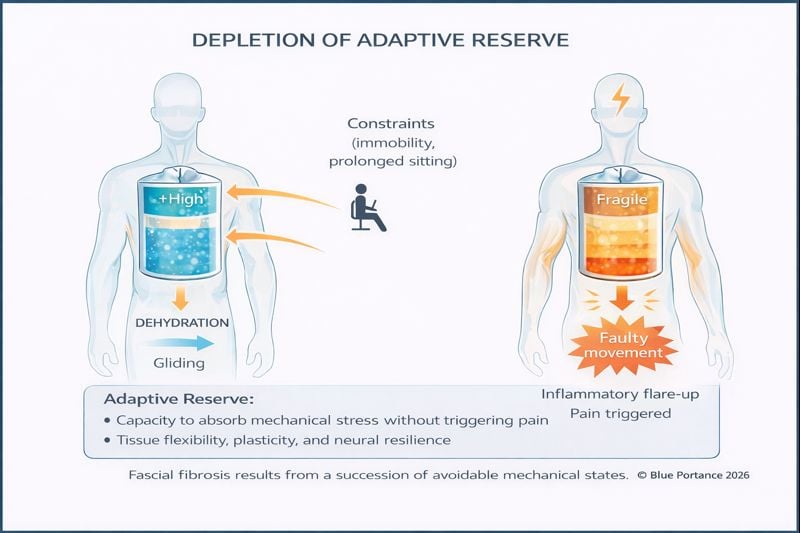
The SBNFA™ framework uses the notion of adaptive reserve to describe the functional margin a system has to absorb, redistribute, and recover from stresses before they become symptomatic or before symptoms persist.
It resides neither in the nerve alone nor in an isolated tissue. It depends on the relative mobility of interfaces, the possibility of varying postures and points of support, stress redistribution, the neuromuscular response, nerve sensitivity, and recovery. Sleep, general health, and emotional context may also modulate it. It is a functional notion intended to organize the analysis, not a quantity measurable by a single clinical test.
This reserve can be described in terms of four capacities: accepting a variation in load, changing configuration, redistributing stresses, and recovering before the next exposure. Its reduction therefore does not necessarily mean that a tissue is “exhausted”: it indicates that the available options are becoming insufficient in the face of the current load.
As long as adaptive capacity remains sufficient, a stress can be tolerated without causing persistent symptoms. When several factors combine, the same stress may become painful or lead to slower recovery.
Symptoms may then fluctuate according to sitting duration, activity, fatigue, psychological stress, sleep, or the possibility of changing position. This variability is compatible with a functional mechanism, but it does not constitute specific proof of fascial involvement.
The functional nature of a clinical picture does not mean that the symptoms are necessarily transient. Functional pain can persist when maintaining factors continue or when the nervous system becomes more sensitive.
Repeated exposure to an aggravating posture may help maintain symptoms in some people. However, it has not been demonstrated that prolonged sitting systematically leads to densification, fibrosis, or a measurable biological depletion of the adaptive reserve.
In the SBNFA™ framework, exceeding the adaptive reserve therefore refers to a functional tolerance threshold. It corresponds to the point at which mechanical load, nerve sensitivity, and protective responses become significant enough to sustain the symptoms. This notion remains an interpretive framework specific to the SBNFA™ framework.
The threshold is neither fixed nor exclusively quantitative. A moderate but prolonged and minimally varied demand may become less tolerable than a stronger but brief demand that is alternated and followed by recovery. This distinction links symptoms not only to the intensity of a pressure, but also to its duration, its repetition, and the scope for adjustment left to the body.
5. SBNFA™ triage indicators
SBNFA™ triage relies on a convergence of clues. No single element can distinguish with certainty structural factors from functional mechanisms.
These clues do not produce a binary verdict. They serve to answer three questions in turn: Is there a structural factor to investigate or monitor? Does the variability of symptoms reveal a modifiable functional component? Which signs suggest that the margin for adaptation is shrinking or being restored?
5.1 Findings compatible with a structural investigation
- Clearly identified trauma, surgery, or local event.
- Pain that appeared suddenly after that event.
- Anatomical abnormality concordant with the territory and profile of the pain.
- Objective neurological deficit or focal clinical sign requiring specialist evaluation.
- Stable course, little influenced by variations in posture or load.
These findings do not prove that an abnormality is responsible for the symptoms. They indicate that a targeted structural or neurological investigation may be relevant.
5.2 Findings compatible with a functional or mixed mechanism
- Symptoms that fluctuate with posture, sitting duration, or load.
- Partial improvement with changes of position or during off-loading phases.
- No sufficiently explanatory structural abnormality on the available imaging.
- Perineal pain associated with urinary, sexual, or rectal manifestations, without a single identified local lesion.
- Symptoms that vary with fatigue, psychological stress, sleep, or recovery.
These findings point toward a functional or mixed analysis, but they do not allow the conclusion of an exclusively mechanical, fascial, or muscular origin.
5.3 Clues related to adaptive reserve
- Time to symptom onset that shortens with successive exposures.
- Slower recovery after a comparable sitting duration.
- Fewer positions or points of support still tolerated.
- Conversely, improvement in tolerance time or recovery when points of support and positions can be varied.
These changes describe a functional variation in tolerance. They do not directly measure a biological reserve and do not prove a structural restoration or deterioration.
5.4 Situations requiring particular vigilance
Certain symptoms should not be attributed outright to a simple functional mechanism. Medical evaluation should be sought particularly when any of the following appear: progressive neurological weakness, saddle anesthesia, new sphincter disturbances, fever, unexplained weight loss, unusual night pain, or rapid worsening.
6. Structural, functional, and adaptive reserve
The following table presents the predominant features of each reading. In practice, the structural, functional, and adaptive dimensions may overlap. This grid is not a validated diagnostic tool and replaces neither the clinical examination nor the medical interpretation of additional diagnostic testing.
On mobile, scroll the table horizontally.
| Criterion | 🏗️ Possible structural factor | 🌊 Possible functional mechanism |
|---|---|---|
| Definition | Identified anatomical abnormality, potentially concordant with the symptoms. | Symptoms without a sufficiently explanatory structural abnormality, which may involve several mechanical, neuromuscular, or neurophysiological mechanisms. |
| Possible triggers | Trauma, surgery, scar, mass, bony abnormality, or local mechanical interference. | Prolonged sitting, repeated stresses, variations in load, muscle tension, and nerve sensitivity factors. |
| Relationship to imaging | An abnormality may be visible, but its relevance must be confirmed by its clinical concordance. | Normal imaging is possible. It does not always identify functional mechanisms or variations in sensitivity. |
| Symptom profile | Symptoms sometimes more stable and associated with an event or a specific anatomical region. | Symptoms often variable with posture, duration of exposure, fatigue, psychological stress, or recovery. |
| Possible dominant mechanism | Mechanical interference, local irritation, or compression associated with an identifiable structure. | Interaction among mechanical load, nerve sensitivity, muscular protection, and functional adaptation. |
| Interpreting the absence of a lesion | An abnormality may not be visible with the examination used or may be insufficiently characterized. | The absence of a visible lesion may be compatible with a functional mechanism, but does not prove a fascial origin. |
| Adaptive reserve | It may be reduced by an anatomical source of stress, but its level cannot be inferred from imaging alone. | In the SBNFA™ framework, it refers to the margin of tolerance to stresses before symptoms appear or intensify. |
| Clinical example | Pain that appeared after surgery with a concordant scar abnormality, to be confirmed by specialist evaluation. | Pain aggravated by sitting and fluctuating, without a sufficiently explanatory structural abnormality. |
| Possibility of a mixed profile | A real abnormality may be amplified or sustained by functional mechanisms and reduced tolerance. | Disturbed function does not rule out an associated anatomical vulnerability or structural sequela. |
| Key references | Robert et al. (1998); Labat et al. (2008). | Labat et al. (2008); Pavan et al. (2014); Stecco et al. (2019). |
7. Clinical implications and understanding the transition to chronic pain
The absence of explicit triage can encourage a succession of tests and interventions without a shared hypothesis. Conversely, an overly hasty functional reading can lead to overlooking a lesion, a neurological deficit, or another medical cause.
The objective of SBNFA™ triage is therefore to uphold two requirements at the same time: looking for findings that warrant a structural investigation, and recognizing that pain can be real and disabling in the absence of a visible abnormality.
The transition to chronic pain may result from interactions among repeated exposure to stresses, sensitization, protective strategies, activity limitation, sleep disturbance, and psychological or social factors. The persistence of symptoms does not prove progressive anatomical deterioration.
Within this framework, the notion of adaptive reserve can help describe a possible functional trajectory: a previously tolerated stress becomes progressively less well tolerated when several vulnerability factors combine. This notion belongs to the SBNFA™ framework and must be presented as an organizing hypothesis, not as a validated clinical variable.
Triage therefore does not involve artificially opposing “structural” and “functional.” It involves determining whether a structural abnormality is objectively demonstrable and clinically concordant, while evaluating the functional mechanisms likely to contribute to the symptoms.
It takes the form of a hierarchy of hypotheses: structural findings to rule out or document, plausible functional mechanisms, factors that reduce the adaptive reserve, and signs that call for medical referral. This hierarchy may evolve with testing, observation, and the response to changes in context.
Scientific references
- Labat JJ, Riant T, Robert R, Amarenco G, Lefaucheur JP, Rigaud J. Diagnostic criteria for pudendal neuralgia by pudendal nerve entrapment (Nantes criteria). Neurourology and Urodynamics. 2008;27(4):306–310. doi: 10.1002/nau.20505 .
- Robert R, Prat-Pradal D, Labat JJ, Bensignor M, Raoul S, Rebai R, Leborgne J. Anatomic basis of chronic perineal pain: role of the pudendal nerve. Surgical and Radiologic Anatomy. 1998;20(2):93–98. doi: 10.1007/BF01628908 .
- Pavan PG, Stecco A, Stern R, Stecco C. Painful connections: densification versus fibrosis of fascia. Current Pain and Headache Reports. 2014;18(8):441. doi: 10.1007/s11916-014-0441-4 .
- Stecco A, Pirri C, Stecco C. Fascial entrapment neuropathy. Clinical Anatomy. 2019;32(7):883–890. doi: 10.1002/ca.23388 .
These references respectively support the clinical framework of the Nantes criteria, the anatomical basis of the pudendal course, and certain general models concerning fascial interfaces and pain. They do not demonstrate that a fascial or functional mechanism alone explains every case of pudendal neuralgia.
The SBNFA™ framework — notably the notions of triage, adaptive reserve, and tolerance threshold — is a proprietary framework developed by Blue Portance. It must be presented as an internal conceptual model and not as a validated medical classification.
The following internal references may be cited separately from the scientific publications:
- Blue Portance. SBNFA™ framework — Neuro-anatomie, partie IV : triage structurel/fonctionnel [Neuroanatomy, Part IV: Structural/Functional Triage]. 2026.
- Blue Portance. SBNFA™ framework — Neuro-anatomie, partie IV : errance diagnostique et chronicisation [Neuroanatomy, Part IV: Diagnostic Odyssey and Transition to Chronic Pain]. 2026.
© Gil Ayache. The concepts, diagrams, terminology, and principles presented on this page constitute a work protected by copyright. They are made available to Blue Portance under an intellectual property license agreement, without transfer of economic rights or of authorship.
