


1. Nerve root origins and neurofunctional role
The pudendal nerve usually arises from the ventral rami of the sacral roots S2, S3, and S4. It belongs to the sacral plexus and behaves as a mixed peripheral nerve, containing mainly sensory and motor fibers (Kinter & Newton, 2023; Zapletal et al., 2024).
Its sensory fibers contribute to the innervation of the perineal region, the anal margin, the lower part of the anal canal, and the external genitalia. Its motor fibers innervate, in particular, the external anal sphincter, the external urethral sphincter, and several muscles of the perineum (Kinter & Newton, 2023).
It is important to distinguish the pudendal nerve from the pelvic visceral autonomic pathways. The parasympathetic fibers supplying, in particular, the bladder, the rectum, and the internal genital organs travel mainly through the pelvic splanchnic nerves and the pelvic plexuses. They should not be attributed indiscriminately to the pudendal nerve.
The pudendal nerve can nevertheless be involved in certain urinary, anorectal, and sexual functions through its somatic role in the external sphincters, the perineal muscles, and sensation in the external genital region. Involvement of the nerve can therefore produce sensory, motor, or sexual symptoms without necessarily implying a lesion of the organ concerned (Aoun et al., 2021; Kinter & Newton, 2023).
The pudendal nerve is primarily a somatic motor and sensory nerve arising from S2 to S4. It contributes to control of the external sphincters, to the innervation of several perineal muscles, and to sensation in the anoperineal and external genital region.
2. A complex pelvic course
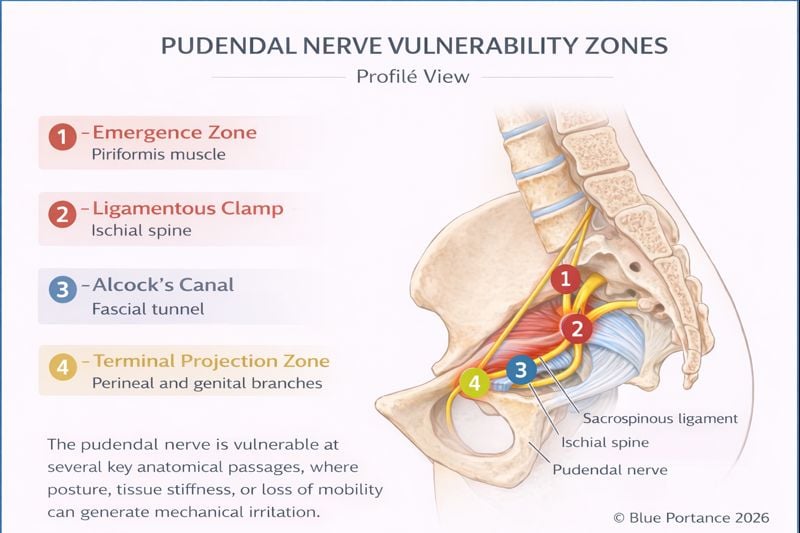
The pudendal nerve follows a looping course around the ischial spine. After forming within the sacral plexus, it generally leaves the pelvis through the greater sciatic notch.
It then runs close to the sacrospinous ligament and the ischial spine before returning to the perineal region through the lesser sciatic notch. It then accompanies the internal pudendal vessels within the pudendal canal, also known as Alcock’s canal (Robert et al., 1998; Kinter & Newton, 2023; Zapletal et al., 2024).
The pudendal canal corresponds to a splitting of the fascia covering the obturator internus muscle. The nerve therefore does not run through an isolated bony tunnel, but through an anatomical interface associated with muscular, vascular, and fascial structures.
Several zones may be of clinical interest: the region of the ischial spine, the space between the sacrospinous and sacrotuberous ligaments, the pudendal canal, and certain zones where the terminal branches divide. Anatomical variations exist, particularly regarding the origin and course of the inferior rectal nerve (Robert et al., 1998; Zapletal et al., 2024).
These relationships may contribute to the nerve’s vulnerability in certain situations. They do not, however, allow one to conclude that a given posture systematically causes nerve compression or nerve injury.
3. Terminal branches and innervated territories
The pudendal nerve usually gives off several main branches. The classic description includes the inferior rectal nerve, the perineal nerve, and the dorsal nerve of the penis or clitoris. The order and level of branching may vary between individuals (Kinter & Newton, 2023; Zapletal et al., 2024).
3.1 Inferior rectal nerve
The inferior rectal nerve runs medially across the ischioanal fossa. It contributes to the motor innervation of the external anal sphincter and carries sensory information from the lower part of the anal canal and the perianal region (Kinter & Newton, 2023).
3.2 Perineal nerve
The perineal nerve divides into superficial and deep branches. It contributes to the sensory innervation of the skin of the perineum and of the scrotum or labia majora, as well as to the motor innervation of several perineal muscles and of the external urethral sphincter (Kinter & Newton, 2023).
Perineal or external genital pain may therefore be consistent with irritation of a pudendal branch. This location alone, however, cannot determine the exact level of involvement.
3.3 Dorsal nerve of the penis or clitoris
The dorsal nerve of the penis or clitoris is a predominantly sensory terminal branch. It contributes to sensation in the external genitalia and carries information related to touch, pressure, and sexual stimulation.
Erectile and genital functions, however, result from the interaction of several somatic and autonomic pathways. It would therefore be incorrect to attribute the entire sexual response to the pudendal nerve alone (Aoun et al., 2021).
The distribution of the pudendal branches may explain why irritation located along the course of the nerve is felt in a more distal region. It is nevertheless preferable to speak of pain distributed within a nerve territory rather than to assert that the perceived location necessarily corresponds to the exact level of the lesion.
4. The nerve in its fascial environment
ESTABLISHED DATA MECHANICAL INTERPRETATION
The pudendal nerve is not isolated from the pelvic tissues. It runs in relation to the muscles, ligaments, vessels, and fascia of the region. The pudendal canal, in particular, is formed by the fascia associated with the obturator internus muscle (Robert et al., 1998; Zapletal et al., 2024).
A peripheral nerve is not merely an anatomical structure passing through a space. It is a living tissue that must adapt to the changes in position and length associated with movement. This adaptation relies, in particular, on its capacity for relative displacement — or gliding — with respect to its connective-tissue sheaths and the surrounding tissues, as well as on its capacity to undergo strain within limits compatible with its function.
Gliding therefore does not mean that the nerve moves freely within an empty conduit. It refers to the relative mobility required between several tissues that are interconnected but not immobile with respect to one another. Along the pudendal course, this mechanical requirement takes on particular significance because of the nerve’s changes of direction and its relationships with the ligaments, the obturator internus muscle, and its fascia.
When the position of the pelvis, the hips, or the perineal tissues changes, stress is not borne by a single isolated point: it is distributed throughout this neuro-musculo-fascial complex. The relative mobility of the interfaces thus contributes to local adaptation to movement and to variations in support. This general mechanical interpretation cannot, however, be used to assert that a loss of gliding is present in a given person.
The concept of fascial entrapment neuropathy proposes that a change in the connective-tissue microenvironment may influence a nerve’s relative mobility, local stress distribution, and its tolerance to repeated loading. An alteration of this relative mobility is therefore a plausible mechanism in certain entrapment neuropathies. This model is general and does not constitute a specific demonstration of fascial densification or of a loss of pudendal nerve gliding in a given patient (Stecco, Pirri & Stecco, 2019).
Fascial densification must also be distinguished from fibrosis. Densification is described as a possible change in the mechanical properties of loose connective tissue, whereas fibrosis corresponds to a more structural change in collagen organization (Pavan et al., 2014).
General mechanism: a peripheral nerve must retain a capacity for mechanical adaptation and relative displacement with respect to the tissues surrounding it. Application to the pudendal nerve: its course makes the influence of these interfaces plausible. Individual limitation: pain, or normal imaging, cannot on its own confirm or rule out a loss of gliding, fascial densification, or dynamic compression.
5. Adaptive reserve: a functional model
SBNFA™ HYPOTHESIS
The SBNFA™ framework uses the notion of adaptive reserve to designate the functional margin available to a living system to absorb and redistribute everyday stresses and recover from them, without these stresses translating into lasting symptoms or a loss of function.
Applied to the environment of the pudendal nerve, this reserve does not reside in the nerve alone. It depends on the whole formed by the nerve, its connective-tissue interfaces, the muscles, the fascia, the joints of the pelvis and hips, as well as the regulatory mechanisms of the nervous system. It can draw on four complementary capacities:
- adapting mechanically to changes in tissue position and length;
- redistributing stress across several support points and several interfaces rather than concentrating it over time;
- varying the loading through postural adjustments and micro-movements;
- recovering between two periods of loading.
This interpretation therefore links the relative mobility of tissues, the variability of support, the repetition of stress, and recovery. Adaptive reserve is not a fixed quantity: it can vary according to the intensity and duration of loading, muscle tension, nerve sensitivity, sleep, general health, and the real possibilities for changing position.
A person may tolerate a sitting posture or an activity for a certain length of time, then develop symptoms when the load is repeated, intensifies, continues without sufficient variation, or combines with other factors. Conversely, a change in support, a better possibility of adjustment, or a period of recovery may improve tolerance without this demonstrating that a lesion has disappeared. The model thus aims to make intelligible the cumulative, fluctuating, and reversible nature of certain symptoms.
From this perspective, pain can be understood as the expression of an interaction between peripheral stress, local adaptive capacity, recovery, and the sensitivity of the nervous system. A decrease in adaptive reserve then means that the same load becomes more difficult to manage; it designates neither an injured structure nor a measurable anatomical threshold.
The notion is thus a functional reasoning tool specific to the SBNFA™ framework. It helps formulate three questions: Which stresses are repeated? What possibilities for variation or redistribution are available? Is recovery sufficient before the next loading? It does not correspond to an anatomical structure or to a clinical measure validated by a single test.
The adaptive reserve model is neither a diagnostic criterion for pudendal neuralgia nor proof of nerve compression or nerve distress. Nor does it allow one to infer directly that a structural lesion, inflammation, or fascial densification is present. It should be used to structure the analysis, as a complement to an appropriate clinical evaluation.
Scientific references
-
Robert R, Prat-Pradal D, Labat JJ, Bensignor M, Raoul S, Rebai R,
Leborgne J.
Anatomic basis of chronic perineal pain: role of the pudendal nerve.
Surgical and Radiologic Anatomy.
1998;20(2):93–98.
DOI:
10.1007/BF01628908
.
View PubMed record -
Labat JJ, Riant T, Robert R, Amarenco G, Lefaucheur JP, Rigaud J.
Diagnostic criteria for pudendal neuralgia by pudendal nerve entrapment
(Nantes criteria).
Neurourology and Urodynamics.
2008;27(4):306–310.
DOI:
10.1002/nau.20505
.
View PubMed record -
Kinter KJ, Newton BW.
Anatomy, Abdomen and Pelvis: Pudendal Nerve.
In:
StatPearls.
Treasure Island: StatPearls Publishing.
Updated 2023.
View NCBI Bookshelf record -
Zapletal J, Nanka O, Halaska MJ, Maxova K, Hajkova Hympanova L,
Krofta L, et al.
Anatomy of the pudendal nerve in clinically important areas:
a pictorial essay and narrative review.
Surgical and Radiologic Anatomy.
2024;46(2):211–222.
DOI:
10.1007/s00276-023-03285-7
.
View PubMed record -
Aoun F, Alkassis M, Abi Tayeh G, Abi Chebel J, Semaan A, Sarkis J,
Mansour R, Mjaess G, Albisinni S, Absil F, Bollens R,
Roumeguère T.
Sexual dysfunction due to pudendal neuralgia:
a systematic review.
Translational Andrology and Urology.
2021;10(6):2500–2511.
DOI:
10.21037/tau-21-13
.
View PubMed record - Pavan PG, Stecco A, Stern R, Stecco C. Painful connections: densification versus fibrosis of fascia. Current Pain and Headache Reports. 2014;18(8):441. DOI: 10.1007/s11916-014-0441-4 .
- Stecco A, Pirri C, Stecco C. Fascial entrapment neuropathy. Clinical Anatomy. 2019;32(7):883–890. DOI: 10.1002/ca.23388 .
The anatomical and clinical references above do not demonstrate that fascial densification, a loss of gliding, or dynamic compression explains every case of pudendal pain. They help distinguish established anatomical data from the functional models proposed in the literature.
The notion of adaptive reserve belongs to the SBNFA™ framework developed by Blue Portance. It should be presented as an internal conceptual framework and not as a validated anatomical or medical criterion.
Proposed internal reference:
- Blue Portance. Modèle SBNFA™ — Neuro-anatomie, partie I : anatomie fonctionnelle du nerf pudendal [SBNFA™ Framework — Neuroanatomy, Part I: Functional Anatomy of the Pudendal Nerve]. 2026.
© Gil Ayache. The concepts, diagrams, terminology, and principles presented on this page constitute a work protected by copyright. They are made available to Blue Portance under an intellectual property license agreement, without transfer of economic rights or of authorship.
