


Pain Management Through Dynamic Balance: Understanding Compensation Mechanisms
When parts of the body compensate for deficiencies, it can trigger a cascade of pain and imbalances. Compensation mechanisms often lead to inflammation and neurosensory disruptions that amplify pain — particularly in the context of pelvic and perineal pain.
A comprehensive approach — aimed at reducing inflammation, restoring tissue function, and retraining neurosensory pathways — is essential for lasting pain relief. The Aporia® bioactive seat, by promoting dynamic postural balance and supporting continuous postural adjustments, is a key part of this approach.
Chronic pain — whether lumbar, pelvic, or perineal — does not always originate where it is felt. It is often the visible result of a silent chain reaction: one area of the body loses its mobility, neighboring structures compensate, and it is this invisible overload that ultimately manifests as pain, sometimes far from the original source.
Understanding the logic of compensation is a radical shift in how we think about pain — and opens the door to therapeutic approaches that address the real causes, not just the symptoms.
1. Understanding Compensation Mechanisms
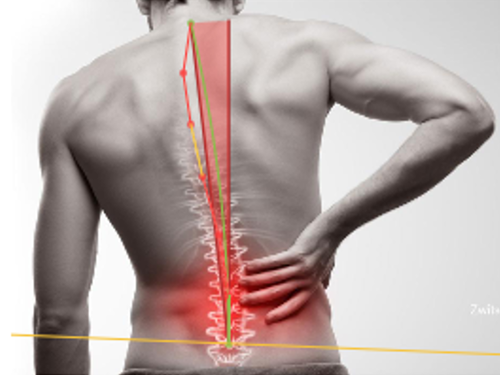
When a part of the body experiences a functional deficiency or restricted movement, surrounding areas attempt to compensate, leading to excessive muscle tension, postural imbalances, and overuse of certain structures. These compensations can generate pain in regions far from the original source, making it significantly harder to identify the true underlying cause.
“Silent zones” of the body
Some areas do not actively signal pain, even when they are involved in the underlying mechanism. This silence may be explained by issues in nerve signal transmission or central modulation of pain perception by the brain. A vertebral deficiency, for example, can trigger compensations in adjacent vertebrae, surrounding muscles, and even nerve structures — without ever being painful in itself.
To illustrate this concept, think of the spine as a bicycle chain. If one link is defective, the surrounding links must absorb additional stress to compensate for that weakness. These mechanisms can therefore trigger pain in distant areas, making it even harder to pinpoint the actual root cause.
2. Inflammation: The Consequence of Compensation
Compensations can trigger inflammation when the adjustments and overloads placed on tissues exceed their tolerance threshold. Four main mechanisms explain this:
- Overuse or excessive stress: body parts working overtime to compensate for a deficiency can develop inflammation in muscles, tendons, ligaments, or joints.
- Biomechanical imbalance: compensations alter the forces exerted on tissues, triggering a local inflammatory response.
- Repeated microtraumas: when compensations persist over time, cumulative minor injuries sustain low-grade chronic inflammation.
- Nerve irritation: pressure or traction on nerve structures can cause irritation and an inflammatory response in surrounding tissues.
These symptoms are common among people suffering from low back pain and pelvic and perineal pain.
3. Inflammation and Neurosensory Disruption
Inflammation is a complex biological process that, when persistent, can lead to fibrosis — excessive formation of scar tissue — compromising the function of affected organs or tissues. This situation is often associated with neurosensory disruption: the pathways that transmit sensory signals become altered, increasing sensitivity to pain.
Excessive fibrosis can compress neighboring nerve structures, triggering neurosensory changes. Conversely, neurosensory alterations can influence inflammatory responses and healing processes, worsening fibrosis formation. These complex interactions are particularly observed in pelvic and perineal pain:
- Fibrosis alters tissue functionality, increasing sensitivity and pain.
- Neurosensory changes amplify the transmission of pain signals and affect pain perception throughout the body.
Inflammation and neurosensory alterations in pudendal neuralgia
Pudendal neuralgia is a condition in which inflammation and neurosensory alterations interact closely. When the pudendal nerve is compressed or irritated, a local inflammatory reaction develops, sensitizing nerve fibers and amplifying pain perception. At the same time, neurosensory alterations — changes in tactile sensitivity, proprioception, and pain perception in the pelvic region — can themselves trigger inflammatory responses, amplifying symptoms. These two mechanisms reinforce each other, which justifies simultaneous treatment on both fronts. The understanding of these mechanisms is still evolving, and their relative contribution varies from person to person.
4. Aporia®: A Comprehensive Approach to Lasting Relief
An integrated approach is required to address these intertwined phenomena of pain and compensation. It combines strategies to reduce inflammation, treat fibrosis, restore tissue functionality, and retrain neurosensory mechanisms. The goal is to identify and treat not only the symptoms, but also the underlying causes — often silent zones — and functional imbalances, in order to achieve complete and lasting recovery.
The Aporia® multi-articulated seat cushion is designed to reduce pain and restore bodily stability and functionality. Whether through a transitional position of acceptability or through specific rehabilitation techniques, the objective is to restore balance and functionality to the body, even in the presence of residual imbalances.
5. Aporia®: A Dynamic Seat for Active Balance
In the neurosensory system, two types of information flows coexist continuously: the ascending (up) flow and the descending (down) flow. The type of seat used directly influences how the body processes and responds to sensory input.
- Up-down configuration: a static cushion can provide comfort signals, but leaves the body in a passive state — it does not stimulate the fine postural micro-adjustments the body needs.
- Down-up configuration: a dynamic seat, like the Aporia® cushion, enables active sensory feedback. Through its 4 articulated pads, it supports postural micro-adjustment movements and continuous muscular adaptations — maintaining bodily stability and harmonious function throughout the day.
There are different ways to learn balance:
- Repetition: performing repeated exercises to improve coordination and stability.
- Active proprioception: being exposed to varying degrees of freedom and actively seeking equilibrium — through muscle strengthening and balance training. This is precisely what the Aporia® cushion enables by design.
Conclusion
Chronic pain is not an isolated phenomenon: it develops within a dynamic of compensation, inflammation, and neurosensory disruption that mutually reinforce one another. An effective approach must therefore act simultaneously on all these levels — structural, inflammatory, and neurosensory — to enable genuine and lasting recovery.
This is the logic that drives the Aporia® bioactive seat: rather than imposing a fixed posture, it supports the body’s natural micro-oscillations, transforming sitting time into a form of continuous movement — contributing, session after session, to the restoration of an active functional balance.
Learn More
-
Chronic Pain Decoded
How the central nervous system can itself become a source of pain, independent of any active injury. -
When Pain Becomes Self-Sustaining
The mechanisms by which pain becomes entrenched long after its original cause has disappeared. -
Fascial Fibrosis and Chronic Pain
Why fibrosis alters tissue functionality and how it perpetuates pain cycles. -
Pelvic Pain Cushion and Seated Position
The role of seating in aggravating or relieving pelvic and perineal pain. -
Micro-Movements While Sitting
Why continuous small postural adjustments are essential to prevent the build-up of mechanical stress.
Sources and References
- Ivaldi P. — Clinical contribution from 20 years of practice at the E3S Functional Rehabilitation Unit, Saint-Jean Polyclinic. Co-founder of the École du dos.
- OPS Clinic — Vertebral compensation mechanism modeling software.
