


This article is part of the Expert Guide “Fascia.”
Chapter 2 — Blue Portance Knowledge BaseHow Does Fascia Behave Under Stress?
Summary — Fascia does not respond like an ideal spring. Its response depends on the magnitude of the load, its direction, its rate, and above all its duration. Under a constant load, it can continue to deform: this is creep. Held at a constant strain, it gradually exerts less force: this is stress relaxation. Over a loading–unloading cycle, the tissue thus dissipates part of the energy: this is hysteresis.
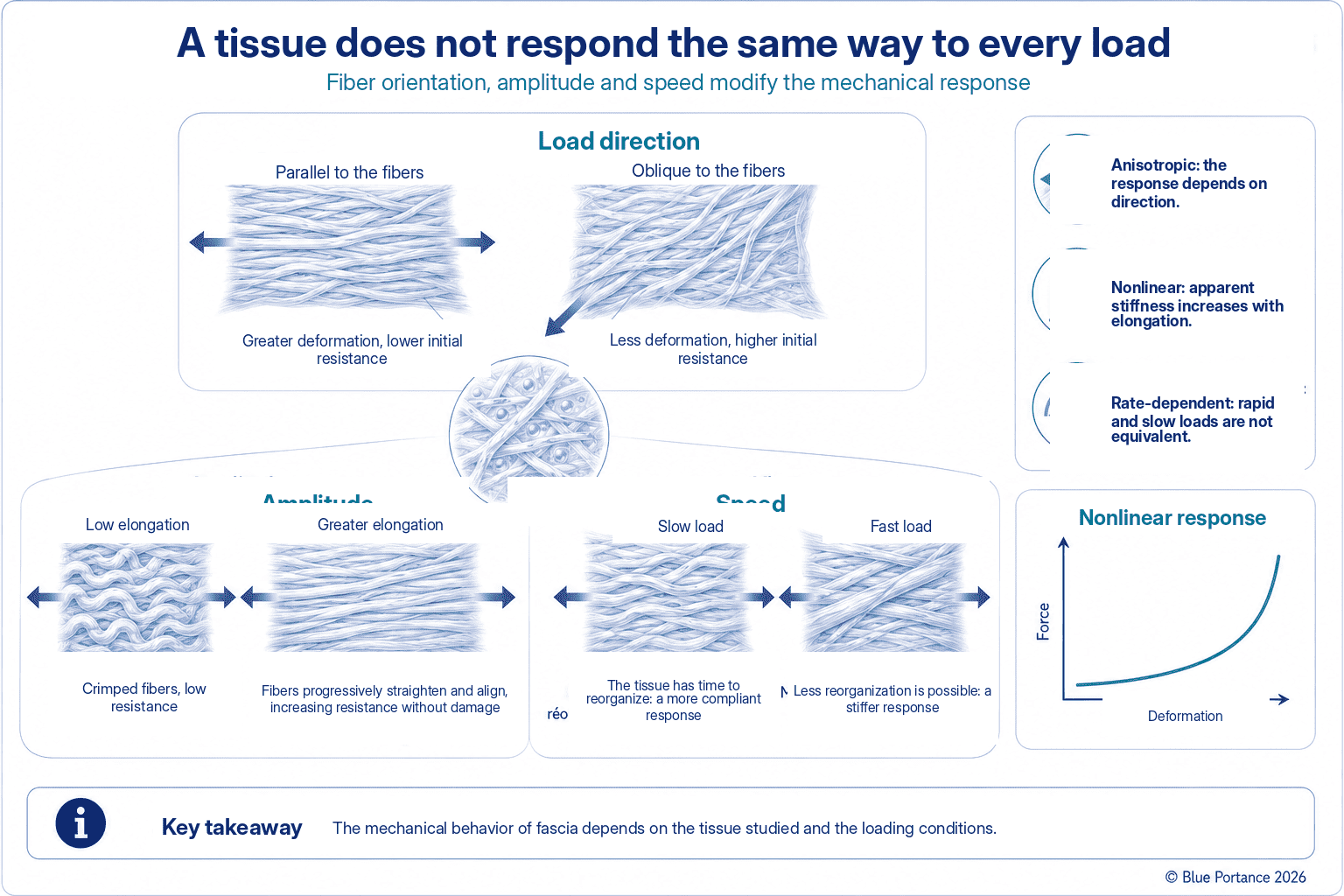
1. An anisotropic, nonlinear material
At rest, collagen fibers are wavy (crimped); they then gradually straighten. Apparent stiffness therefore increases with elongation. Because the fibers also have their own orientation, the tissue does not respond in the same way in every direction: it is anisotropic.
This nonlinearity can be read on a stress-strain curve typical of dense connective tissues. At small elongations, the initial low-stiffness zone, referred to in the literature as the toe region, corresponds simply to the gradual straightening of the crimped fibers, which offer little resistance at this stage. Once the fibers have gradually aligned with the direction of pull, the tissue enters an approximately linear zone characterized by markedly higher stiffness. Then, at larger strains, it reaches a threshold of microdamage and, ultimately, rupture (Fung, 1993).
Loading rate and fiber direction
The response also depends on rate. Rapid loading and slowly applied loading do not produce the same deformation. At high rates, the tissue behaves more stiffly, because the time-dependent viscous mechanisms do not have time to develop fully. This rate dependence explains why rapid loading and gradual loading do not produce exactly the same transient mechanical response. Sitting down abruptly or settling gradually onto a seat therefore does not yield the same mechanical result, even when the final state appears similar.
Anisotropy has concrete consequences. Fascial tissue loaded along the dominant direction of its fibers — for example, the fascia lata along the long axis of the thigh — does not exhibit the same stiffness as when it is loaded in a different direction. How large this variation is, however, depends on the local architecture of the tissue in question, which may be multiaxial rather than strictly unidirectional. This directional dependence explains why two tissues that look alike can respond differently to the same stress depending on the angle at which it is applied. It is also why experimental protocols must always specify the loading direction tested, so that they can be compared with one another.
2. Creep under constant load
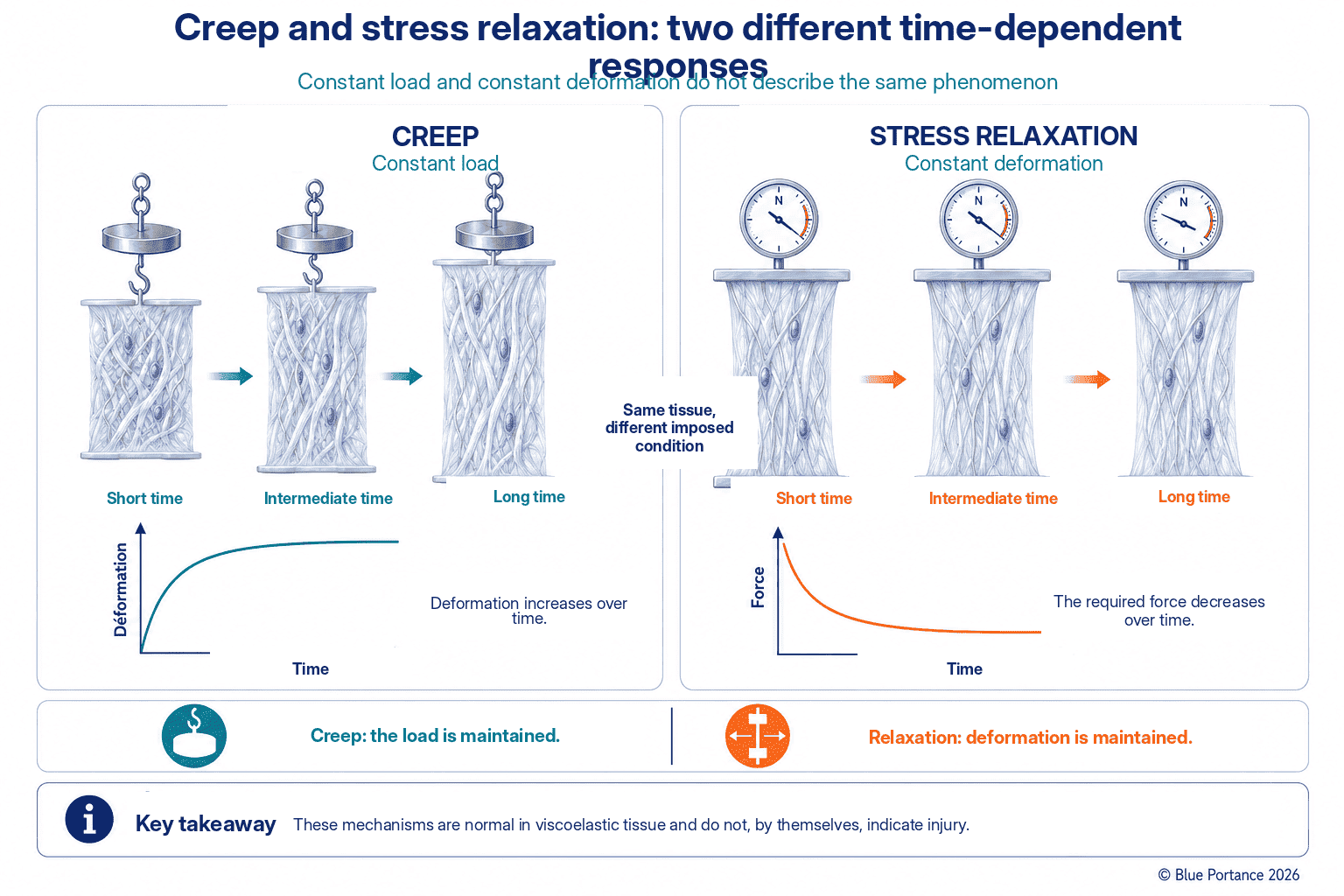
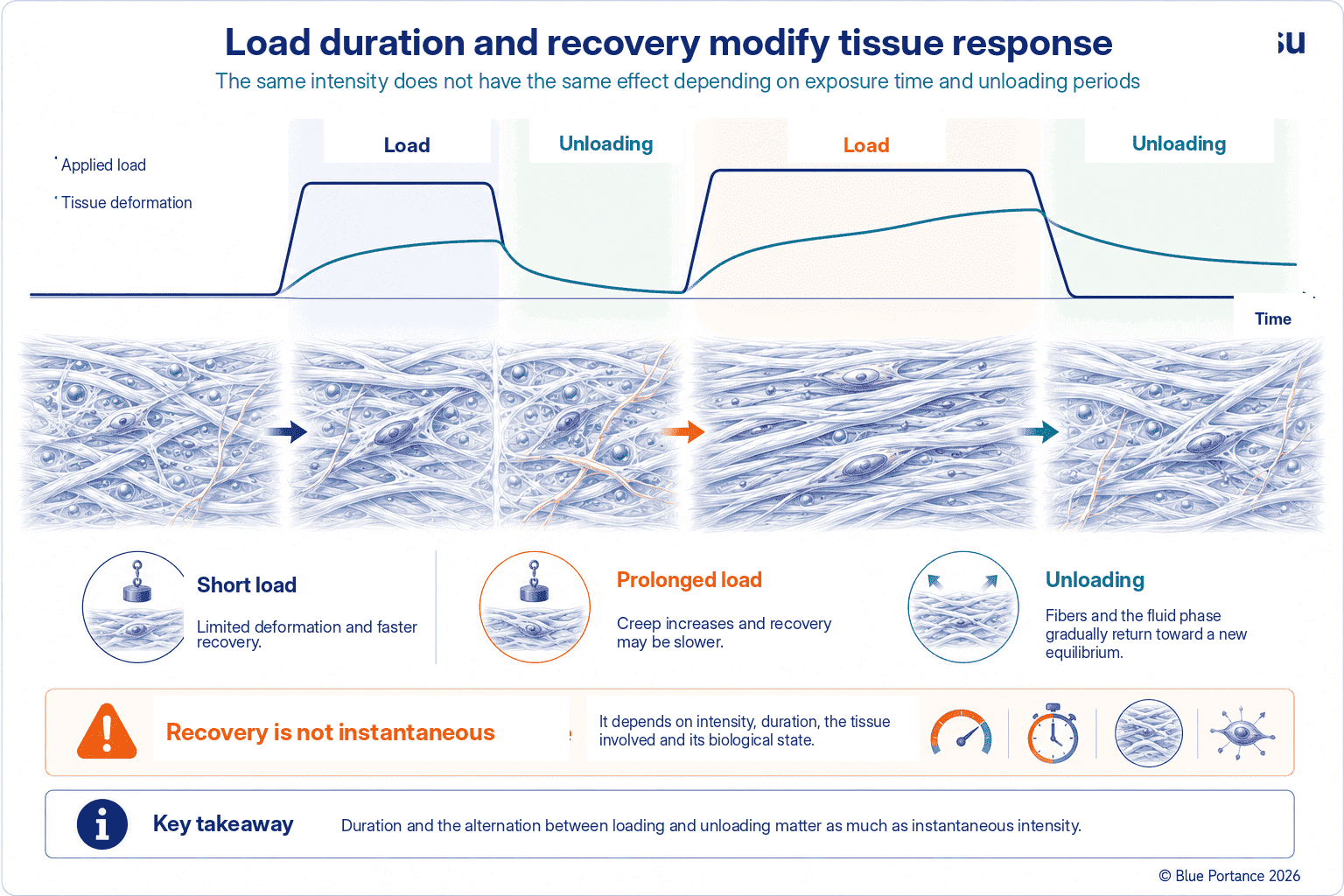
When a load is maintained, the tissue can continue to deform even though the force is no longer increasing. This creep combines fiber reorganization with movements of the fluid phase. Part of it is recovered after unloading; a heavy or prolonged load can lengthen recovery time (Fung, 1993).
The biphasic model and the case of the lumbodorsal fascia
Researchers have modeled this type of behavior in hydrated tissues — articular cartilage in particular — as the interaction between a porous solid matrix and an interstitial fluid phase (Mow et al., 1980). This model distinguishes a solid phase, formed by the network of fibers and cells, and a fluid phase, made up of water and dissolved molecules, which occupies the space between the fibers. Applying this model quantitatively to fascia requires data specific to these tissues, whose architecture and loading conditions differ from those of cartilage.
In hydrated connective tissues broadly speaking, the movement of water within the matrix — roughly comparable to fluid being gradually squeezed out of a porous material, although the architectures are not equivalent — may contribute to this time-dependent evolution. The relative contributions of fluid movement and fiber reorganization, however, depend on the tissue and the loading mode. Human lumbodorsal fascia itself exhibits marked viscoelastic behavior, with hysteresis and stress relaxation under load, measured directly in tensile testing (Yahia et al., 1993).
Creep helps explain why the duration of exposure matters as much as instantaneous magnitude. It does not mean that the tissue is permanently “crushed.” After unloading, fluid movements partially reverse and the tissue gradually returns toward its initial state. This recovery can, however, remain incomplete for a variable period, particularly if the load has exceeded the tissue’s adaptive capacity.
3. Stress relaxation
If the tissue is held at a given length, the force required to maintain that deformation decreases over time. This relaxation redistributes internal tension. It should not be mistaken for the disappearance of all stress on the cells, vessels, or nearby nerves.
Prolonged sitting illustrates this phenomenon. When a person sits down, the tissues under the ischial tuberosities are suddenly deformed and offer a relatively high initial resistance. If the posture is held without change, this resistance gradually decreases through stress relaxation. The tissue “gives” a little, yet the local compression on vessels and nerve endings does not disappear. While sitting, the tissues under the ischial tuberosities are therefore also subject to time-dependent phenomena. Their deformation evolves under the sustained load, while local pressure and perfusion may themselves change. These mechanisms may contribute to discomfort that builds up gradually over the minutes, without being sufficient on their own to explain it fully. Individual sensitivity, shear, and local temperature also play a role, hence the relevance of postural micro-variability, discussed in Chapter 5.
4. Hysteresis and dissipation
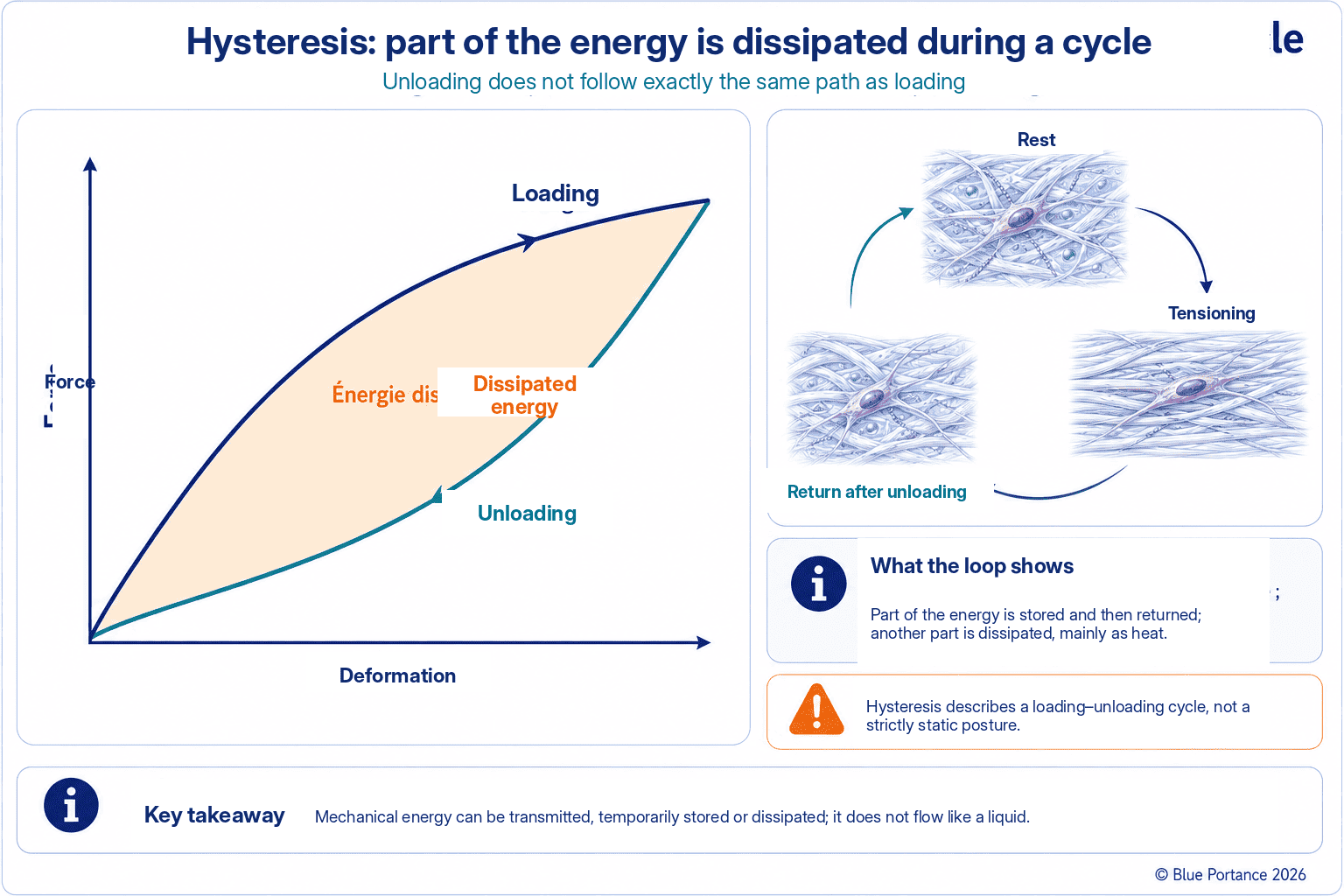
Over a cycle, the unloading curve does not exactly follow the loading curve. The difference corresponds to dissipated energy, mainly in the form of heat. Hysteresis is therefore a property of deformation cycles; a strictly static posture falls instead under creep and relaxation.
Walking provides a repeated example of this loading–unloading cycle. With each step, weight-bearing stretches and then releases the fascia and tendons of the lower limbs, which follow a slightly different path during unloading than during loading. The area between the two curves represents the energy dissipated in each cycle. This dissipation is neither good nor bad in itself: it partially protects the tissue from an abrupt release of stored energy. It does, however, reduce the share of mechanical energy returned in each cycle; in a repeated movement, this loss may need to be offset by additional muscular work.
Myofascial transmission and interpreting hysteresis
It would be inaccurate to claim that energy “flows” through fascia like a liquid. It can be transmitted, stored elastically, or dissipated. Part of the force generated by a muscle can thus be transmitted to neighboring connective tissues rather than following the tendinous pathway exclusively (Huijing, 2003) (Maas & Sandercock, 2010). Studies have documented this myofascial force transmission experimentally. Its extent, however, cannot be reduced to a universal proportion: it varies widely depending on the muscle, the protocol, and the loading conditions studied (Wilke et al., 2018).
In research, the hysteresis area is sometimes used as an indirect indicator of the state of a connective tissue. A wider loop may thus reflect increased dissipation, associated, depending on the context, with a change in the composition or organization of the matrix. This indicator should nonetheless be interpreted with caution. It reflects overall mechanical behavior measured under specific experimental conditions. On its own, therefore, it does not allow one to conclude that the tissue is in a pathological state in a given individual.
5. Why time and recovery are decisive
Periods of unloading allow partial mechanical and fluid recovery. The sequence of loads, their amplitude, and the length of rest periods determine the overall behavior. This time dimension sets the stage for the chapter on stress distribution.
These four properties — nonlinearity, creep, relaxation, and hysteresis — are not observed in isolation in daily life: they combine. Prolonged sitting combines progressive creep, localized stress relaxation, and hysteresis micro-cycles linked to spontaneous postural adjustments. It is this combination, more than any single mechanism, that determines whether a tissue recovers fully during unloading phases or shows incomplete mechanical recovery before the next loading. When loading is repeated before full recovery, the mechanical response to subsequent cycles may thus be altered. Longer-term structural adaptations, for their part, depend on the tissue, the magnitude of the loads, and the biological context. Chapter 9, on deterioration and fibrosis, will examine them in more detail.
A practical implication for sitting comfort
In practical terms, these four mechanical properties invite us to move beyond a binary view of postural comfort that would simply contrast a “supple” tissue with a “stiff” one. The same tissue can behave differently depending on its loading history over the preceding minutes. A recently unloaded tissue will not necessarily show the same mechanical response as it does after a period of continuous loading. This dependence on loading history — more than on any fixed property of the tissue — is one of the reasons why the experience of sitting comfort changes over time, even on a seat that does not itself change. It is this view of fascia as a mechanically active tissue, rather than as mere passive packaging, that Lesondak’s synthesis traces (Lesondak, 2019).
Key Takeaways
- Fascia is viscoelastic, anisotropic, and nonlinear.
- Under constant load, creep increases deformation over time.
- At constant strain, internal force gradually relaxes.
- Hysteresis concerns loading–unloading cycles and should not replace the concepts of creep or relaxation.
Frequently Asked Questions
Is fascia elastic?
Why can light pressure become bothersome over time?
Is creep always pathological?
Scientific References
- Fung YC. Biomechanics: Mechanical Properties of Living Tissues. Springer; 1993.
- Mow VC, Kuei SC, Lai WM, Armstrong CG. Biphasic creep and stress relaxation of articular cartilage in compression: theory and experiments. J Biomech Eng. 1980;102(1):73–84.
- Yahia L, Pigeon P, DesRosiers EA. Viscoelastic properties of the human lumbodorsal fascia. J Biomed Eng. 1993;15(5):425–429.
- Huijing PA. Muscular force transmission necessitates a multilevel integrative approach. Exerc Sport Sci Rev. 2003;31(4):167–175.
- Maas H, Sandercock TG. Force transmission between synergistic skeletal muscles through connective tissue linkages. J Biomed Biotechnol. 2010;2010:575672.
- Wilke J, Schleip R, Yucesoy CA, Banzer W. Not merely a protective packing organ? A review of fascia and its force transmission capacity. J Appl Physiol. 2018;124(1):234–244.
- Lesondak D. Le Fascia. [Fascia.] Éditions Ressources Primordiales; 2019.
← Previous chapter: What Is Fascia and How Is It Organized?
Back to the Fascia guide
Next chapter: How Does Fascia Transmit Forces and Distribute Stress? →
Note: this content explains general mechanisms. It does not constitute a medical diagnosis or a therapeutic recommendation.
© Gil Ayache. The original concepts, biomechanical models, diagrams, terminology, graphic representations, foundational figures, original texts, and principles presented on this page are works protected by copyright. They are made available to Blue Portance under an intellectual property license agreement, without transfer of economic rights or of authorship.
