


Pain that does not behave as expected
One of the great difficulties of coccydynia is this: the pain does not always behave the way one expects.
In some people, it is obvious, precise, almost textbook. In others, by contrast, it disguises itself, moves, radiates — to the point of casting doubt on the diagnosis.
Understanding this distinction between local pain and referred pain is essential, because this is often where misdirection begins… along with diagnostic wandering.
Local pain: a precise mechanical signal
In its most typical form, coccydynia presents as pain strictly localized to the coccyx.
The person affected can often:
- point to the exact spot with one finger,
- describe pain triggered by direct pressure,
- and clearly identify the aggravating situations.
This pain is classically:
- worse in the seated position,
- exacerbated when moving from sitting to standing,
- sometimes triggered during defecation or certain pelvic movements [1] (Fogel et al., 2004).
“As long as I don’t sit down, it’s fine. But as soon as I press there, it’s as if something were being driven inside.”
This kind of description is highly suggestive of direct mechanical involvement of the coccyx: dislocation, hypermobility, local irritation of the soft tissues.
Clinically, reproducing the pain by palpating the coccyx is a strong diagnostic argument, especially when it fits a coherent mechanical context [1] (Fogel et al., 2004).
When pain moves: the trap of referred pain
In other cases, however, the pain seems to come from somewhere else.
The person no longer talks only about the coccyx, but describes:
- diffuse perineal discomfort,
- sometimes pain in the buttocks,
- or even a more anterior burning or pressure sensation,
- sometimes even pain suggestive of low sciatica.
And yet the starting point often remains the coccyx.
This situation is confusing, for the person affected as much as for the practitioner. It explains why coccydynia is frequently confused with:
- a lumbar condition,
- anorectal pain,
- a functional perineal disorder,
- or even poorly defined “nerve” pain [2] (Nathan et al., 2010).
Why the coccyx can “send” pain elsewhere
To understand this phenomenon, one has to abandon the idea of a compartmentalized body.
The sacrococcygeal region is a dense anatomical crossroads where the following meet:
- bony structures,
- ligaments,
- pelvic floor muscles,
- closely interconnected nerve networks.
The coccyx is innervated by nerve branches from the sacral and coccygeal plexuses, and is functionally related to structures such as the ganglion impar, located in front of the sacrum [2] (Nathan et al., 2010).
When a mechanical structure is chronically irritated — for example a coccyx that is hypermobile or carries a spicule — the pain can:
- be perceived at a distance,
- travel along shared nerve pathways,
- or appear in neighboring areas that share the same innervation territory [2] (Nathan et al., 2010).
It is the same mechanism as a splinter under the skin: the entry point is tiny, but the pain seems to spread far beyond it.
A typical clinical example: when the diagnosis aims at the wrong target
For example, a person seeks care for burning perineal pain that worsens when sitting. Urinary and digestive tests are normal. However, the pain resists local treatments.
It is only after a careful clinical examination and appropriate imaging that the following is discovered:
- coccygeal hypermobility,
- or a bony spicule irritating the soft tissues.
The pain was not “in the perineum”:
in reality, it was referred from the coccyx.
This type of situation is well described in clinical reviews, and explains why coccydynia can take on very different faces from one person to another [2] (Nathan et al., 2010).
This confusion is further accentuated by a phenomenon well known in modern neuroscience: central sensitization [3] (Sandrasegaram et al., 2020).
When the mechanics of the coccyx remain disturbed over a long period, the nervous system can enter a state of “high alert.” The threshold for triggering pain then drops globally.
This phenomenon, called central sensitization, means that the brain can continue to generate a pain signal even if the initial lesion has begun to stabilize [3] (Sandrasegaram et al., 2020).
In this context, sensitization may contribute to a broader perceived pain distribution, sometimes extending toward the territory of the pudendal nerve or the cluneal nerves, with burning or electric sensations in the perineal area [3] (Sandrasegaram et al., 2020).
The challenge is then no longer only to treat the bony “hinge,” but to calm a neurological alarm system that has become hypersensitive.
Why this distinction changes everything
Confusing local pain and referred pain leads to two frequent errors:
- treating only the apparent painful area,
- ignoring the underlying mechanical mechanism.
Under these conditions, treatments are often:
- ineffective,
- partially effective,
- or effective… but only temporarily.
Understanding where the pain really comes from makes it possible to stop chasing its manifestations.
Figure — Local pain vs referred pain in coccydynia
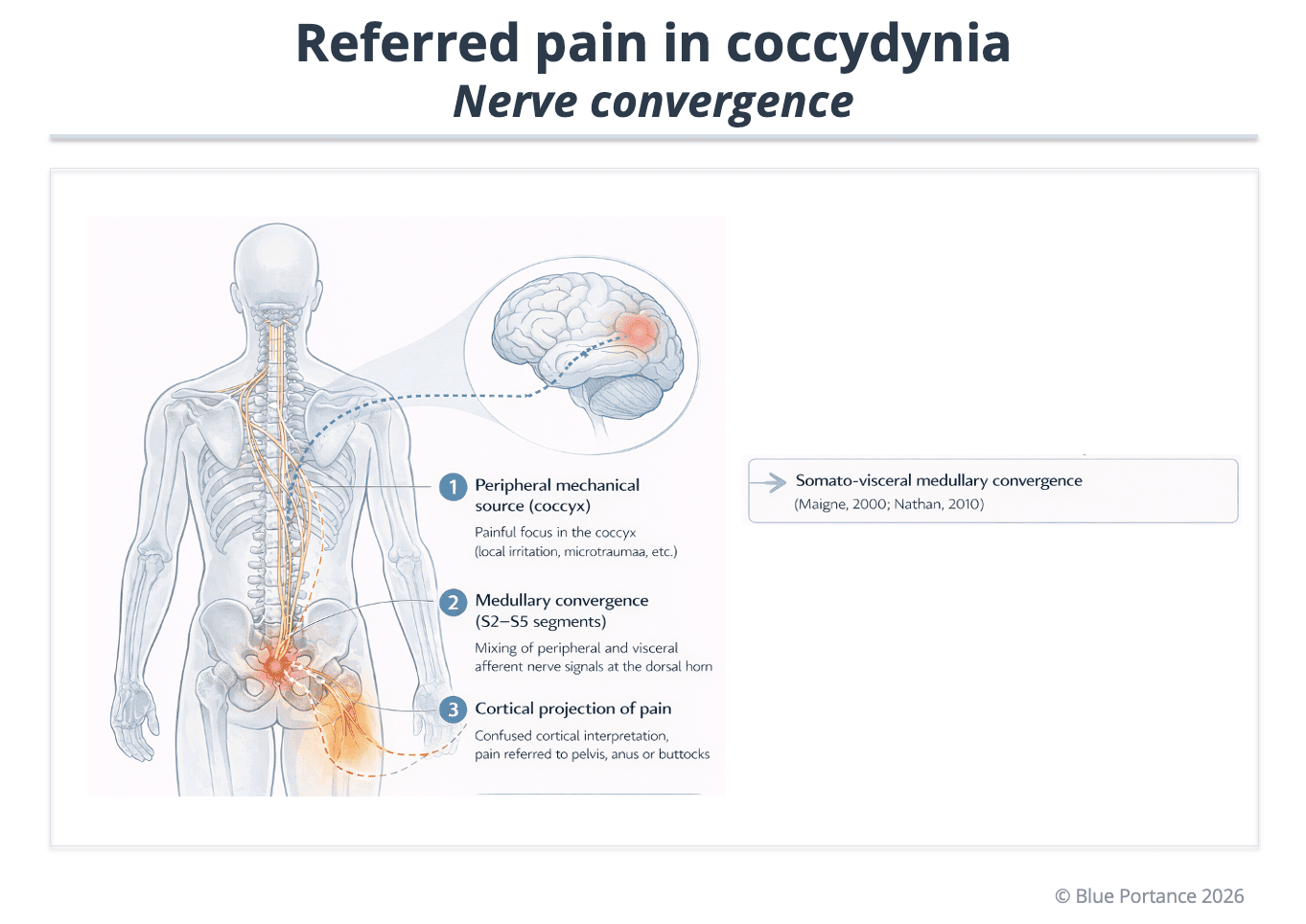
Referred pain in coccydynia may follow the principle of segmental spinal convergence.
The coccyx is considered to be innervated mainly by the sacral roots S2 to S5. Nociceptive afferents from the coccyx may therefore converge in the dorsal horn of the corresponding sacral segments.
This convergence may combine signals coming from:
- the coccygeal osteoligamentous structures
- the pelvic floor
- the perineal tissues
- certain pelvic visceral structures
The cortical interpretation of these signals generally remains confined to the territories corresponding to the sacral metameres.
Referred pain can thus be felt in:
- the perineum
- the anus
- the buttocks
- the back of the thigh
- sometimes the lower lumbar region
By contrast, radiation toward the cervical regions or the shoulder does not stem from a direct S2–S5 segmental projection. It would correspond to a distinct mechanism (global postural compensation, central sensitization, or another supra-segmental process).
Scientific references
- Fogel, G. R., Cunningham, P. Y., & Esses, S. I. (2004). Coccygodynia: Evaluation and management. Journal of the American Academy of Orthopaedic Surgeons, 12(1), 49–54.
- Nathan, S. T., Fisher, B. E., & Roberts, C. S. (2010). Coccydynia: A review of pathoanatomy, aetiology, treatment, and outcome. Journal of Bone and Joint Surgery (British Volume), 92-B(12), 1622–1627.
- Sandrasegaram, N., Gupta, R., & Baloch, M. (2020). Diagnosis and management of sacrococcygeal pain. BJA Education, 20(3), 74–79.
© Gil Ayache. The concepts, diagrams, terminology, and principles presented on this page constitute a work protected by copyright. They are made available to Blue Portance under an intellectual property license agreement, without transfer of economic rights or of authorship.
