


1. Movement as Mechanical Variation
To begin with, a movement changes the relationships among tissues, vessels, the extracellular matrix and contact surfaces.
As a result, it can lead to:
- deformation of the tissues;
- a change in their local volume;
- a change in fiber tension;
- a change in interstitial pressure;
- a redistribution of weight-bearing areas;
- a change in the pressure exerted on vessels;
- loading of lymphatic structures.
Movement therefore acts first and foremost through a mechanical transformation. It does not necessarily move a fluid directly; instead, it changes the physical conditions under which that fluid can move.
Indeed, living tissues are deformable, hydrated media. For this reason, a change in their shape can alter the volume available to interstitial fluid and the pressure gradients that steer its movement (Lu & Wang, 2008).
2. The Mechanical and Fluidic Chain
Overall, the central mechanism can be summarized as follows:
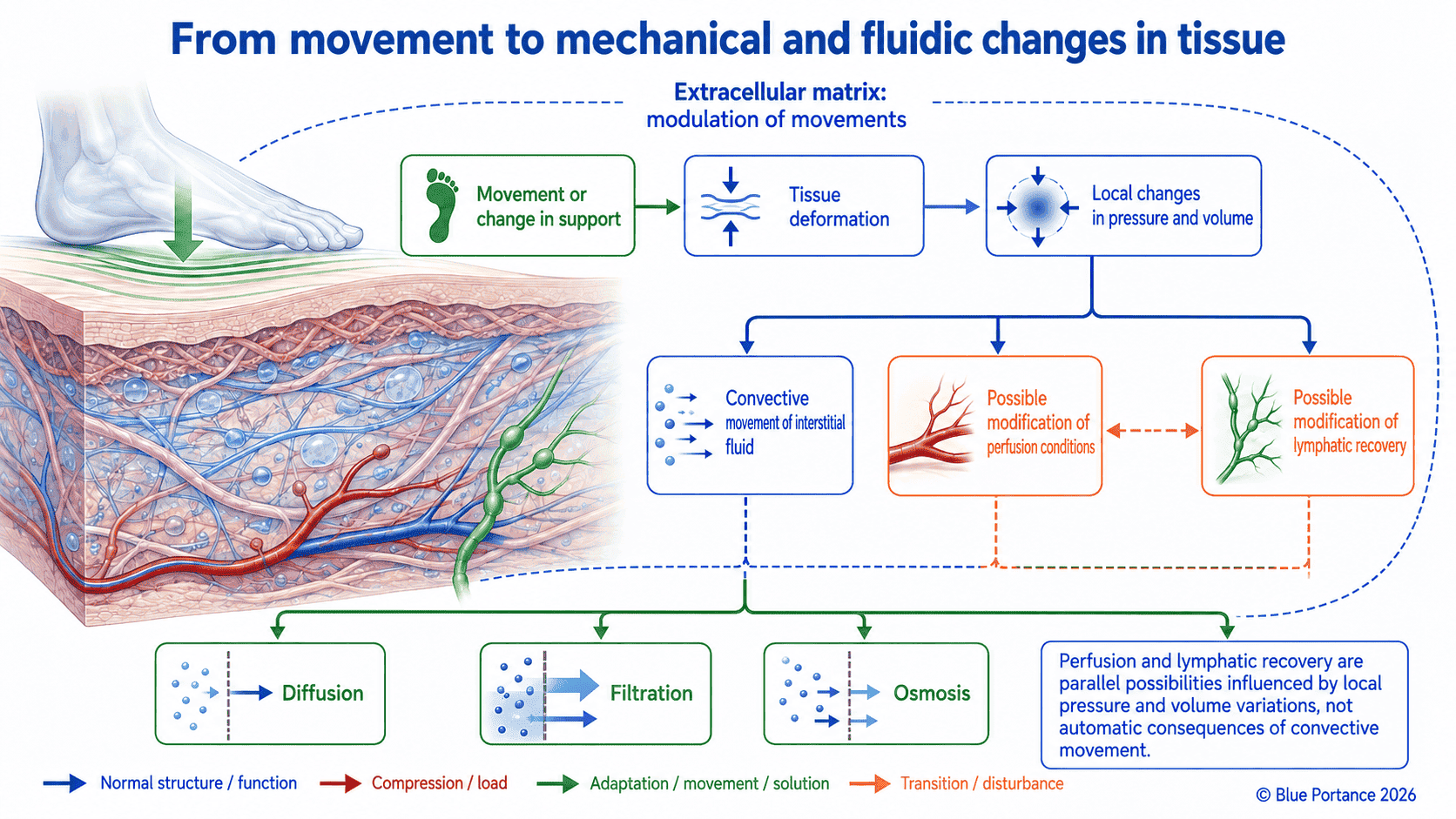
Movement or change in support → tissue deformation → local changes in pressure and volume → convective displacement of interstitial fluid and a possible change in the conditions of perfusion and lymphatic uptake.
When a deformation creates a pressure difference between two regions of a tissue, it can cause bulk movement of the fluid and the solutes it carries. In other words, this is convective transport.
This mechanism is different from diffusion, which results mainly from the individual movement of molecules driven by their thermal agitation and their concentration gradient.
Movement and deformation therefore do not replace diffusion. Instead, they can create or change the mechanical conditions under which diffusion and convection combine.
The extracellular matrix also influences this chain by offering variable resistance to the movement of fluid and solutes. In particular, its porosity, density, compliance and interactions with macromolecules partly determine the conditions for interstitial fluid mobility (Fan et al., 2014).
3. Muscle Contractions
Firstly, muscle contractions actively change the shape and volume of tissues. As a result, they can compress certain spaces, raise local pressure and push some of the fluid toward adjacent regions or along paths of least resistance.
In muscles, contraction and relaxation phases can also exert forces on lymphatic vessels. Lymphatics located within muscle tissue are indeed subject to the mechanical stresses of their surroundings and can be compressed or released as muscle fibers deform (Negrini & Moriondo, 2011).
Their effect, however, depends on:
- the intensity of the contraction;
- its duration;
- its frequency;
- the location of the muscle;
- the position of the body segment;
- the structure of the tissue;
- the state of the vascular and lymphatic networks.
Muscle contraction can therefore change local pressures and volumes, but it does not produce the same effect in every tissue.
4. Breathing Movements
Breathing movements are another source of mechanical variation.
During spontaneous inspiration:
- the diaphragm contracts and descends;
- thoracic volume increases;
- intrathoracic pressure decreases;
- abdominal pressure generally increases.
During expiration, these changes reverse.
Accordingly, this alternation changes the pressure gradients between the thorax, the abdomen, the great vessels and the surrounding tissues. It can thus influence venous return and certain mechanisms of lymph propulsion (Biais, 2016; Negrini & Moriondo, 2011).
Respiratory variations are not, however, an isolated mechanism. Rather, their effect depends on posture, breathing amplitude, tissue compliance, muscle activity and the properties of the vascular and lymphatic networks.
5. Lymphatic Uptake
In general, excess interstitial fluid and certain macromolecules are gradually collected by the lymphatic vessels.
The initial lymphatics form an entry interface, whose filling depends in particular on the pressure differences between the interstitium and their lumen, as well as on the deformation of their wall.
Further along the network, collecting lymphatic vessels have valves and can generate intrinsic contractions. Lymph propulsion therefore results from the combination of:
- forces exerted by the surrounding tissues;
- pressure gradients;
- breathing movements;
- vascular pulsations;
- the collecting vessels’ own contractions;
- valve function.
Indeed, Scallan et al. describe this combination of extrinsic and intrinsic forces as an essential component of lymphatic propulsion (Scallan et al., 2016).
Movement can therefore support lymphatic uptake, but its effect depends on the anatomical configuration, the tissue involved and the functional state of the lymphatic network.
6. Compression and Decompression
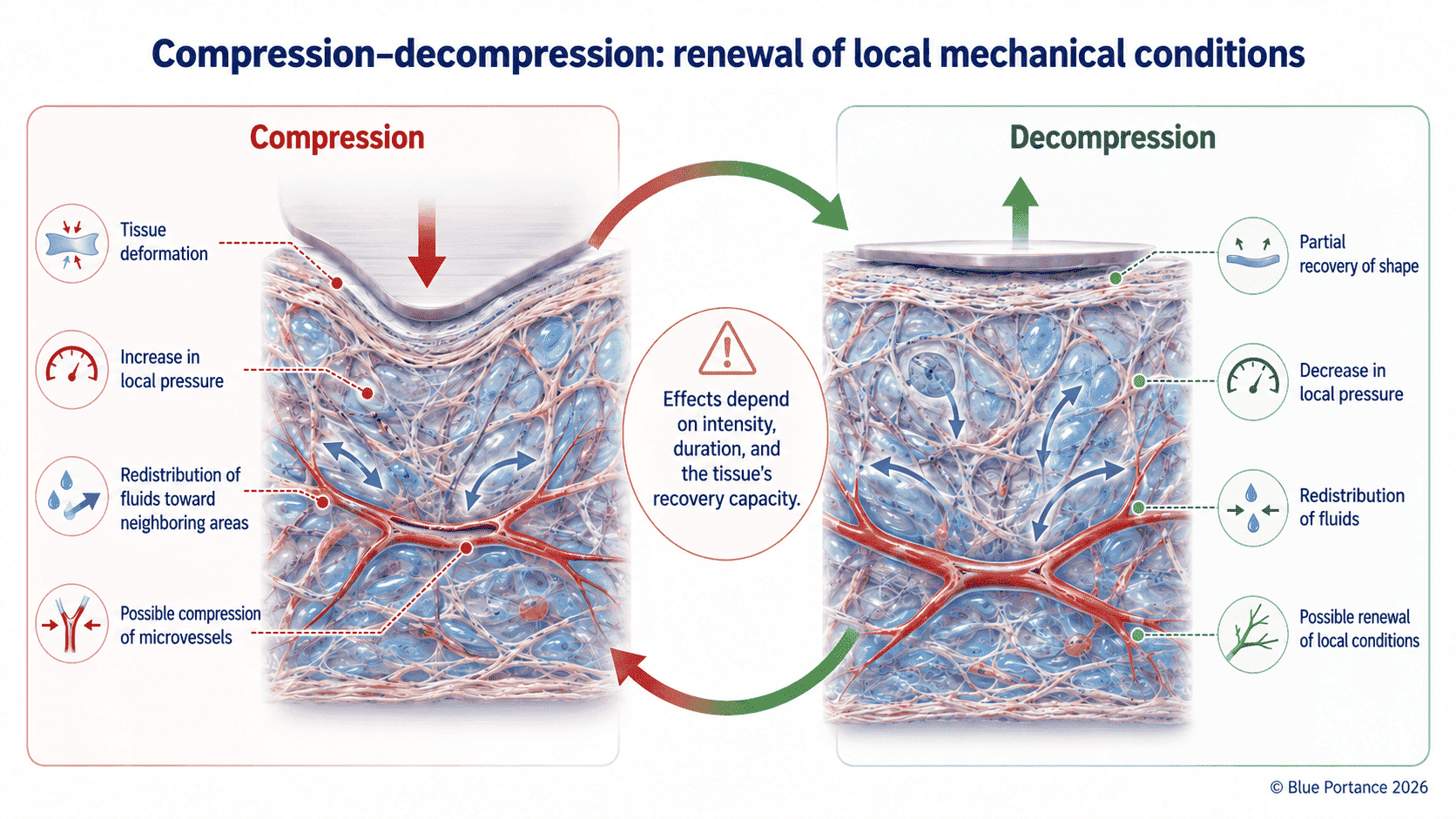
During compression, a local rise in pressure can push some of the fluid toward adjacent regions or along paths of least resistance.
During decompression, the drop in pressure and the partial recovery of tissue volume allow the fluid to redistribute. Repeating this cycle can renew local mechanical conditions, provided that the intensity of the load, its duration and the tissue’s capacity to recover remain compatible with its properties.
The effects may thus involve:
- soft-tissue deformation;
- interstitial pressure;
- water distribution;
- the pressure exerted on vessels;
- local perfusion conditions;
- the opportunities for fluid entry and uptake.
This alternation does not, however, amount to a complete emptying of the tissue, nor does it, on its own, guarantee a uniform increase in lymph flow or perfusion.
Moreover, tissues show time-dependent responses. For instance, they may fully or partially recover their shape after unloading, depending on the intensity, duration and mechanical history of the load (Lu & Wang, 2008).
7. The Four Levels of Interpretation
Given these points, the relationship between movement and exchange must be analyzed at several levels:
- Mechanical — Movement changes local deformation, pressure and volume.
- Fluidic — A pressure difference can then drive convective displacement of the fluid and the solutes it carries.
- Physiological — These variations can also influence certain conditions of perfusion and lymphatic uptake.
- Clinical — However, a benefit for pain, comfort or tissue health cannot be automatically inferred from these mechanisms.
This hierarchy thus prevents confusing an observed mechanical phenomenon with a demonstrated physiological effect, or a physiological effect with a clinical benefit.
8. Postural Micro-Movements
Micro-movements can also gradually change:
- the areas of peak pressure;
- the orientation of the pelvis;
- the contact surface;
- pressure gradients within deformable tissues;
- the activity of stabilizing muscles;
- the tension transmitted to the matrix and soft tissues.
In particular, they can interrupt the persistence of a compressive configuration and introduce local phases of lower load, even without full unloading.
The potential value of micro-movements therefore does not necessarily lie in their amplitude. Instead, it may lie in their ability to introduce variability:
- over time;
- in space;
- in the direction of mechanical stresses;
- in the distribution of support.
Of course, this variability does not, on its own, guarantee improved perfusion or lymphatic uptake. It does, however, offer a way to renew local mechanical conditions.
9. Active, Passive and Permitted Movement
To clarify, three situations need to be distinguished.
Active Movement
In this case, the person produces or controls the movement. They can initiate it, regulate its intensity, direct it and stop it according to the task and their perceptions.
Passive Movement
In contrast, the support or the environment changes the position without significant participation from the person. The effect then depends on the amplitude, the direction and the compatibility of the movement with the task.
Permitted Movement
Finally, between imposed immobility and imposed instability lies a third approach: a support that allows movement without constantly provoking it.
The person then retains the ability to:
- initiate their adjustments;
- regulate their intensity;
- direct them;
- stop them;
- adapt them to the task and to their perceptions.
This distinction matters, because a support that allows movement does not serve the same function as a support that imposes constant instability.
10. Application to Sitting
When sitting, the load is transmitted to the support through several body regions, notably the pelvis, the gluteal tissues and the back of the thighs.
Changes in posture can thus alter:
- the contact surface;
- the orientation of the pelvis;
- pressure distribution;
- tissue deformation;
- the activity of stabilizing muscles;
- local perfusion conditions.
For example, studies by Makhsous show that seat design and certain experimental pressure-relief maneuvers can change interface pressures and the perfusion measured in the gluteal tissues (Makhsous et al., 2007, 2012). However, these studies mainly address interface pressure and perfusion. Consequently, they do not directly measure interstitial transport or lymph flow, and they cannot isolate the specific role of spontaneous micro-movements.
The link with sitting should therefore be stated as follows: a seat that allows changes in configuration can alter local pressures, deformations and volumes, and thereby renew certain mechanical conditions of exchange.
Similarly, the potential value of such a seat does not necessarily lie in large movements. Rather, it may lie in the possibility of not holding the same combination of load, direction and support area for long periods.
11. Key Takeaways
In summary, movement contributes to tissue exchange through an identifiable mechanical and fluidic chain:
movement → deformation → changes in pressure and volume → convective displacement of interstitial fluid and a possible change in the conditions of perfusion and lymphatic uptake.
It is, however, integrated with other mechanisms:
- diffusion;
- filtration;
- convection;
- osmosis;
- vascular pulsations;
- breathing;
- intrinsic lymphatic activity.
Movement therefore does not replace these mechanisms. Instead, it can change the conditions under which they occur.
Article Summary
In short, movement is a modulator of tissue exchange. Specifically, by changing local pressures, deformations and volumes, it can contribute to the displacement of interstitial fluid, influence certain perfusion conditions and may contribute to lymphatic uptake.
Furthermore, muscle contractions, breathing, vascular pulsations and changes in support act at different scales. Their effect depends on the intensity, duration, frequency and direction of the movement and on the properties of the tissue involved.
When sitting, then, the goal is not to provoke constant movement. It is to preserve the possibility of changing configuration, so as to renew the spatial, temporal and directional conditions of mechanical stress.
A functional seat can thus be designed as a support that allows movement without imposing it, leaves the person in control of their adjustments, and avoids needlessly maintaining the same mechanical configuration.
Scientific References
Tissue Mechanics and the Extracellular Matrix
- Fan, D., Creemers, E. E., & Kassiri, Z. (2014). Matrix as an interstitial transport system. Circulation Research, 114(5), 889–902. https://doi.org/10.1161/CIRCRESAHA.114.302335
- Lu, Y., & Wang, W. (2008). Interaction between the interstitial fluid and the extracellular matrix in confined indentation. Journal of Biomechanical Engineering, 130(4), 041011. https://doi.org/10.1115/1.2939310
- Reed, R. K., & Rubin, K. (2010). Transcapillary exchange: role and importance of the interstitial fluid pressure and the extracellular matrix. Cardiovascular Research, 87(2), 211–217. https://doi.org/10.1093/cvr/cvq143
- Wiig, H., & Swartz, M. A. (2012). Interstitial fluid and lymph formation and transport: physiological regulation and roles in inflammation and cancer. Physiological Reviews, 92(3), 1005–1060. https://doi.org/10.1152/physrev.00037.2011
Muscle Contraction, Breathing and Lymphatic Function
- Biais, M. (2016). Interactions cardiopulmonaires. Medical training material, CHU de Bordeaux. https://reanesth.chu-bordeaux.fr/Congr%C3%A8s-et-s%C3%A9minaires/Cours-europ%C3%A9ens-du-grand-Sud-Ouest/2016/Textes/Interactions-cardiopulmonaires-M-Biais.pdf/
- Negrini, D., & Moriondo, A. (2011). Lymphatic anatomy and biomechanics. The Journal of Physiology, 589(Pt 12), 2927–2934. https://doi.org/10.1113/jphysiol.2011.206672
- Scallan, J. P., Zawieja, S. D., Castorena-Gonzalez, J. A., & Davis, M. J. (2016). Lymphatic pumping: mechanics, mechanisms and malfunction. The Journal of Physiology, 594(20), 5749–5768. https://doi.org/10.1113/JP272088
Sitting, Interface Pressure and Perfusion
- Makhsous, M., Priebe, M., Bankard, J., et al. (2007). Measuring tissue perfusion during pressure relief maneuvers: insights into preventing pressure ulcers. The Journal of Spinal Cord Medicine, 30(5), 497–507. https://doi.org/10.1080/10790268.2007.11754584
- Makhsous, M., Lin, F., Hanawalt, D., Kruger, S. L., & LaMantia, A. (2012). The effect of chair designs on sitting pressure distribution and tissue perfusion. Human Factors, 54(6), 1066–1074. https://doi.org/10.1177/0018720812457681
