


1. Force, Stress and Deformation
A force is a mechanical action exerted on a body. In biomechanics, however, the overall force must be distinguished from the stress actually applied to the tissue.
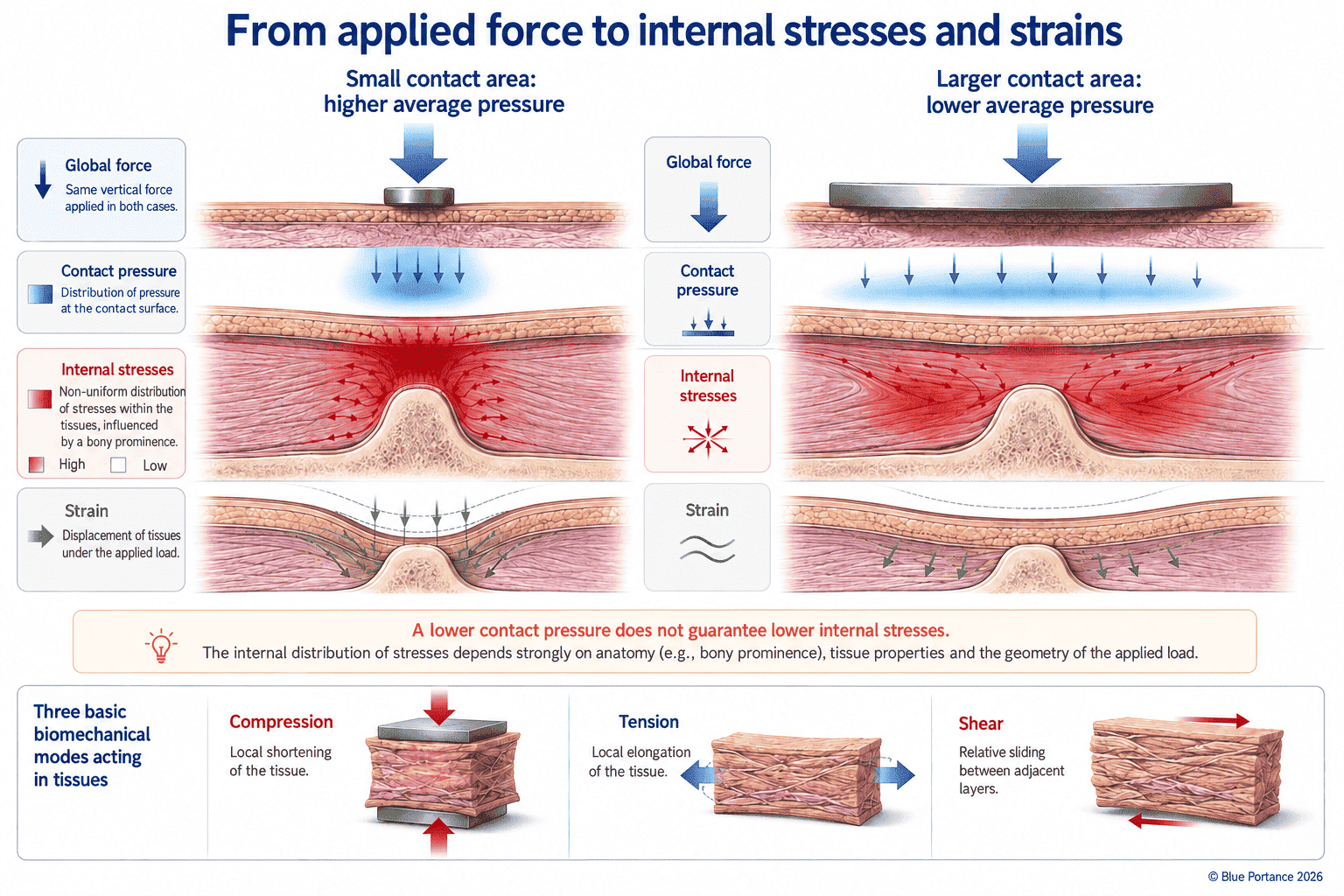
Specifically, mechanical stress describes the intensity of internal forces per unit area. It can be normal to that surface — in compression or tension — or tangential, in the case of shear. At the interface with a support surface, a force distributed over a smaller area generally produces a higher average pressure. This measurement, however, is not enough to describe all the internal stresses within the tissue.
This clarification avoids confusing:
- the pressure measured at the interface;
- internal mechanical stress;
- the overall force.
Deformation, on the other hand, describes the change in shape or dimension produced by the load. It can involve:
- compression;
- tension;
- shear;
- torsion;
- elongation;
- relative displacement between several tissue planes.
A tissue can therefore bear a large force without experiencing the same stress in all of its regions. This is because geometry, the support surface, fiber orientation and the interfaces between tissues all influence the distribution of stresses.
This distinction is essential in sitting, because total body weight alone is not enough to describe the stresses borne by the gluteal and pelvic tissues or by the tissues at the back of the thigh.
2. Compression, Tension and Shear
Compression
To begin with, compression tends to bring the components of a tissue closer together and to alter its shape or thickness. In highly hydrated tissues, the apparent decrease in volume depends in particular on whether the fluid is able to move. In the short term, a large part of the response may therefore take the form of deformation and pressure redistribution, rather than an immediate reduction in total volume. Compression can also alter:
- tissue thickness;
- interstitial pressure;
- water distribution;
- local perfusion;
- the relationships between different tissue planes.
Overall, the response depends on the amount of fluid, the extracellular matrix, cell density and the structure of the tissue.
Tension
Tension, conversely, tends to pull the components of the tissue apart. As a result, it places particular demand on collagen fibers and anchoring structures.
Moreover, depending on fiber orientation, tension can be transmitted in very different ways in a tendon, a ligament, a fascia or the skin.
Shear
Finally, shear corresponds to a relative displacement of parallel layers or planes. It can occur when a surface remains fixed while the tissues move, or when one part of the body slides relative to another.
Shear is important at support interfaces, because it can produce internal deformation without being fully detected by a surface pressure measurement.
In addition, the internal stresses that develop in prolonged postures can combine compression, shear and deformation, particularly near bony prominences (Gefen et al., 2012).
3. A Load Is Not Evenly Distributed
How a load is distributed depends on the geometry of the contact, the properties of the support surface and the shape of the tissues.
A load is described as localized when it acts on a small area or around a zone of high concentration. In contrast, it is described as distributed when the same force is spread over a larger area.
Load distribution depends in particular on:
- contact area;
- the curvature of the interfaces;
- the relative stiffness of the support surface and the tissues;
- soft-tissue thickness;
- the presence of bony prominences;
- posture;
- the possibility of movement.
Seat design and the materials used therefore influence the distribution of interface pressures. They also influence certain perfusion indicators in the gluteal region (Makhsous et al., 2012).
An average pressure measurement can, however, mask more complex internal stresses. In other words, a moderate surface pressure does not necessarily rule out larger deformations or shear in the deep tissues.
4. Tissues as Viscoelastic Materials
Living tissues generally behave neither as perfectly elastic solids nor as perfectly viscous liquids.
A perfectly elastic material recovers its shape immediately once the load is removed. In contrast, a perfectly viscous material retains a deformation linked to flow or internal displacement. Biological tissues, however, often display intermediate behavior: they are viscoelastic.
In other words, their response depends on:
- the intensity of the load;
- the duration of application;
- the rate of deformation;
- the mechanical history of the tissue;
- composition;
- temperature and hydration.
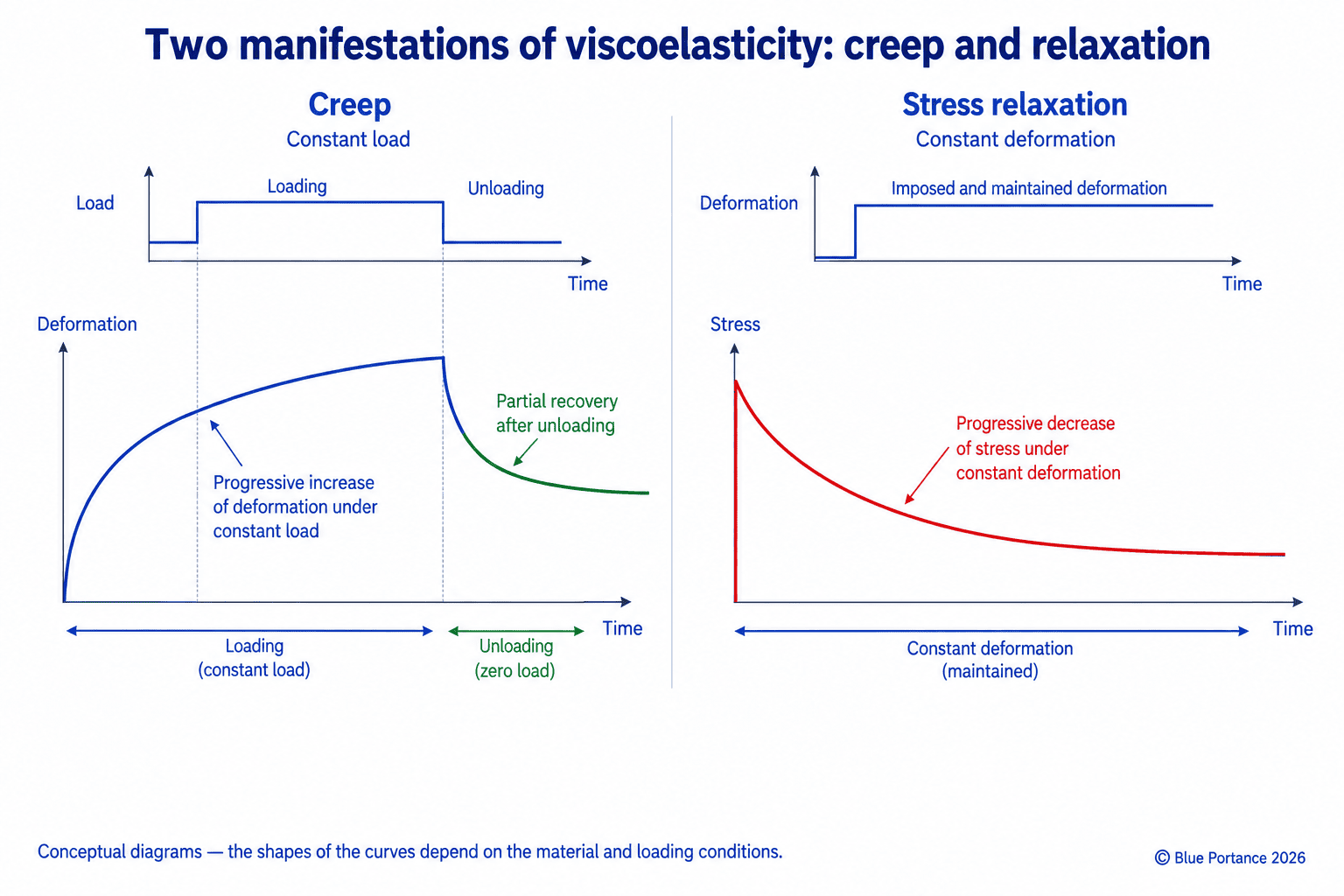
Viscoelasticity shows up in particular as creep and relaxation.
Creep
Creep is a progressive increase in deformation when a constant load is sustained.
Relaxation
Conversely, relaxation is a progressive decrease in stress when the deformation is held constant.
These phenomena explain why a constant load does not necessarily produce a constant response over time. The measured force may decrease, while the deformation of the tissue continues or is redistributed.
5. The Role of Water and Poroelasticity
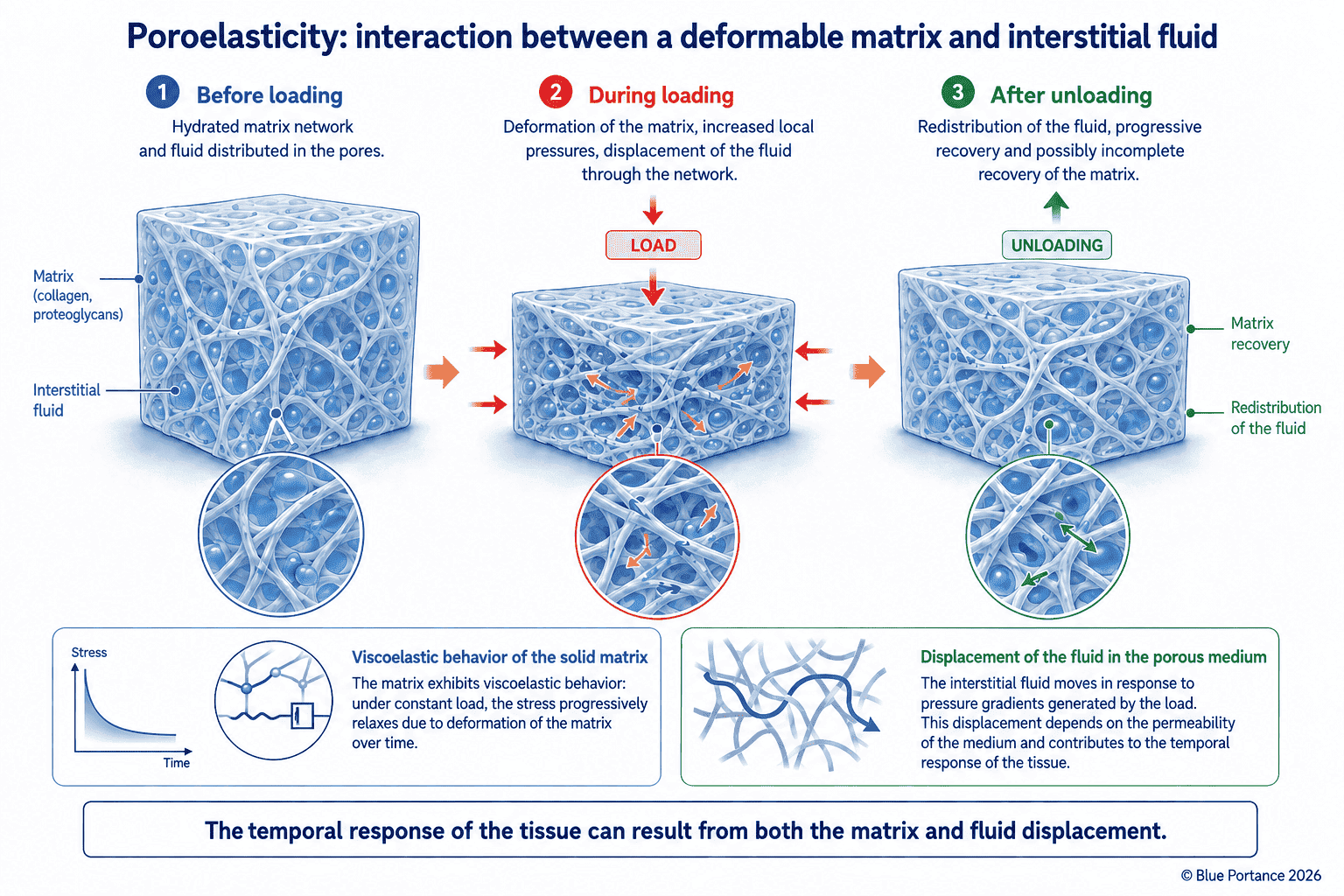
Some tissues can be described as biphasic media, made up of a solid phase and a fluid phase. Their mechanical response then depends both on the deformation of the matrix and on the movement of the fluid it contains.
More specifically, poroelasticity refers to the behavior of a porous medium saturated with fluid. When a load is applied, the fluid can move through the network and contribute to the overall response of the tissue.
In hydrated tissues, two phenomena can therefore contribute to the time-dependent response:
- the intrinsic viscoelasticity of the matrix;
- the movement of fluid through the porous network.
When these two contributions are considered together, the behavior is described as poroviscoelastic. The time-dependent response then results both from the viscous properties of the solid phase and from fluid exchange through the porous medium. These contributions can produce similar changes over time, but they correspond to distinct mechanisms.
Mak’s work demonstrates this for the compression of hydrated viscoelastic tissues. In particular, interstitial fluid flow can contribute to mechanical dissipation. The viscoelastic properties of the matrix also contribute to it, as well as to relaxation behavior (Mak, 1986).
Poroelasticity does not mean that all fluid movement is beneficial. Instead, it describes a mechanical coupling between the solid phase and the liquid phase.
6. Transmission, Storage and Dissipation of Energy
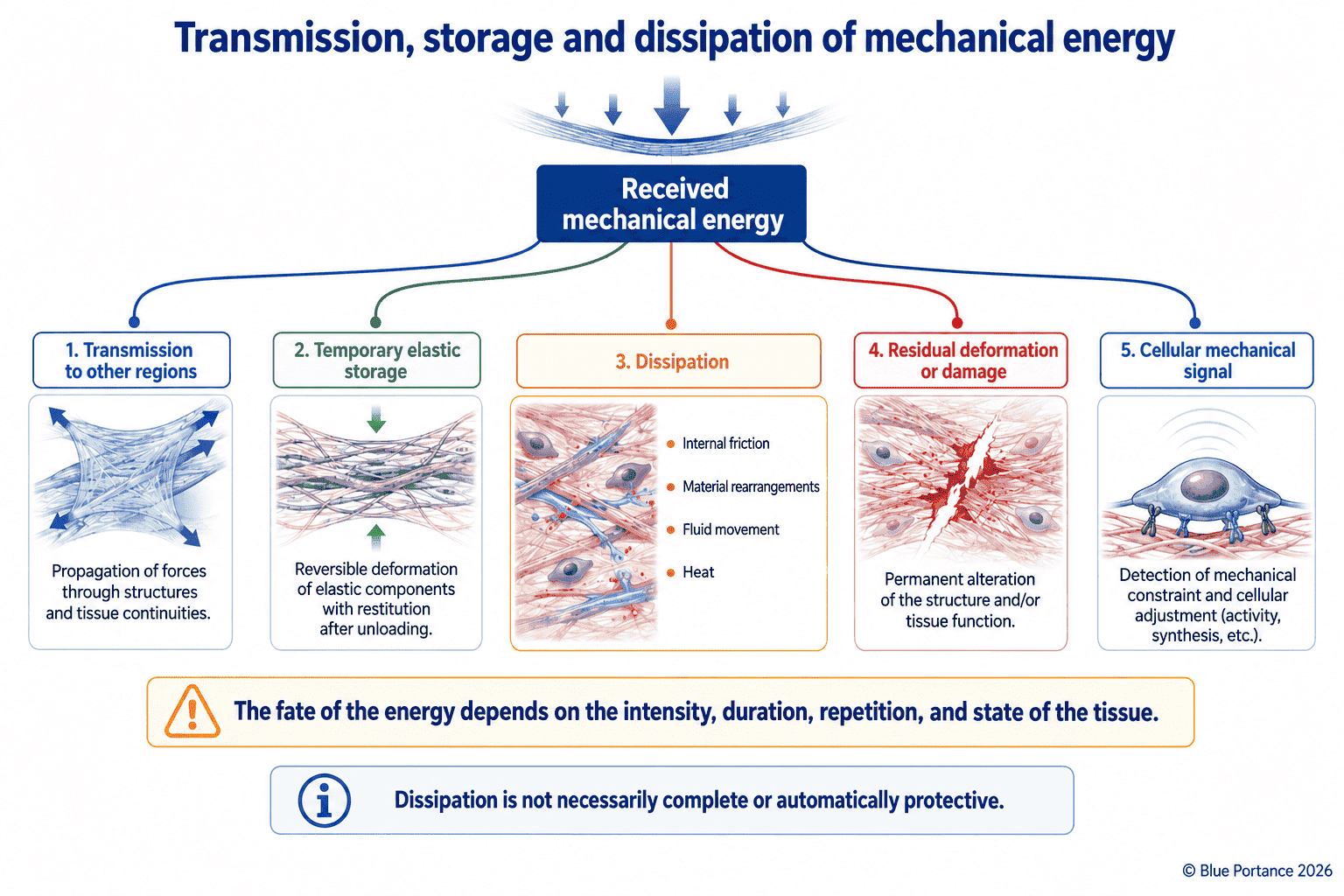
When a force is applied to a tissue, the mechanical energy it receives may be:
- transmitted to other regions;
- temporarily stored as elastic deformation;
- dissipated as heat and internal friction;
- taken up in the movements and pressure gradients of the fluid phase;
- used to produce irreversible deformation;
- converted into mechanical signals sensed by cells.
A tissue therefore does not necessarily return all the energy it receives. Part of it may be dissipated through:
- friction between components;
- fluid movement;
- rearrangements of the matrix;
- internal reorganizations and interactions among the components of the matrix;
- relative movements between fibers and cells.
This dissipation can limit the immediate return of energy and alter how mechanical loads propagate. It is not, however, necessarily protective. Depending on its intensity, its repetition and the condition of the tissue, it may also be accompanied by local heating, residual deformation or damage. Repeated or excessive loading can thus lead to an accumulation of deformation and damage.
The relationship between load, deformation and energy therefore depends on time and on the condition of the tissue.
7. Why Duration and Rate Matter
The same overall load can produce different effects depending on how long it is applied.
For example, a brief load can generate transient deformation, with partial or complete recovery. Conversely, a sustained load can cause creep, fluid redistribution and an increase in local deformation.
The rate of application also plays a role. Tissues can respond differently to a rapid load and to a slow one, because the mechanisms of relaxation and fluid movement do not have time to develop in the same way.
Studies on deep tissue injury show that the magnitude of deformation and the duration of exposure interact in producing damage. In particular, a large local deformation can cause rapid injury. A less intense but prolonged load can also become harmful (Gefen et al., 2012).
It is therefore a mistake to look for a single pressure threshold that would apply to every individual and every situation.
8. Continuous Loading and Alternating Loading
Continuous loading keeps the same region under relatively constant mechanical conditions. In contrast, alternating loading periodically changes the intensity, direction or location of the load.
This alternation can:
- shorten the exposure time of a given area;
- redistribute stresses;
- alter internal deformations;
- allow partial recovery;
- renew pressure and perfusion conditions.
However, alternation is not automatically protective. Instead, its effect depends on the amplitude, the frequency, the duration of the unloading phases and the condition of the tissue.
For example, an experimental study published in 2010 shows that deformation-induced muscle damage depends on the time history of loading. In particular, it indicates that a brief intermediate unloading period is not necessarily enough to prevent the cumulative effects of two phases of prolonged loading (Ceelen et al., 2010).
Mechanical variability should therefore be assessed according to its actual ability to change tissue conditions, not merely by the fact that it exists.
9. From Mechanical Stress to Biological Response
Cells are sensitive to the mechanical properties of their environment. For instance, a deformation can alter membrane tension, cytoskeletal organization, adhesions and certain signaling pathways.
This conversion of mechanical stress into a biological response is known as mechanotransduction. It will be discussed in article A8.
This article (A7) must nevertheless establish an essential distinction:
- mechanical stress: a physical event;
- deformation: the tissue’s response;
- mechanical signaling: the cellular response;
- biological adaptation: a functional or structural change over time.
Specifically, mechanical transmission can extend from the extracellular matrix to integrins, focal adhesions and the cytoskeleton. The cytoskeleton, in particular, is connected to the nuclear envelope by the LINC complex, which allows certain forces and deformations to reach the lamina and chromatin. The mechanisms by which this mechanical continuity alters nucleocytoplasmic exchange and the expression of certain genes will be examined in A8 (Kirby & Lammerding, 2018).
These levels must therefore not be confused. For example, a measured force alone does not allow one to infer the cellular response or the clinical benefit.
10. What This Means for Sitting
When sitting, the body transfers part of its weight to the support surface. This transmission then depends on the geometry of the seat, posture, soft tissues, bony prominences and the person’s movements.
As a result, the same overall load can be distributed differently depending on:
- the support area;
- seat depth and width;
- material stiffness;
- the shape of the pelvis;
- trunk orientation;
- contact with the backrest;
- pelvic movements;
- sliding or shear.
Studies on pressure distribution confirm this. Indeed, seat design and materials alter interface pressures and certain perfusion indicators (Makhsous et al., 2012).
Tissue deformation models also suggest marked heterogeneity of internal stresses. This applies especially to areas near bony prominences, as well as to deep tissues (Gefen et al., 2012; Chen et al., 2022).
One should nevertheless avoid concluding that high pressure necessarily causes injury, or that lower pressure guarantees a favorable response. Duration, deformation, shear, perfusion, tissue condition and the ability to reposition also play a role.
11. Key Takeaways
The effects of a mechanical load do not depend solely on its magnitude.
They also depend on:
- the area over which it acts;
- location;
- orientation;
- duration;
- rate of application;
- repetition;
- the tissue’s capacity to transmit, dissipate or recover from deformation.
The question, then, is not only which force is applied. We also need to know where, over what area, for how long, at what rate and with what possibility of variation.
Overall, this framing connects tissue mechanics to the question of seating, without reducing the analysis to interface pressure alone.
Article Summary
In short, living tissues transmit, distribute, store and dissipate the forces they receive. Their response depends on their composition, hydration, architecture, viscoelasticity, poroelasticity and mechanical history.
Localized loading, distributed loading, continuous loading and alternating loading therefore do not necessarily produce the same effects. Likewise, duration and rate of application can alter deformation, relaxation, fluid movement and energy dissipation.
Consequently, in sitting, the analysis must go beyond the pressure measured at the interface. It must also take into account internal stresses, shear, tissue deformation, duration of exposure and the opportunities for changing configuration.
A functional seat should therefore do more than reduce a peak pressure value. In addition, it should help prevent the lasting concentration of stresses and leave room for an appropriate redistribution of loads.
Scientific References
Mechanics and Rheology of Living Tissues
- Fung, Y. C. (1993). Biomechanics: Mechanical Properties of Living Tissues. 2nd ed. New York: Springer.
- Humphrey, J. D., & Delange, S. L. (2004). Structure and Mechanics of Biological Tissues. New York: Springer.
- Mak, A. F. (1986). Unconfined compression of hydrated viscoelastic tissues: a biphasic poroviscoelastic analysis. Biorheology, 23(4), 371–383. https://doi.org/10.3233/BIR-1986-23406
- Sowinski, D. R., McGarry, M. D. J., Van Houten, E. E. W., et al. (2021). Poroelasticity as a model of soft tissue structure. Frontiers in Physics, 8, 617582. https://doi.org/10.3389/fphy.2020.617582
Internal Stresses, Deformation and Tissue Injury
- Ceelen, K. K. M., Stekelenburg, A., Loerakker, S., et al. (2010). Temporal effects of mechanical loading on deformation-induced muscle damage. Wound Repair and Regeneration. https://pubmed.ncbi.nlm.nih.gov/20232152/
- Chen, Y., Shen, Y., Wang, K., Qi, Y., Niu, W., & Wang, Y. (2022). Mechanical analysis of deep tissue injury during sitting in patients with spinal cord injury via parametric finite element model. Biomechanics and Modeling in Mechanobiology, 21(5), 1573–1584. https://doi.org/10.1007/s10237-022-01607-z
- Gefen, A., et al. (2012). Deformations, mechanical strains and stresses across the different hierarchical scales in weight-bearing soft tissues. Journal of Tissue Viability, 21(2), 39–46. https://pubmed.ncbi.nlm.nih.gov/22520396/
Sitting, Seat Design and Mechanotransduction
- Kirby, T. J., & Lammerding, J. (2018). Emerging views of the nucleus as a cellular mechanosensor. Nature Cell Biology, 20(4), 373–381. https://doi.org/10.1038/s41556-018-0038-y
- Makhsous, M., Lin, F., Hanawalt, D., Kruger, S. L., & LaMantia, A. (2012). The effect of chair designs on sitting pressure distribution and tissue perfusion. Human Factors, 54(6), 1066–1074. https://doi.org/10.1177/0018720812457681
