


1. From Fixed Seating to an Adaptable Interface
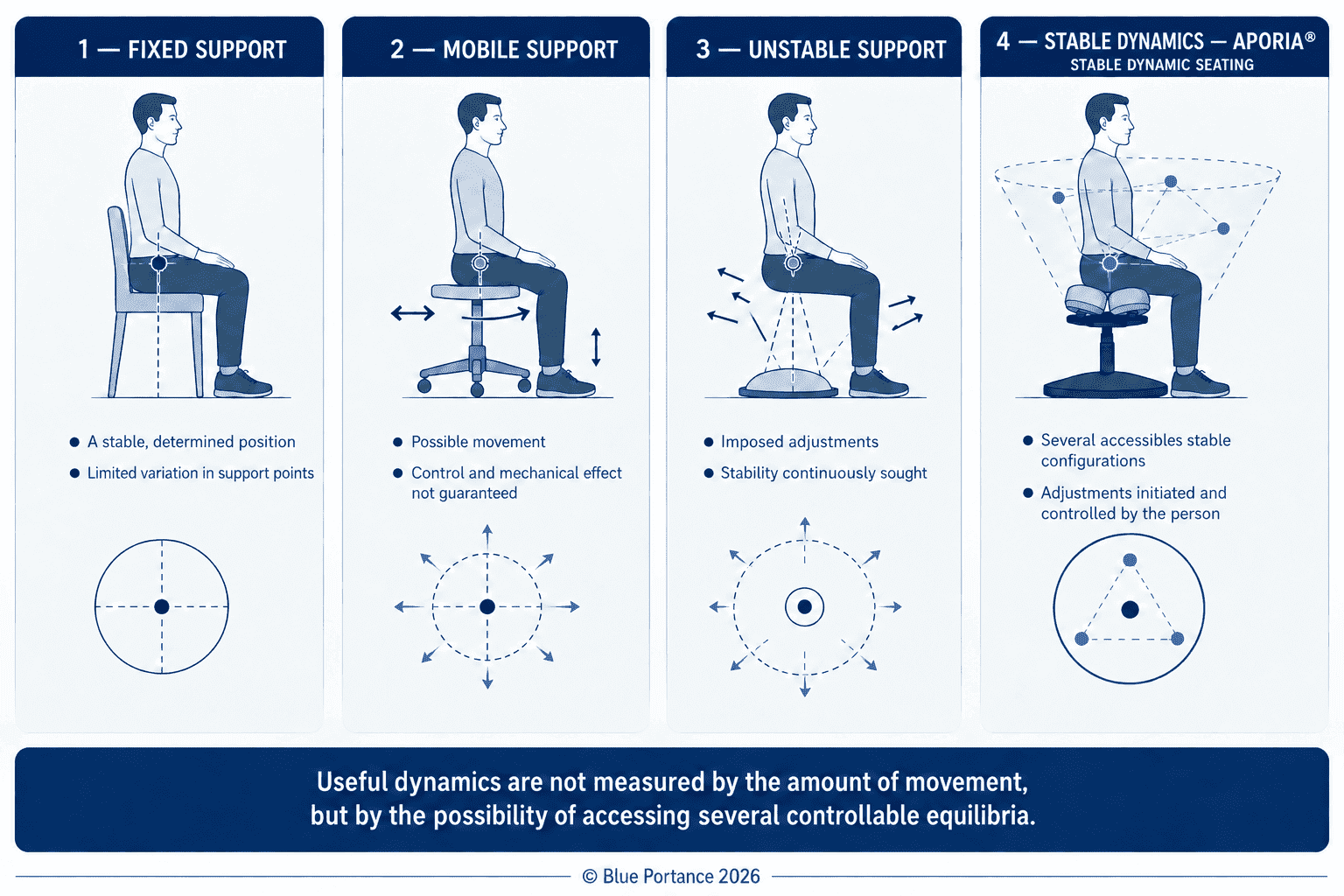
A fixed seat provides a support geometry that does not change as the pelvis moves. As a result, the person must find successive points of balance on their own, by adapting their posture or by creating support bridges.
Of course, this fixed geometry can provide a predictable base for certain tasks. However, each balance point achieved remains tied to holding a particular posture, and it becomes unsustainable over time when that posture locks the same body configuration and the same weight-bearing areas in place for long periods.
In contrast, stable dynamic seating seeks neither to immobilize the person in a balanced posture nor to impose constant instability. Instead, it gives them access to several controllable balance configurations, compatible with the task and with their spontaneous adjustments.
- Static sitting — A fixed support geometry that forces the person to seek, one after another, postural balance points that are precarious and unsustainable over time.
- Aporia® stable dynamic seating — A range of accessible, controllable balance configurations within a cone of balance, preserving independent mobility of the right and left hips and, when the feet contribute to support, of the right and left ankles.
- Unstable dynamic seating — Immobilizes or couples these same regulators, preventing their differentiated adjustments, regardless of whatever movements or corrections the support otherwise imposes.
The essential distinction, then, is not between immobility and mobility, but between preserving and immobilizing the regulators of human balance — the hips and the ankles.
2. What Does “Dynamic Sitting” Mean?
The term “dynamic sitting” is used in the literature and in the marketplace for very different kinds of support. The SBNFA™ framework, however, distinguishes stable dynamic seating — which preserves independent mobility of the right and left hips and, when the feet contribute to support, of the right and left ankles, and thereby gives access to several controllable balance configurations — from unstable dynamic seating, which immobilizes or couples these same regulators, preventing their differentiated adjustments, regardless of whatever movements the support otherwise produces or imposes.
For example, this variation may involve backrest recline, seat pan orientation, pelvic displacement, the articulation of certain components or the redistribution of weight-bearing areas.
Dynamic character does not depend solely on the range of movement, however. A small-amplitude variation can gradually alter pressures and deformations if it changes the location, direction or duration of loading.
Conversely, a large but imposed movement may not be functional if it disrupts the task, increases muscular effort or reduces the sense of security.
The relevant question, therefore, is not only: does the seat move? It is also: is the movement controllable, useful, compatible with the task and capable of changing local mechanical conditions?
3. What a Change in Support Does Mechanically
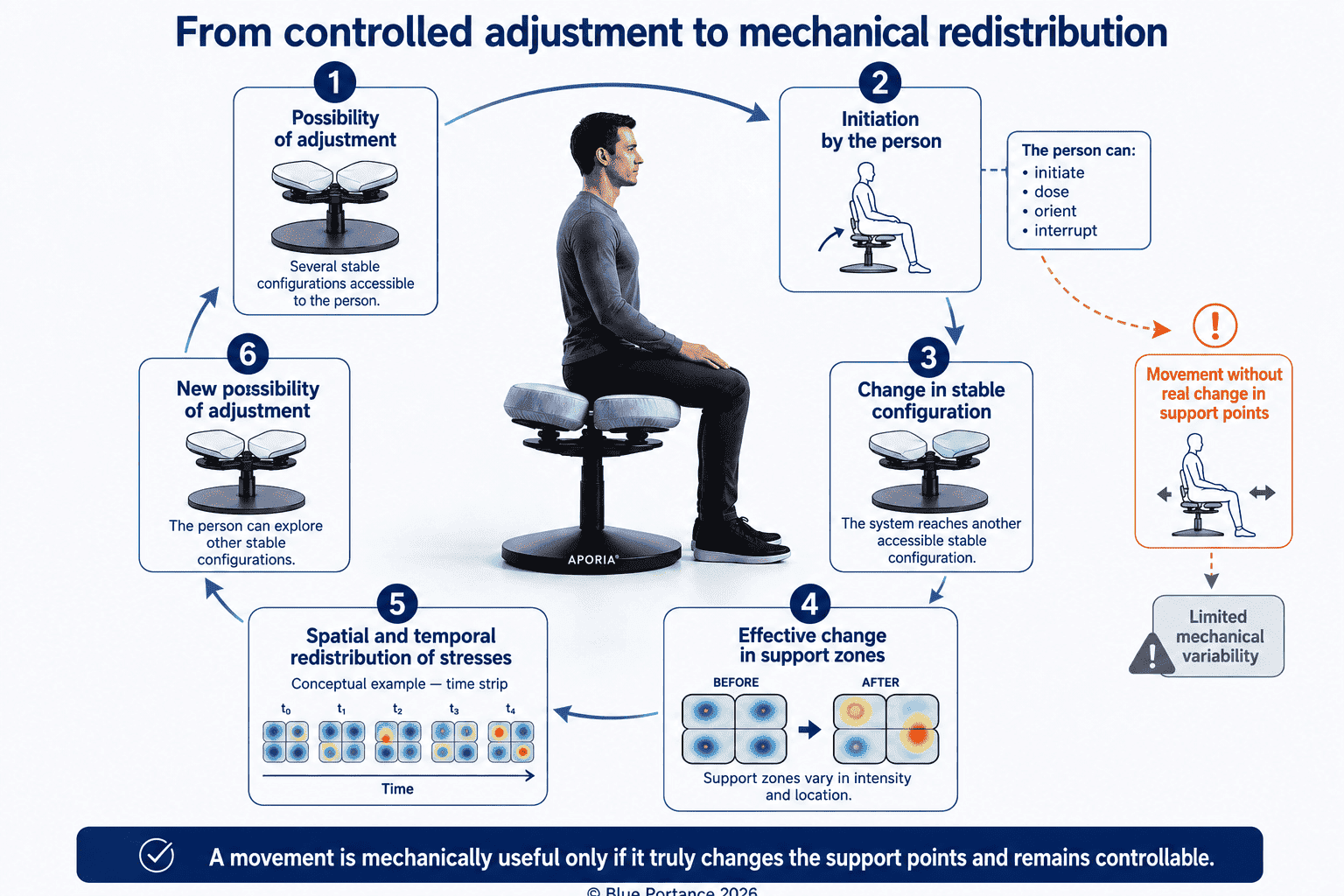
A change in configuration can simultaneously alter the contact surface, the location of peak pressures, the direction of forces and tissue deformation. It can also shift certain compressive or shear loads and change the demand placed on stabilizing muscles.
However, these effects do not necessarily amount to an overall reduction in mechanical stress. Indeed, a load reduced in one region may be transferred to another.
Backrest recline, pelvic rotation or a change in thigh support can thus redistribute the load without eliminating it. The effect depends on the geometry of the support, the person’s posture and the properties of the tissues.
For example, in a study of chair articulations, changes in seat pan and backrest angle altered pressure distribution and certain perfusion indicators under the conditions studied (Scott & Bush, 2022).
This observation therefore shows that dynamic sitting should be analyzed as a spatiotemporal redistribution of mechanical stresses, not simply as a universal reduction in pressure.
4. Interface Pressure and Perfusion
Interface pressure is a useful indicator for studying the relationship between the body and the support. On its own, however, it is not enough to determine the state of deep tissues.
Studies by Makhsous et al. show that chair design and the materials used can alter pressure distribution and certain perfusion indicators in the buttock region and the thighs (Makhsous et al., 2012).
In a study of people with spinal cord injury and able-bodied controls, Makhsous et al. (2007) also compared a usual sitting position with several pressure-relief maneuvers. Momentary pressure relief did not necessarily guarantee complete and immediate recovery of perfusion (Makhsous et al., 2007).
These findings make it possible to distinguish several levels:
- a seat can alter interface pressure;
- a change in pressure may be associated with a change in perfusion;
- measured perfusion does not capture the entire tissue response;
- a laboratory effect does not automatically constitute a general clinical benefit.
In the study by Makhsous et al. (2012), conducted with fifteen young, healthy women, all five chair designs tested altered pressure distribution and certain perfusion indicators. However, the short duration of the trials and the characteristics of this population do not allow these results to be generalized to all people or to all sitting situations.
5. Mechanical Alternation
Dynamic seating can allow alternation between several support configurations.
In particular, this alternation can change how long a given area is exposed, the direction of forces, the location of peak stresses and tissue deformation.
It can also change the tension transmitted to muscles and to the extracellular matrix. Its effect, however, depends on several parameters: the range of movement, the frequency of changes, the duration of each phase, the location of the off-loaded areas and the time available for recovery.
For instance, a study of a dynamic tuberal support examined alternating loading under the ischial tuberosities along with perfusion measurements in superficial and subcutaneous tissues. Under the experimental conditions studied, adjustments of the support altered the load under the ischial areas and were associated with changes in local blood supply (van Geffen et al., 2010).
This study documents the principle of dynamic redistribution. However, it does not allow its findings to be generalized to all seating, all populations or all forms of mobility.
This type of support involves movement produced by the device, not movement permitted to the person: it is a useful mechanism to understand, but it is not the model this article adopts as its reference.
6. Micro-Movements and Adaptable Variability
Micro-movements can gradually shift the areas of peak pressure, the orientation of the pelvis, the distribution of support and the tension transmitted to tissues.
They can also reduce, shift or temporarily interrupt certain local compressions. A small-amplitude adjustment can therefore have a mechanical effect when it actually changes the location or direction of loading.
The potential value of micro-movements does not necessarily lie in their amplitude. Instead, it may lie in their ability to introduce variation in the timing, location and direction of mechanical stresses.
This variability alone does not guarantee improved perfusion or comfort. It may, however, help avoid prolonged maintenance of the same combination of pressure, deformation and shear, when it genuinely changes the loaded areas.
Useful dynamics are therefore defined not by the amount of movement produced, but by the actual possibility of varying mechanical configurations.
7. Active, Passive and Permitted Movement
Three modes of mobility need to be distinguished.
Active Movement
The person produces the movement and can control its range, direction, duration and when it stops.
Passive Movement
In this case, the support changes the body’s configuration without significant participation from the person. This movement can redistribute loads, but it can also disrupt the task or increase the effort needed to stabilize the body. In the SBNFA™ framework, a support that produces movement in place of the person falls under imposed dynamics: it is not enough to establish the presence of adaptable variability.
Permitted Movement
Between imposed immobility and imposed instability lies a third approach: a support that allows movement without constantly provoking it.
In the approach advocated here, adaptable seating does not move the person for them: it leaves them room to act and explore. The person then retains the ability to initiate, modulate, direct or stop their adjustments according to the task and their own perceptions.
This notion of permitted movement is the original core of A11.
8. Adaptable Stability vs. Imposed Instability
In the approach advocated here, adaptable seating provides a sufficiently predictable base of support while allowing certain changes in configuration.
It does not seek to make the body unstable. Rather, it seeks to offer controllable mobility, compatible with precision, safety and the task. In the sense of the SBNFA™ framework, a seat is stable when it preserves independent mobility of the right and left hips and, when the feet contribute to support, of the right and left ankles; it becomes unstable as soon as it immobilizes or couples these regulators, preventing their differentiated adjustments.
In contrast, imposed instability can increase muscle activity, attentional demand and postural corrections. It can also reduce the sense of security or disrupt work.
Conversely, permitted mobility lets the person decide when movement is appropriate. The person can hold a configuration while it suits them, then change it when another configuration becomes more comfortable or mechanically preferable.
This distinction matters when analyzing “active sitting” solutions and the associated workstations. Indeed, the available literature remains heterogeneous and does not support the conclusion that all active solutions produce the same effects (Pearse et al., 2024).
9. What the SBNFA™ Framework Confirms
Blue Portance’s SBNFA™ framework names what the preceding sections have just described. Static seating imposes a succession of precarious balance points that are unsustainable over time. Stable dynamic seating preserves independent mobility of the right and left hips and, when the feet contribute to support, of the right and left ankles — in the Aporia® sense, this makes several controllable balance configurations accessible within a cone of balance: this is the adaptable stability and the permitted movement defined above. Conversely, a seat becomes unstable as soon as it immobilizes or couples these regulators, preventing their differentiated adjustments: this is the imposed instability described in Section 8.
A fixed seat (Section 1) does not freeze the person in place: it forces them to find successive points of balance on their own — leaning the trunk, resting an elbow, bracing against the desk. Each of these balance points remains precarious and unsustainable over time, because holding it locks in a single configuration. Outside exceptional configurations of structural self-stabilization, human postural balance never freezes: it is continuously regulated.
Permitted movement (Section 7) and adaptable stability (Section 8) describe the SBNFA™ response to this demand: preserving independent mobility of the right and left hips and, when the feet contribute to support, of the right and left ankles, by making several controllable balance configurations accessible within a cone of balance. Conversely, movement produced by the support rather than directed by the person — the passive movement of Section 7, the imposed instability of Section 8 — immobilizes or couples these same regulators, preventing their differentiated adjustments: it adds a compensatory load without providing that access.
It is this three-way classification — static sitting, stable dynamic seating, unstable dynamic seating — that this framework uses to evaluate any seating, including seating presented as “active” or “dynamic” in the literature.
10. Individual Variation in Response
The response to dynamic seating depends in particular on anatomy, body mass, soft-tissue thickness, pelvic mobility, trunk control, sensitivity, the task and the properties of the support.
For example, in an exploratory MRI study of six participants and six wheelchair cushions, Brienza et al. (2018) observed that three-dimensional tissue deformation depended on both the participant’s anatomy and the cushion used. In fact, none of the cushions evaluated produced the lowest deformation in all participants (Brienza et al., 2018).
This study supports the importance of individualization, but its small sample size calls for caution.
Dynamic seating therefore cannot be evaluated independently of the person using it. In other words, a movement that is useful for one person may be useless, insufficient or disruptive for another.
11. Evaluating Dynamic Seating
Evaluating dynamic seating cannot rely on a single indicator.
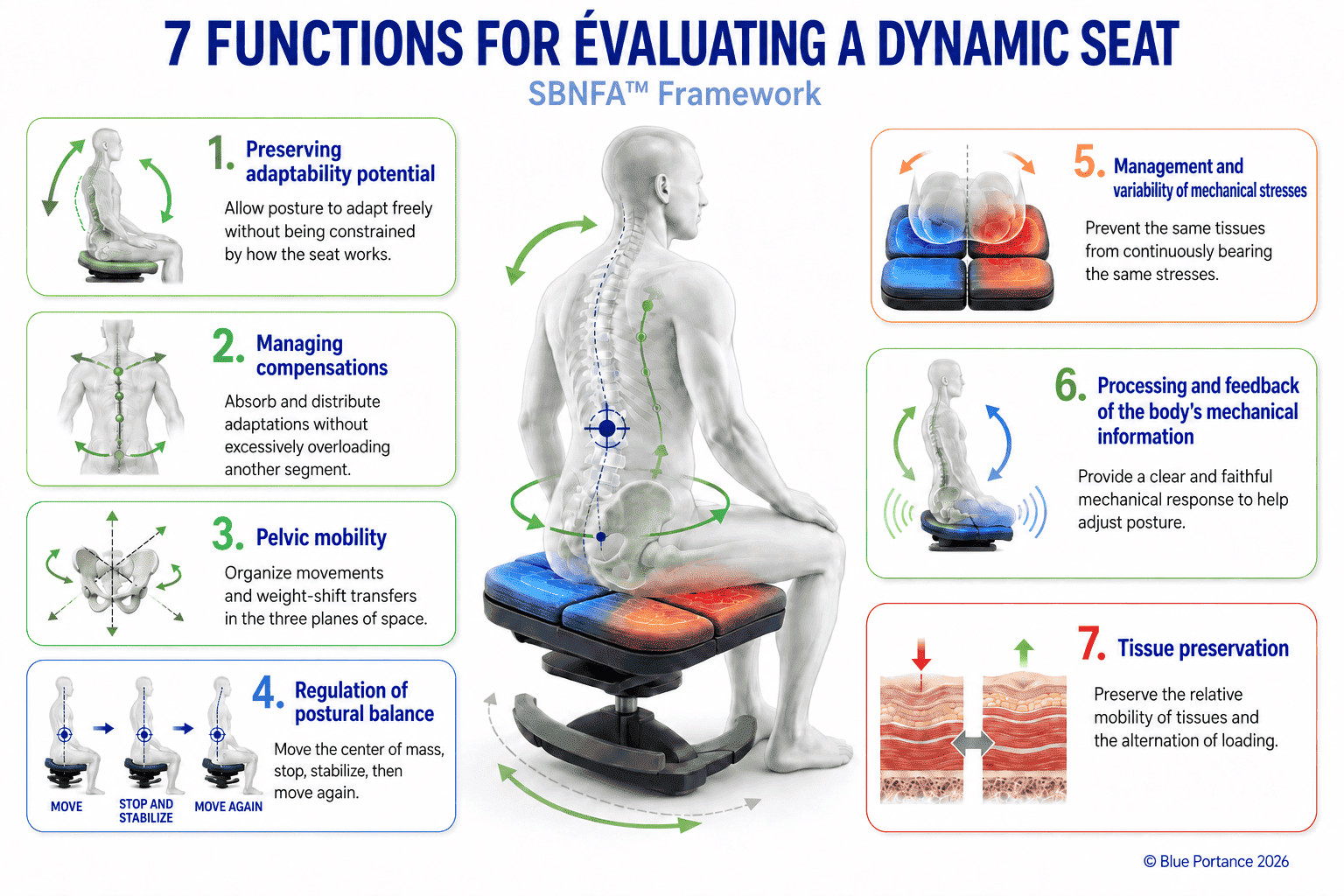
To this end, the SBNFA™ framework structures this evaluation around seven complementary functions, presented in the following figure.
In Ergonomic Practice
One can observe:
- stability;
- comfort;
- ease of adjustment;
- freedom of movement;
- compatibility with the task;
- ability to reposition;
- perceived safety.
In Research or Specialized Settings
One can also study:
- interface pressure;
- load distribution;
- the direction of pressure gradients;
- internal deformation;
- perfusion;
- oxygenation;
- muscle activity;
- movements of the pelvis and trunk.
Pressure and perfusion measurements provide different information. Consequently, a reduction in pressure alone does not justify concluding that tissues have fully recovered.
12. The Four Levels of Interpretation
- Mechanical — Dynamic seating can alter the distribution, direction and duration of pressures, mechanical stresses and deformations.
- Fluid — These mechanical changes can locally influence interstitial pressures and certain fluid movements.
- Physiological — They may be associated with changes in perfusion or oxygenation under certain experimental conditions.
- Clinical — A benefit for pain, comfort or tissue health must be demonstrated separately.
This hierarchy protects the article against directly extrapolating from an observed mechanism to a clinical promise.
13. Key Takeaways
Meaningful dynamic seating does not move the person for them. Instead, it allows support, pelvic orientation and the distribution of mechanical stresses to change when needed.
Its potential value lies in controllable access to several balance configurations compatible with the task, rather than in constant instability or restlessness.
Useful dynamics are not constant movement, but the real possibility of a controlled adjustment.
Article Summary
Dynamic seating is therefore defined neither by the amount of movement it produces nor by the instability it imposes. Its relevance depends on its ability to allow controllable changes in configuration that genuinely change support and remain compatible with the task.
The goal is thus to make several balance configurations accessible within a cone of balance: a predictable base from which the person can initiate, modulate, direct or stop their adjustments.
The available data show that certain seat configurations, articulations and alternating off-loading can alter interface pressures and certain perfusion indicators under the conditions studied (Makhsous et al., 2007, 2012; van Geffen et al., 2010; Scott & Bush, 2022).
These findings do not automatically validate every form of dynamic seating. They do show, however, that a seat can be studied as a mechanical interface capable of changing the duration, location and direction of mechanical stresses.
Scientific References
Individualization and Tissue Deformation
- Brienza, D. M., Vallely, J. J., Karg, P. E., Akins, J. S., & Gefen, A. (2018). An MRI investigation of the effects of user anatomy and wheelchair cushion type on tissue deformation. Journal of Tissue Viability, 27(1), 42–53. https://doi.org/10.1016/j.jtv.2017.04.001
Sitting, Interface Pressure and Perfusion
- Makhsous, M., Priebe, M., Bankard, J., et al. (2007). Measuring tissue perfusion during pressure relief maneuvers: insights into preventing pressure ulcers. The Journal of Spinal Cord Medicine, 30(5), 497–507. https://doi.org/10.1080/10790268.2007.11754584
- Makhsous, M., Lin, F., Hanawalt, D., Kruger, S. L., & LaMantia, A. (2012). The effect of chair designs on sitting pressure distribution and tissue perfusion. Human Factors, 54(6), 1066–1074. https://doi.org/10.1177/0018720812457681
- Scott, J., & Bush, T. R. (2022). Shifting loads as a result of chair articulations and associated perfusion responses in the context of pressure injuries: an investigation with able-bodied individuals. Journal of Tissue Viability, 31(1), 104–111. https://doi.org/10.1016/j.jtv.2021.10.001
- van Geffen, P., Reenalda, J., Veltink, P. H., & Koopman, B. F. J. M. (2010). The effects of a dynamic tuberal support on ischial buttock load and pattern of blood supply. IEEE Transactions on Neural Systems and Rehabilitation Engineering, 18(1), 29–37. https://doi.org/10.1109/TNSRE.2009.2039384
Active Seating and Workstations
- Pearse, S., Léger, M., Albert, W. J., & Cardoso, M. (2024). Active workstations: a literature review on workplace sitting. Journal of Bodywork and Movement Therapies, 38, 406–416. https://doi.org/10.1016/j.jbmt.2024.01.001
