


1. What Is a Biological Rhythm?
A biological rhythm is a variation that repeats according to an identifiable temporal organization. It can be described by several parameters:
- a period;
- a frequency;
- an amplitude;
- a phase;
- a degree of regularity;
- possible synchronization by the environment.
The period is the duration of one complete cycle. The frequency is the number of cycles per unit of time; it is therefore inversely related to the period. The amplitude describes the magnitude of the variation, while the phase indicates the moment at which the phenomenon reaches a given level.
Moreover, a rhythm may be highly regular or may show variability in period and amplitude. However, this variability does not necessarily cancel out the temporal organization of the phenomenon.
It is also important to distinguish between:
- rhythm, which has an identifiable temporal organization;
- oscillation, which refers to a repeated variation;
- fluctuation, which may be less regular;
- variability, which describes the diversity of the values and intervals observed.
These notions may overlap, but they are not synonymous.
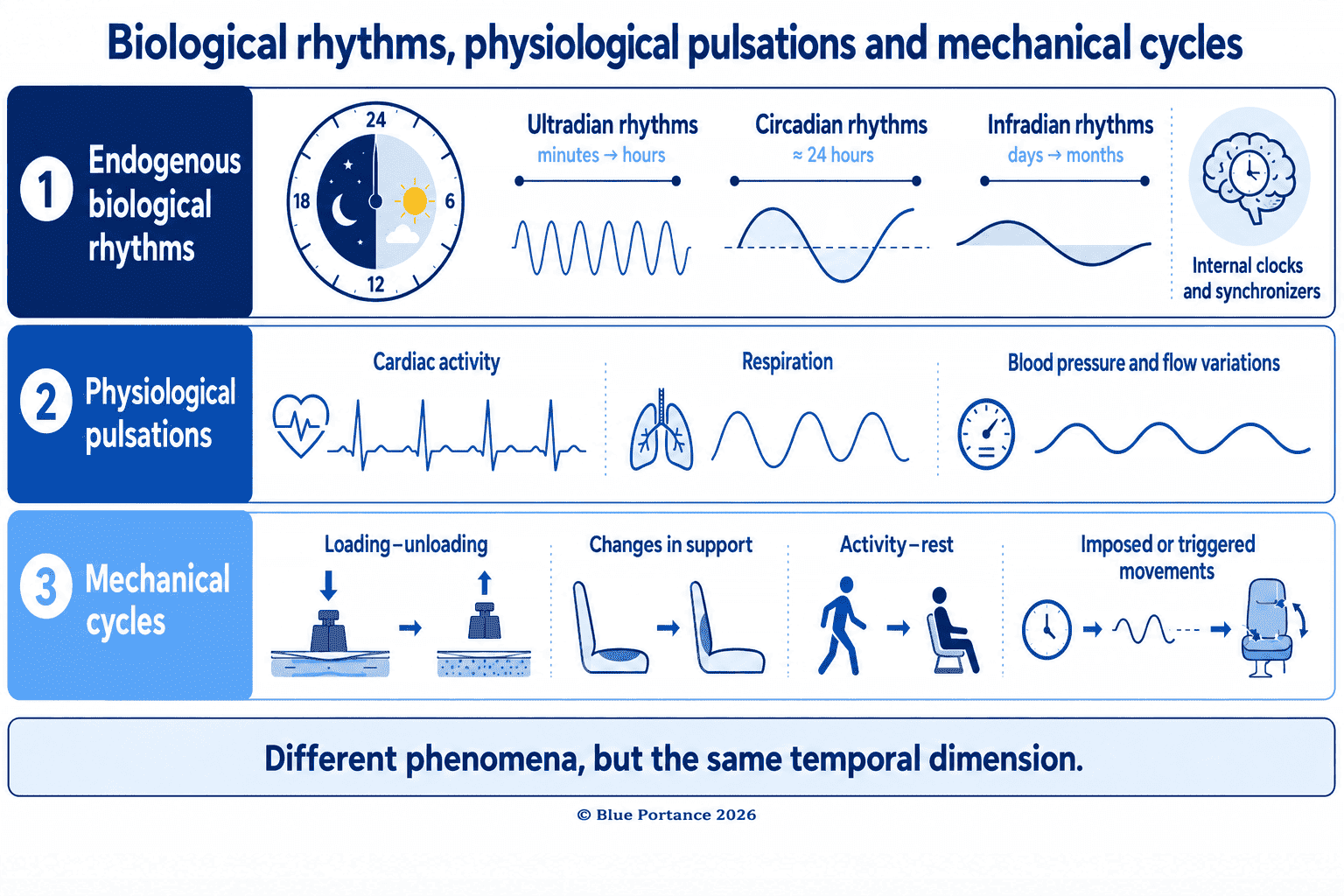
2. Rhythms at Different Timescales
Biological rhythms are often classified according to their period.
Ultradian Rhythms
Ultradian rhythms have a period shorter than twenty-four hours. They include, in particular:
- heart rhythm;
- respiratory rhythm;
- certain hormonal secretions;
- oscillations in neuronal activity;
- variations in muscle activity.
Circadian Rhythms
In contrast, circadian rhythms have a period of approximately twenty-four hours. They involve, in particular:
- the sleep–wake cycle;
- body temperature;
- blood pressure;
- the secretion of certain hormones;
- metabolic activity;
- cycles of activity and rest.
Indeed, almost every function in the body can be influenced by circadian organization, in ways specific to each tissue (Inserm, 2017).
Infradian Rhythms
Infradian rhythms have a period longer than twenty-four hours. For example, they may involve certain seasonal, hormonal or reproductive functions.
This classification therefore shows that the body is subject to several timescales at once. In other words, a single cell or tissue can receive fast, daily and slower signals that combine without necessarily being perfectly synchronized.
3. Biological Clocks and Synchronizers
Circadian rhythms, in particular, are generated by internal mechanisms called biological clocks. In mammals, for example, a central clock located in the suprachiasmatic nuclei of the hypothalamus helps coordinate the body’s rhythms.
Peripheral clocks also exist in many organs and tissues. Specifically, they contribute to the temporal coordination of metabolism, hormone production, cellular activity and behavior (Moore-Ede et al., 1982; Duez et al., 2013).
These rhythms are endogenous, but they are synchronized by external factors called synchronizers. Light is the main synchronizer, but food intake, physical activity, social schedules and the sleep–wake cycle also play a role (Inserm, 2017).
This organization shows that living systems are both autonomous and responsive to their environment. They have internal rhythms, but they adjust them according to the temporal information they receive.
The temporal dimension thus complements the notions of flow, renewal and adaptation presented in the previous articles.
4. Cardiac and Respiratory Pulsations
To begin with, cardiac activity produces rhythmic variations in pressure and flow within the vascular system. Consequently, these variations influence the mechanical conditions to which the vessels and surrounding tissues are subjected.
Breathing also produces cyclic variations in volume and pressure in the thorax and abdomen. During inspiration, contraction of the diaphragm increases thoracic volume and changes intrathoracic pressure. Conversely, expiration shifts these gradients in the opposite direction.
Overall, these rhythms may contribute to:
- the renewal of respiratory gases;
- the adjustment of blood flow;
- pressure variations within the vessels;
- venous return;
- certain conditions of lymphatic filling or propulsion.
Heartbeats and respiratory movements do not, however, have equivalent effects in every region of the body. Instead, their influence depends on posture, activity, tissue compliance, local gradients and the properties of the vascular and lymphatic networks (Negrini & Moriondo, 2011; Scallan et al., 2016; Wiig & Swartz, 2012).
They therefore do not constitute a single mechanism that would uniformly renew all of the body’s fluids.
5. Activity–Rest Alternations
In general, biological activity involves many alternations:
- muscle contraction and relaxation;
- wakefulness and sleep;
- activity and rest;
- feeding and fasting;
- loading and unloading;
- temporal variations in molecular synthesis and degradation.
However, these processes do not necessarily function as two mutually exclusive phases. Molecular synthesis and degradation can occur simultaneously while varying according to different rhythms.
Depending on the function involved, alternating between demand and recovery can also alter resource use, the accumulation of certain metabolic products and the conditions for recovery. Its effects nonetheless depend on the duration, the intensity and the state of the system concerned.
Moreover, a period of rest does not mean a complete halt in biological activity. Indeed, metabolism, thermoregulation, tissue repair and many cellular processes continue.
Conversely, a period of activity does not mean that all functions are constantly elevated. Instead, biological systems modulate their activity and retain phases of recovery or reorganization.
6. Variability Is Not the Absence of Regulation
A biological rhythm may show variations in period, amplitude and phase. This variability may stem, for example, from:
- changes in the environment;
- physical activity;
- temperature;
- diet;
- stress;
- sleep;
- age;
- disease states;
- interactions between several rhythms.
A perfectly regular function is not necessarily healthier than one that shows small variations. After all, living systems must be able to adapt their activity to changing conditions. Research on physiological complexity has in fact linked a loss of variability in several physiological systems — cardiovascular regulation, pulsatile hormone secretion, electroencephalographic activity — with aging and a reduced capacity to adapt to physiological stress (Lipsitz & Goldberger, 1992).
The opposite conclusion should, however, be avoided: variability is not automatically beneficial. For instance, a large, disorganized fluctuation, or one incompatible with the system’s regulatory capacity, may reflect a disturbance.
The key notion is therefore not variability in itself, but functional, regulated variability.
7. From Biological Rhythms to Mechanical Cycles
To begin with, not all of the repetitive phenomena described in this article are biological rhythms in the same sense.
Some are generated by internal physiological oscillators, such as circadian, cardiac or respiratory rhythms. Others, in contrast, result from activity, movement or repeated exposure to a load.
What they have in common, however, is that they introduce temporal organization and alternation into the conditions to which tissues are subjected.
In particular, this distinction matters for the rest of the guide. Mechanical cycles are not necessarily endogenous; instead, they can be produced by:
- walking;
- muscle contraction;
- respiratory movements;
- changes in support;
- postural movements;
- the mechanical environment;
- a support surface that allows or imposes variation.
Earlier, A6 showed how movement can modulate pressures and deformations. A7 then clarified that tissue response depends on the duration, the rate and the mechanical history of the load. A9 thus revisits these notions from the standpoint of their temporal organization.
8. Loading, Unloading and Mechanical Rhythms
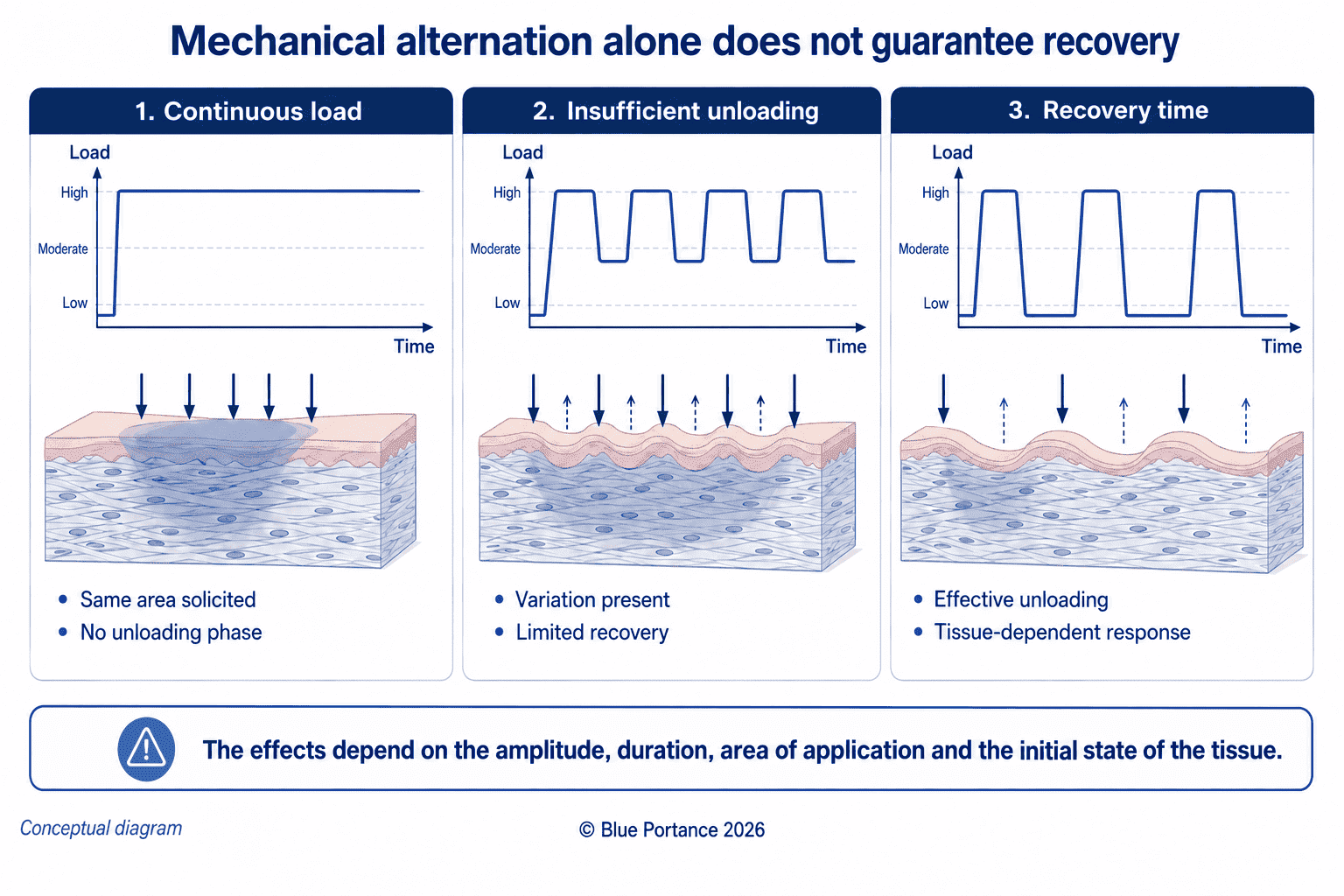
Tissues can be subjected to mechanical cycles of loading and unloading. These cycles directly alter local deformations, stresses, pressures and volumes. As a result, these variations can displace interstitial fluid and, depending on the intensity, the duration and the region involved, alter certain local conditions of perfusion or lymphatic transport.
The response nonetheless depends on several parameters:
- the amplitude of loading and unloading;
- the duration of each phase;
- the frequency of the cycles;
- the ratio between loaded and unloaded time;
- the regularity or variability of the cycles;
- the time available for recovery;
- the initial state and mechanical history of the tissue.
These parameters are essential because a rapid, small or imposed alternation does not necessarily produce the same effect as a slower, larger or self-controlled alternation.
9. A Rhythm Is More Than Its Frequency
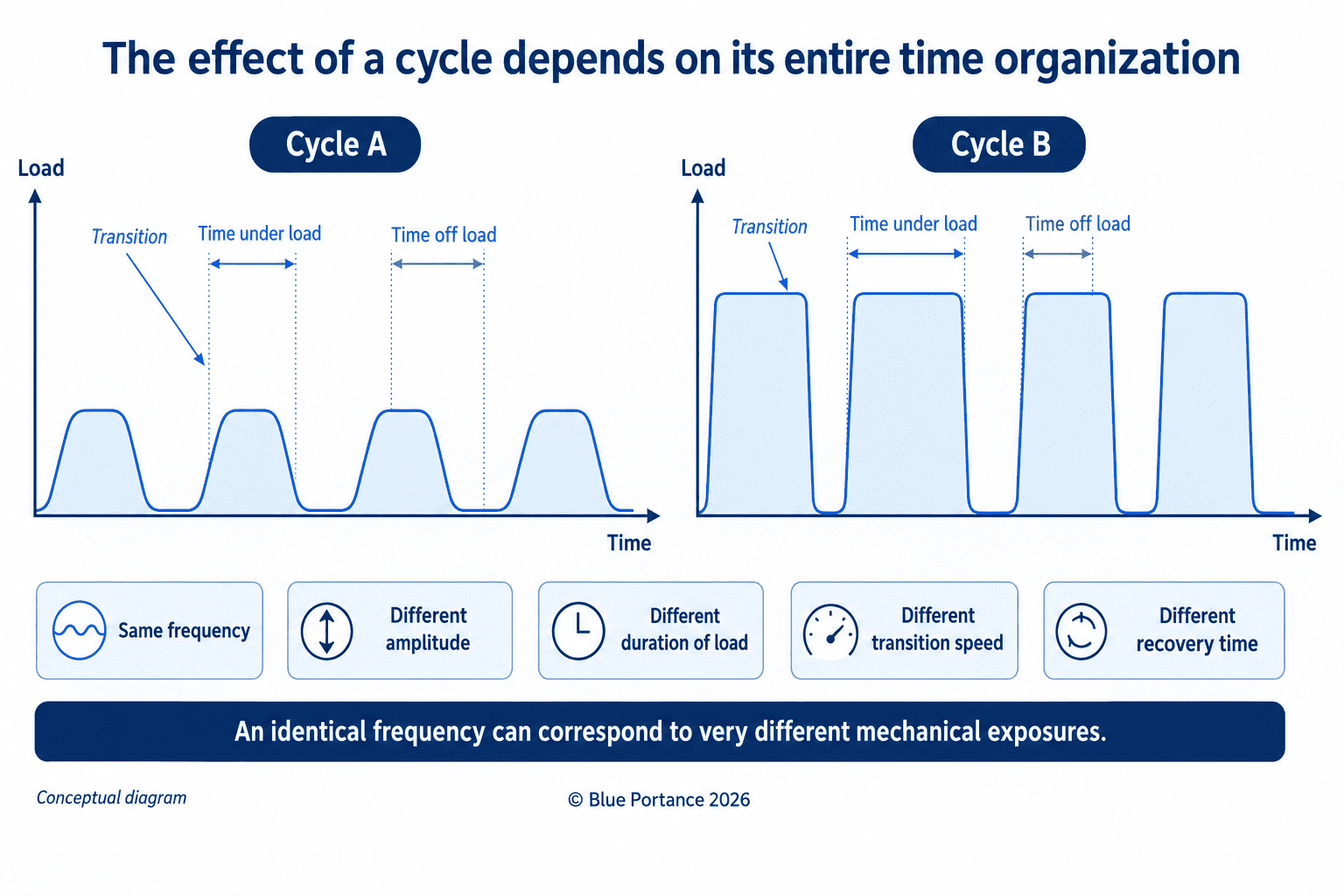
The frequency of a cycle is not enough to determine its effects.
For example, two alternations with the same frequency may differ in:
- their amplitude;
- the duration of the loading phase;
- the duration of the unloading phase;
- the speed of transition;
- their regularity;
- their direction;
- whether they can be modulated;
- the recovery time available.
A rapid, low-amplitude mechanical oscillation should therefore not be equated with an alternation that includes sufficient unloading and a recovery time suited to the tissue in question.
An ex vivo study comparing static and cyclic pressures applied to human skin (neonatal tissue) showed that exposure to cyclic pressure altered the tissue’s tensile mechanical properties less than a static pressure of the same magnitude maintained continuously (Edsberg et al., 1999). However, this finding, obtained on a specific tissue model outside a living organism, cannot be generalized to all tissues or transposed directly to perfusion or lymphatic transport. It nonetheless illustrates that whether a load is continuous or intermittent can influence the tissue’s mechanical response, independently of frequency alone.
Likewise, an imposed variation does not necessarily have the same effect as a spontaneous adjustment that the person can initiate, direct or stop.
This distinction is particularly important for sitting. In fact, the mere presence of movement is not enough to establish its mechanical relevance.
10. Data on Sitting
Studies by Makhsous et al. show that pressure-relief maneuvers and seat configurations can alter interface pressures and certain perfusion indicators, in specific populations and protocols (Makhsous et al., 2007, 2012).
For instance, in the 2007 study, a single episode of pressure relief did not necessarily guarantee complete and immediate recovery of perfusion. This finding therefore underscores the importance of load duration and of the recovery time available. In addition, in the fifteen young, healthy women studied by Makhsous et al. (2012), the five seat designs tested altered pressure distribution and certain perfusion indicators in the buttock and thigh tissues. The limited duration of the trials and the characteristics of this population do not allow these results to be generalized to all people or all sitting situations, nor do they support direct conclusions about an effect on interstitial transport or lymphatic flow.
They do show, however, that interpreting support conditions cannot be limited to an instantaneous measurement: seat configuration, load duration, unloading patterns and recovery time must also be taken into account.
11. The Four Levels of Interpretation
- Chronobiological — Living systems operate according to rhythms and alternations of different periods.
- Mechanical — Loading and unloading cycles alter stresses, deformations and weight-bearing areas.
- Physiological — These variations may influence certain local conditions of perfusion, interstitial or lymphatic transport, and tissue recovery.
- Clinical — A benefit for pain, comfort or tissue health cannot be automatically inferred from the mere presence of a rhythm or an alternation.
In short, this hierarchy avoids confusing an observed temporal phenomenon with a demonstrated physiological effect, or a physiological effect with a clinical benefit.
12. Key Takeaways
In summary, living systems display several forms of temporal organization. Biological rhythms organize, in particular:
- cardiac activity;
- breathing;
- metabolism;
- the secretion of many hormones;
- certain variations in muscle activity;
- the sleep–wake cycle;
- certain cellular activities.
In contrast, mechanical cycles of loading and unloading are not necessarily endogenous biological rhythms. They do, however, introduce an additional temporal organization into the conditions to which tissues are subjected.
The response of living systems depends not only on the nature of a demand, but also on how it is organized over time: period, frequency, amplitude, duration of exposure, alternation and opportunity for recovery.
When sitting, changes in support can alter the distribution and duration of local mechanical stresses. The goal is not to provoke constant fidgeting, but to preserve a capacity for variation that is compatible with stability, the task at hand and the person’s needs.
This temporal organization becomes especially important when the opportunities for variation decrease. A10 will therefore examine what happens when the same mechanical configuration and the same weight-bearing areas are maintained for a prolonged period.
Scientific References
Chronobiology and Biological Rhythms
- Duez, H., Sebti, Y., & Staels, B. (2013). Horloges circadiennes et métabolisme : intégration des signaux métaboliques et environnementaux. Médecine/Sciences, 29(8–9), 772–777. https://doi.org/10.1051/medsci/2013298017
- Inserm. (2017). Chronobiologie. La science pour la santé. https://www.inserm.fr/dossier/chronobiologie/
- Moore-Ede, M. C., Sulzman, F. M., & Fuller, C. A. (1982). The Clocks That Time Us: Physiology of the Circadian Timing System. Cambridge, MA: Harvard University Press.
Physiological Variability and Regulation
- Lipsitz, L. A., & Goldberger, A. L. (1992). Loss of “complexity” and aging. Potential applications of fractals and chaos theory to senescence. JAMA, 267(13), 1806–1809.
Cardiorespiratory Pulsations and Lymphatic Function
- Negrini, D., & Moriondo, A. (2011). Lymphatic anatomy and biomechanics. The Journal of Physiology, 589(Pt 12), 2927–2934. https://doi.org/10.1113/jphysiol.2011.206672
- Scallan, J. P., Zawieja, S. D., Castorena-Gonzalez, J. A., & Davis, M. J. (2016). Lymphatic pumping: mechanics, mechanisms and malfunction. The Journal of Physiology, 594(20), 5749–5768. https://doi.org/10.1113/JP272088
- Wiig, H., & Swartz, M. A. (2012). Interstitial fluid and lymph formation and transport: physiological regulation and roles in inflammation and cancer. Physiological Reviews, 92(3), 1005–1060. https://doi.org/10.1152/physrev.00037.2011
Cyclic Loading and Tissue Response
- Edsberg, L. E., Mates, R. E., Baier, R. E., & Lauren, M. (1999). Mechanical characteristics of human skin subjected to static versus cyclic normal pressures. Journal of Rehabilitation Research and Development, 36(2), 133–141.
Sitting, Interface Pressure and Perfusion
- Makhsous, M., Priebe, M., Bankard, J., et al. (2007). Measuring tissue perfusion during pressure relief maneuvers: insights into preventing pressure ulcers. The Journal of Spinal Cord Medicine, 30(5), 497–507. https://doi.org/10.1080/10790268.2007.11754584
- Makhsous, M., Lin, F., Hanawalt, D., Kruger, S. L., & LaMantia, A. (2012). The effect of chair designs on sitting pressure distribution and tissue perfusion. Human Factors, 54(6), 1066–1074. https://doi.org/10.1177/0018720812457681
