


Sitting in a chair is not a natural posture for the human body: it immobilizes the pelvis, deactivates deep musculature, and generates repeated mechanical stress on the spine, coccyx, and pelvic structures. These mechanisms explain why a large share of work-related musculoskeletal disorders (MSDs) originate from prolonged static sitting. Understanding what happens inside the body is the first step toward effective action.
Every year, musculoskeletal disorders are the leading cause of occupational disease in France. While repetitive movements and heavy lifting come to mind first, prolonged sitting — at a desk, while working remotely, or commuting — is an equally significant and far more underestimated risk factor. The reason is straightforward: the stillness we associate with rest is, for the body, a continuous mechanical constraint.
Contrary to popular belief, sitting in a standard chair is not a recovery position. It is a fixed posture that the body was never designed to hold for hours on end — and one that leaves lasting consequences.
1. Why Is Sitting in a Chair an Unnatural Position?
Over the course of human evolution, the body developed a repertoire of natural postures: standing, squatting, kneeling, and sitting on the ground. All of these share a fundamental characteristic: they allow continuous lumbo-pelvic mobility — the pelvis’s ability to constantly adjust in order to maintain postural balance.
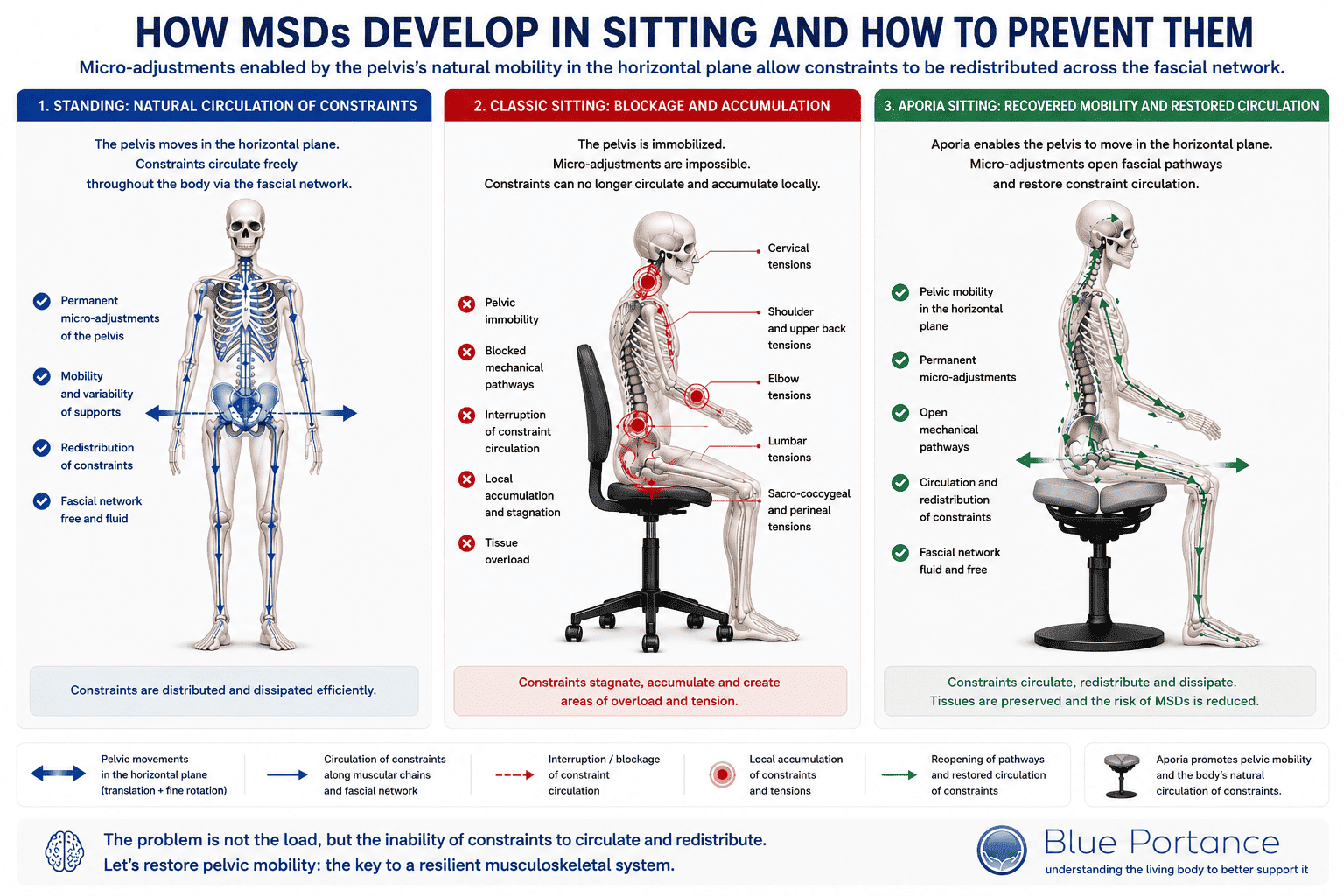
The standard chair breaks with this logic. By placing the hips at a 90-degree angle and locking the pelvis in a fixed upright position, it eliminates these permanent micro-adjustments. As a result, the deep trunk muscles — those that support the spine effortlessly in a standing position — stop working. The load is then transferred to passive structures: intervertebral discs, ligaments, fascia, and sacroiliac joints.
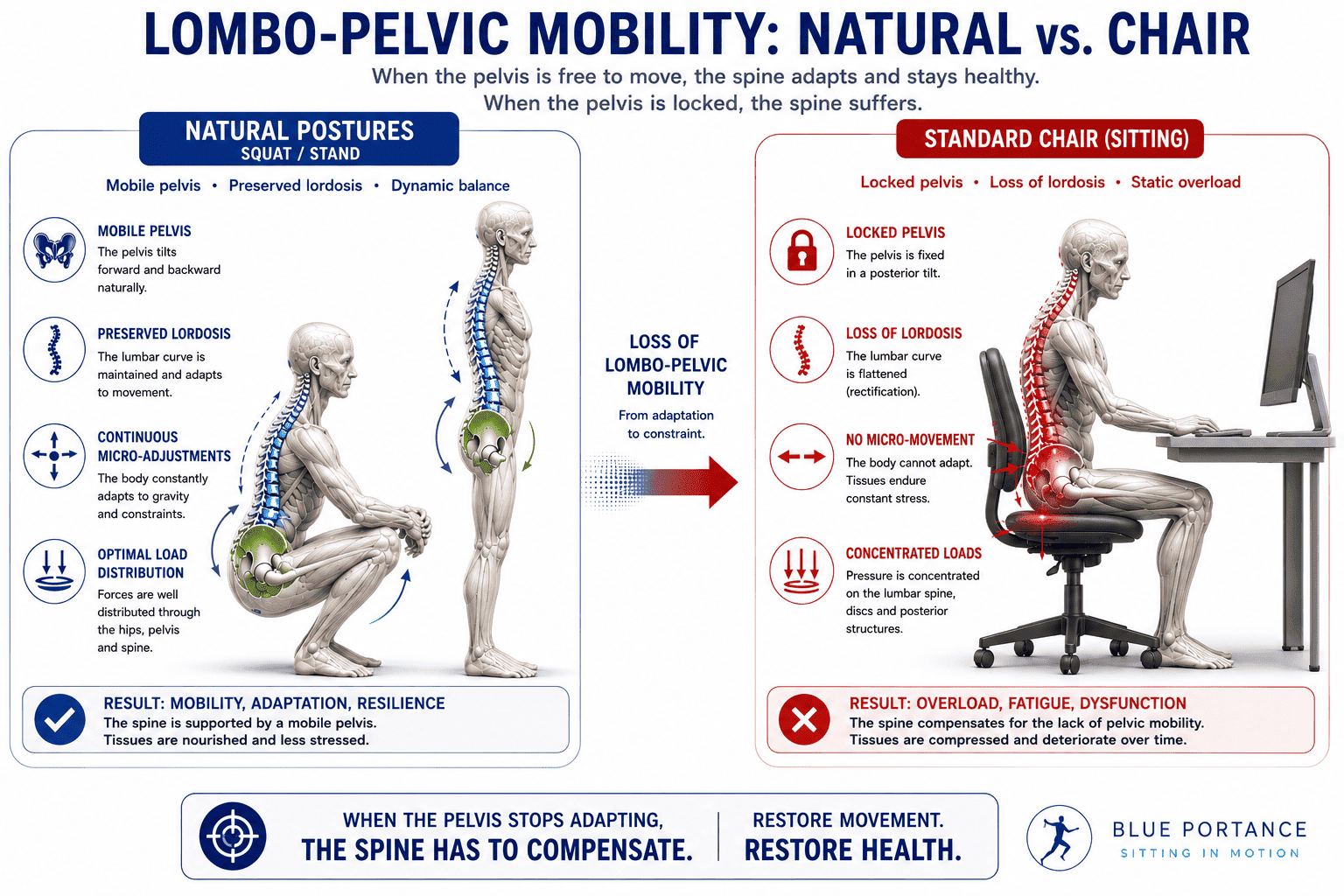
Key insight: In static sitting, the electromyographic activity of the lumbar paraspinal muscles decreases significantly. This relaxation is not rest — it is a load transfer onto passive structures that are far less tolerant of sustained mechanical stress.
2. The Mechanisms Behind Musculoskeletal Disorders
Several mechanisms combine to produce MSDs during prolonged sitting.
Disc and Ligament Compression
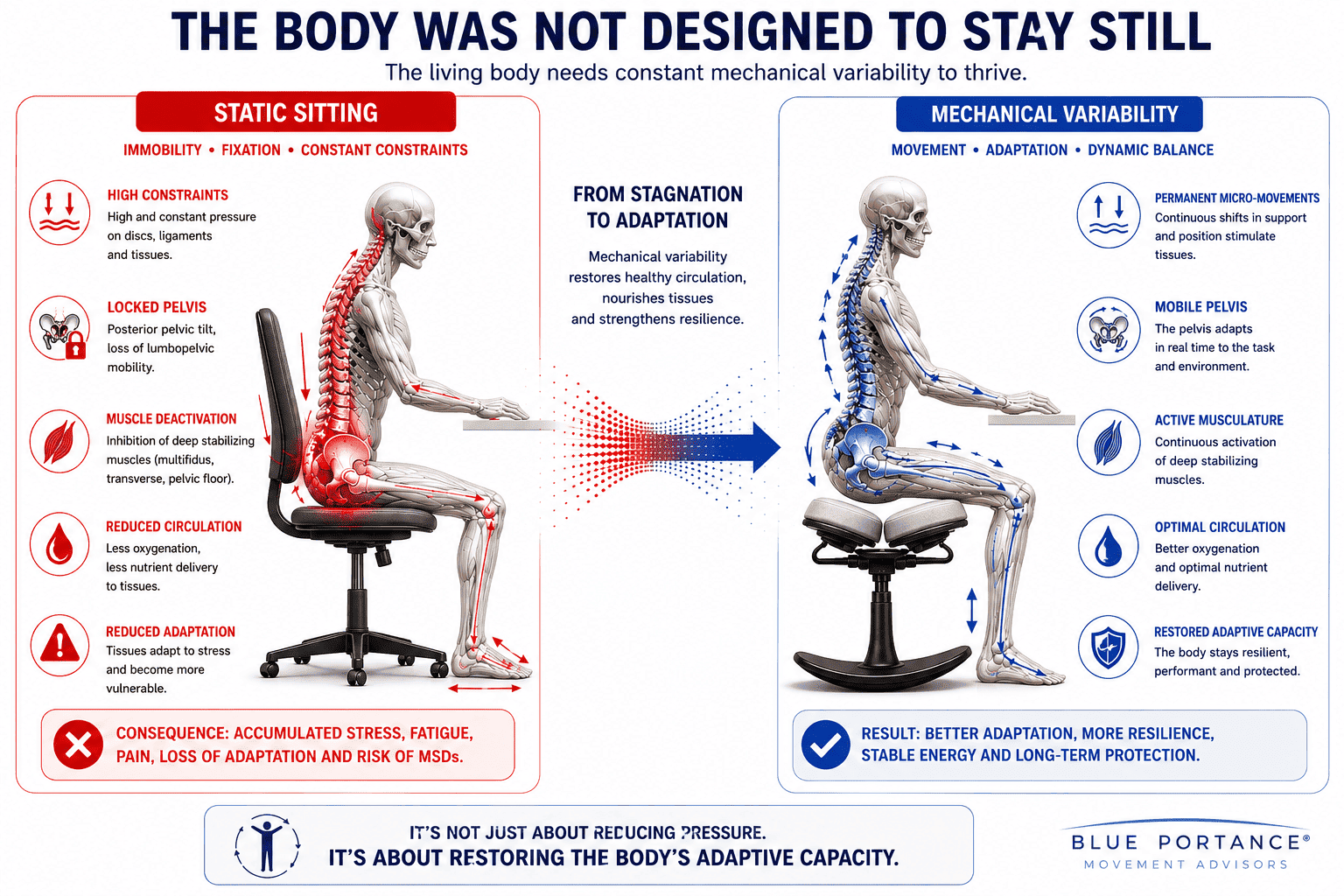
In a seated position, lumbar intradiscal pressure is noticeably higher than when standing — and increases further when the posture becomes slouched or asymmetric. This repeated pressure gradually impairs disc nutrition, which depends on alternating compression-decompression cycles to remain hydrated. Immobility effectively deprives the discs of their natural nourishment mechanism.
Pelvic Locking
The pelvis is a major biomechanical interface between the lower limbs and the spine. Its mobility — particularly anterior and posterior tilting — helps absorb mechanical stress and preserve natural spinal curvatures. In a chair, this mobility is severely restricted. The hip flexors (psoas, iliacs) remain in a shortened position for extended periods, creating muscular imbalances that perpetuate pain well beyond working hours.
Deep Muscle Deactivation
The multifidus, transverse abdominis, and pelvic floor muscles normally function as an active corset. During prolonged sitting, their tonic activity diminishes. This progressive deactivation creates functional instability that exposes joint structures to repeated microtrauma — often imperceptible day to day, but cumulative over time.
3. Specific Pain Conditions Aggravated by Static Sitting
Low Back Pain
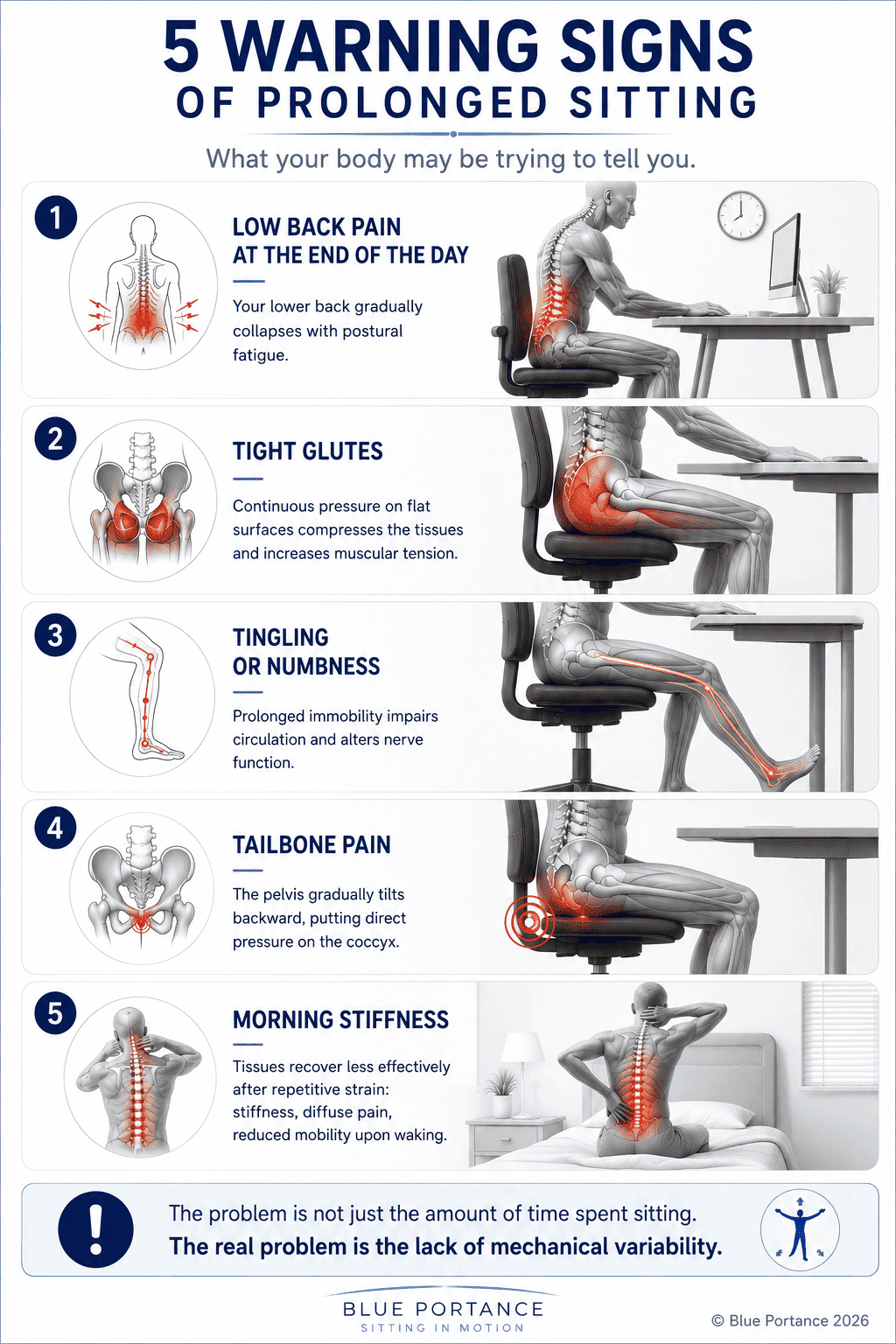
Low back pain is the most widespread MSD. In a seated position, the lumbar spine progressively loses its natural lordosis — especially as the day goes on and postural fatigue sets in. This flattening of the curve increases stress on the posterior discs and stretches the interspinous ligaments, producing the dull, diffuse ache many people recognize by late afternoon.
Pelvic and Perineal Pain — Pudendal Neuralgia
When sitting on a flat surface, body weight concentrates on the ischial tuberosities and perineal structures. For people with irritation or compression of the pudendal nerve, this direct pressure is a significant aggravating factor. Sitting also narrows the available space within Alcock’s canal — the nerve’s passage — by altering pelvic orientation.
Coccydynia
The coccyx is not meant to bear direct load in a correctly seated position. However, when the pelvis tilts into retroversion — which commonly occurs after several hours of sitting — the coccyx comes into contact with the seat surface. Repeated pressure on this naturally mobile structure irritates surrounding tissues and can sustain persistent pain.
Sciatica and Cruralgia
Compression of lumbar nerve roots is promoted by the reduction of intervertebral space in a seated position. Sedentary habits also worsen muscular contractures (piriformis, psoas) that can mechanically irritate nerve trunks — independently of any disc herniation.
4. What Research Says About Sitting and MSDs
Epidemiological studies consistently show that beyond six to eight hours of continuous sitting per day, the risk of chronic low back pain, neck pain, and upper limb disorders increases significantly. This threshold is not a single tipping point — it is cumulative exposure that builds over months and years.
Biomechanical research has also demonstrated that postural alternation — even of minimal amplitude — is sufficient to restart deep muscle activity and reduce peak disc pressure. It is not necessarily the total duration of sitting that causes harm, but its static and fixed nature.
5. Practical Ways to Reduce Mechanical Stress
The first and most effective recommendation is to regularly interrupt the sitting position. A two-to-three minute break every hour — even without specific exercise — is enough to reactivate deep musculature and reduce disc compression.
Beyond breaks, several adjustments help limit mechanical stress during unavoidable periods of sitting:
- Prioritize pelvic mobility rather than locking the posture into a “perfect” and rigid position.
- Vary sitting height to regularly shift the hip-to-trunk angle.
- Support natural spinal curves without forcing them: the goal is to accompany, not impose.
- Adapt support to the specific condition: coccyx pain, pelvic pain, and low back pain each call for different solutions.
Key point: A fixed “correct” posture is no better than a mobile imperfect one. The body needs variation, not static perfection.
Conclusion
Musculoskeletal disorders linked to sitting are not an inevitable consequence of sedentary work. They are the mechanical result of a posture the human body was never designed to hold, motionless, for hours at a time. Understanding these mechanisms — disc compression, pelvic locking, muscle deactivation — makes it possible to address the root cause rather than treat symptoms in isolation.
This is the logic behind Aporia® bioactive seating: rather than imposing a posture, it accompanies the body’s natural micro-oscillations, transforming seated time into a form of continuous mobility.
Further Reading
- Micro-movements and pain while sitting
Why even tiny movements are enough to fundamentally change the mechanics of sitting. - Prolonged sitting and mechanical variability
Why postural monotony is a risk factor in its own right, regardless of total sitting duration. - Tissue adaptability and back pain
The body is plastic: how tissues respond to prolonged stress — and how to reverse the process. - Pelvic and perineal pain while sitting
A detailed look at perineal compression mechanisms and appropriate unloading solutions. - Coccydynia: understanding and relieving coccyx pain
Everything you need to know about coccyx pain, its postural causes, and effective approaches.
Sources and References
- Nachemson A., 1981 — Disc pressure measurements. Spine, 6(1):93-97.
- Wilke H.J. et al., 1999 — New in vivo measurements of pressures in the intervertebral disc. Spine, 24(8):755-762.
- Driessen M.T. et al., 2010 — The effectiveness of physical and organisational ergonomic interventions on low back pain and neck pain. Occupational & Environmental Medicine, 67(4):277-285.
- Parry S., Straker L., 2013 — The contribution of office work to sedentary behaviour associated risk. BMC Public Health, 13:296.
- Bjorklund M. et al., 2000 — Muscle activation during whole body tilting. Journal of Electromyography and Kinesiology, 10(4):275-281.
