


1. Postural Balance, Prolonged Holding and Functional Immobility
These three notions need to be distinguished.
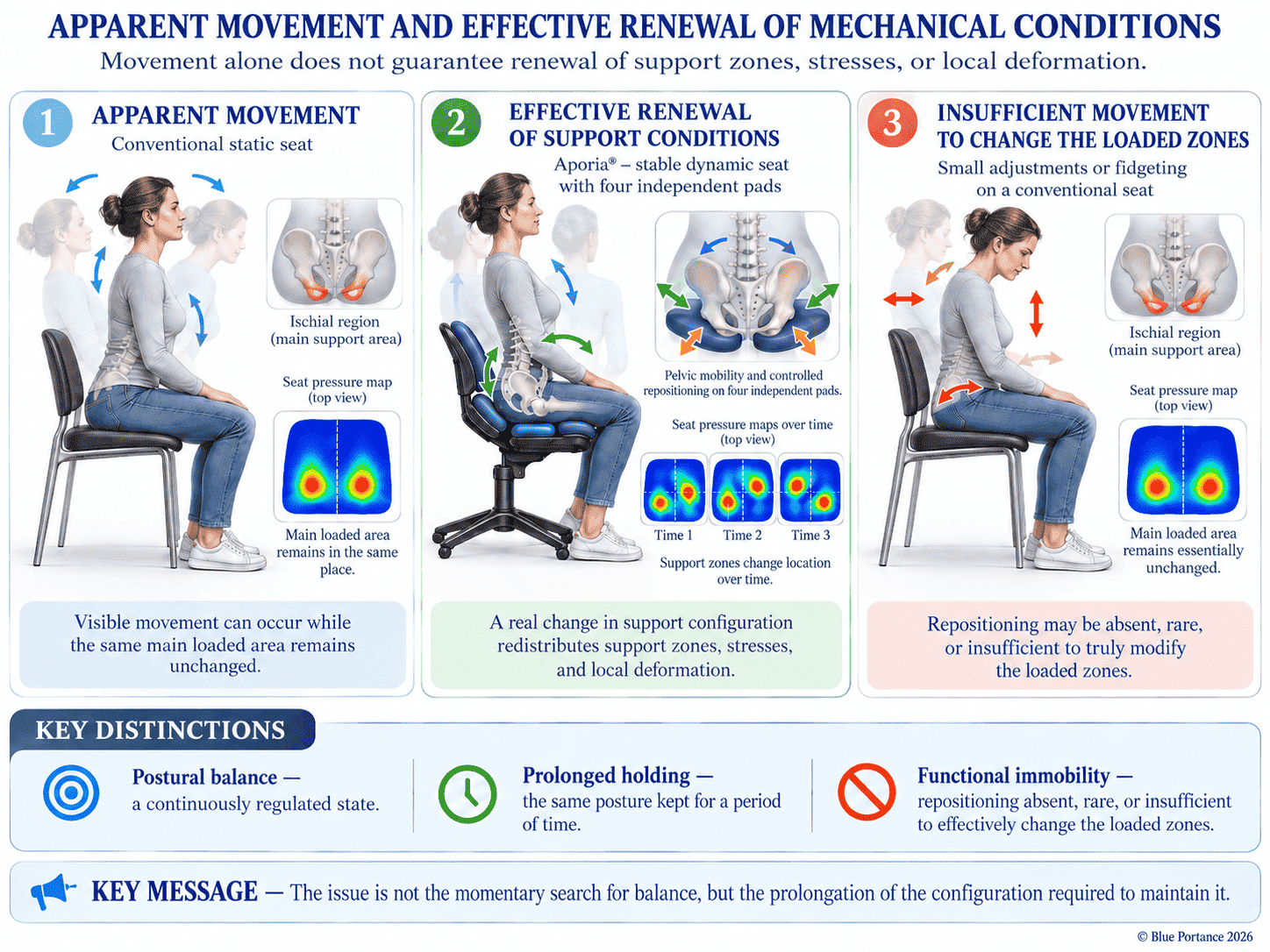
- Postural balance — A state continuously regulated by bodily adjustments and, on a static seat, by the successive search for postures and support bridges.
- Prolonged holding — The same posture kept for a certain length of time.
- Functional immobility — Repositioning that is absent, infrequent or insufficient to actually change the loaded areas.
Postural balance can be found momentarily without being sustainable over time. For example, on a static seat, a person may tilt the trunk, move the pelvis or create new support bridges to regain balance. However, these adaptations only truly change the loaded areas if they produce a sufficient change in the support configuration: flexing the trunk may alter the intensity or direction of stresses while keeping the load on the same main region.
Conversely, a posture that seems to involve little stress can become more demanding when it is held without sufficient opportunity to change it.
The problem, therefore, lies not in momentarily seeking balance, but in prolonging the configuration needed to maintain it.
2. Static Sitting, Stable Dynamic Sitting and Unstable Dynamic Sitting
Blue Portance’s SBNFA™ framework distinguishes three balance regimes in the seated position. Static sitting imposes a succession of precarious balance states that cannot be sustained over time. In contrast, stable dynamic sitting — in the Aporia® sense — makes several controllable balance configurations accessible within a cone of balance, while preserving the independent mobility of the right and left regulators of human balance: the hips and the ankles. It becomes unstable as soon as it immobilizes or locks these regulators together, preventing their differentiated adjustments.
On a static seat, a person has only one support geometry available. They must therefore find successive balance states on their own: tilting the trunk, resting an elbow on the thigh, leaning forward on the forearms against the desk. These adjustments create temporary “balance bridges” — but each remains precarious and unsustainable over time, because holding it immobilizes a single configuration. The person must therefore continually change posture and support. In fact, except in an exceptional configuration of structural self-stabilization, human postural balance never freezes: it is continuously regulated.
Stable and Unstable Dynamic Sitting
Stable dynamic sitting — in the sense of the Aporia® support — addresses this limitation differently: it makes several controllable balance configurations accessible within a cone of stability, while preserving the independent mobility of the right and left hips and, when the feet contribute to support, of the right and left ankles. As a result, the individual can shift the pelvis, move from one stabilized configuration to another, then re-center — without ever being subjected to permanent instability. Thus, what defines this regime is not the presence of movement, but the preservation of these differentiated adjustments.
In contrast, unstable dynamic sitting immobilizes or locks together these same regulators, preventing their differentiated adjustments: it is this criterion, and not the presence or absence of movement of the support, that defines instability in the SBNFA sense. The individual must then constantly compensate for the support’s movements, which may increase muscular effort and attentional load, without guaranteeing access to several stabilized balance configurations.
Overall, this distinction shapes the rest of the article: the problem is never perceived immobility or apparent movement, but the capacity — or lack of capacity — to actually change the support configuration.
3. A Sustained Mechanical Configuration
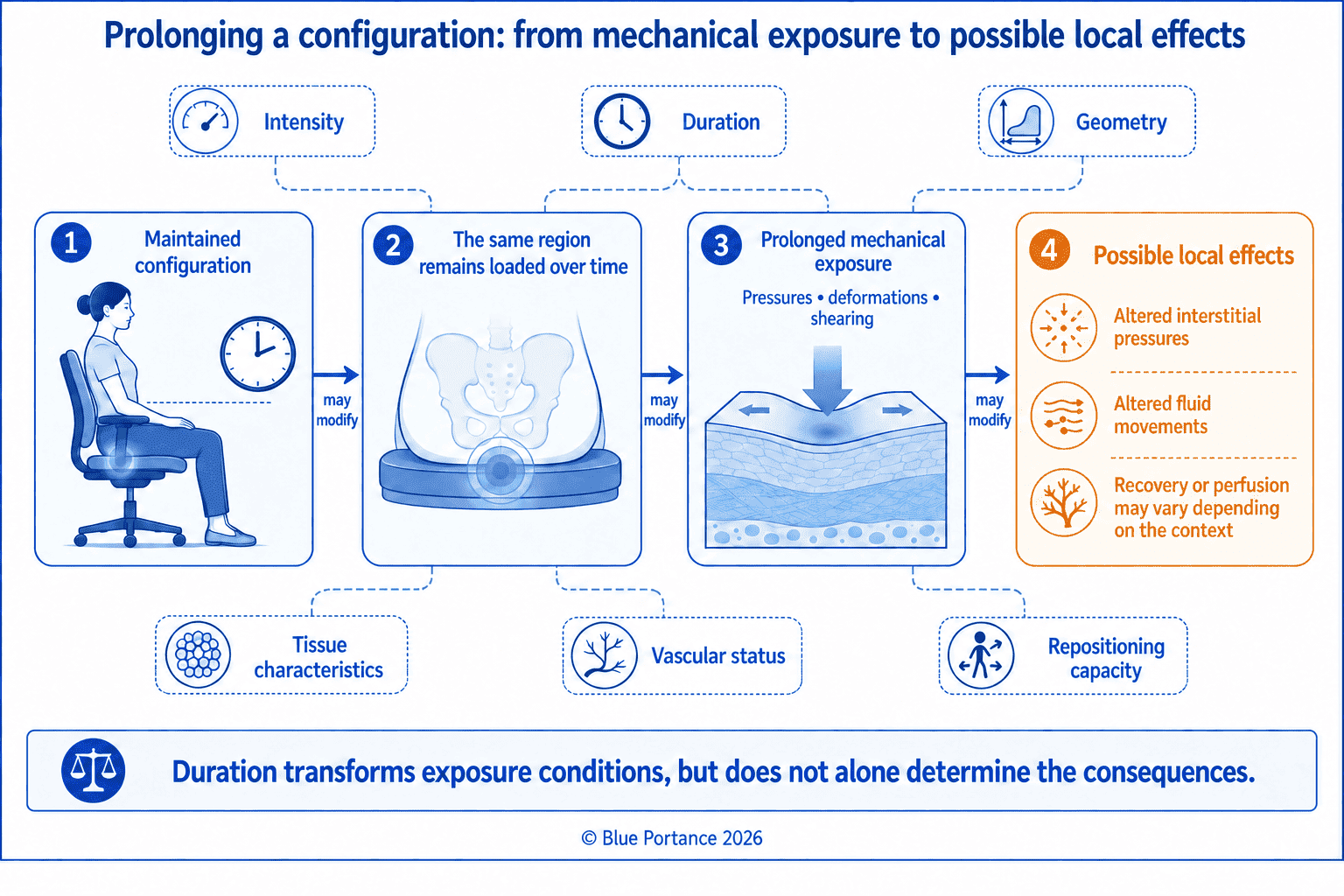
When a posture is kept for a long time, certain areas of the body may remain exposed to relatively constant mechanical conditions.
These conditions may involve:
- interface pressure;
- soft-tissue compression;
- shear;
- deformation of muscle and adipose tissue;
- skin tension;
- interstitial pressure;
- the temporal variability of muscle activity.
Specifically, holding the same configuration for a prolonged period may reduce the temporal variability of muscle activity and prolong the recruitment of certain stabilizing groups. This activity may nonetheless fluctuate and be distributed across several muscles.
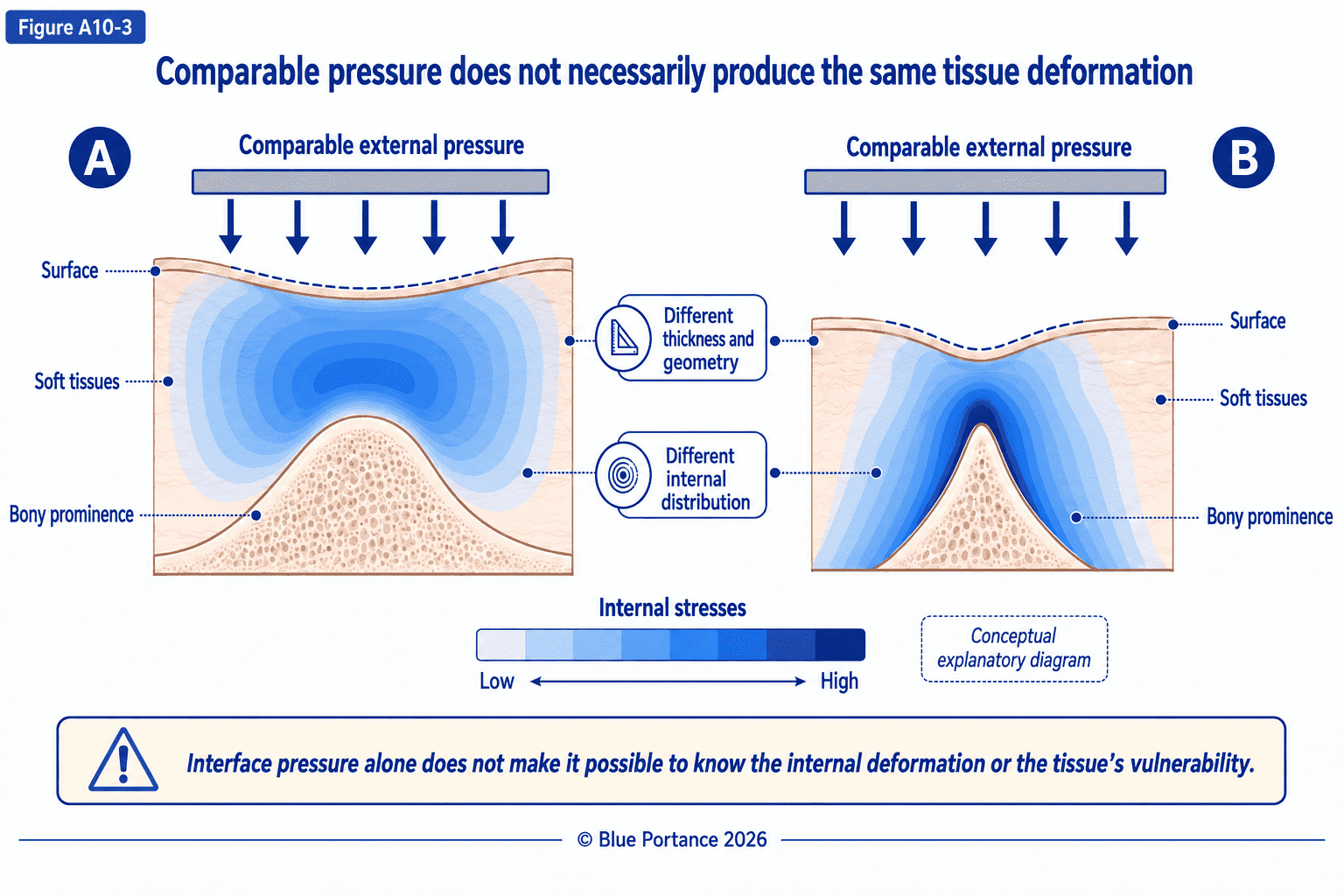
Moreover, the body’s overall load is not enough to describe the situation. For instance, two people of similar weight may show different pressure distributions and internal deformations depending on their anatomy, muscle mass, adipose tissue, posture and contact area.
In addition, biomechanical models show that internal stresses can be heterogeneous, particularly around bony prominences and in deep tissues (Shoham & Gefen, 2012).
4. Duration as a Mechanical Factor
Duration of exposure is a key factor in the tissue response.
A briefly applied load may produce transient deformation with partial or complete recovery after unloading. In contrast, a load held for longer may lead to:
- progressive deformation;
- fluid redistribution;
- stress relaxation;
- a change in local pressure;
- an increase in residual deformation;
- slower recovery.
Indeed, biological tissues exhibit viscoelastic and poroelastic behavior. Their response therefore depends on time, loading rate and their mechanical history.
For example, in twenty healthy older women, Dobos et al. (2015) studied the effects of 90 minutes of loading on several skin areas exposed to pressure injuries. In particular, the authors observed changes in microtopography, elasticity and residual deformation that varied across the regions studied. Under the experimental conditions, however, the measured changes recovered after unloading (Dobos et al., 2015).
This study does not make it possible to define a universal risk duration. It does show, however, that loading duration can alter the mechanical properties of the skin, and that the response depends on the area involved.
5. Pressure, Deformation and Perfusion
Prolonged loading may alter the pressure exerted on tissues and certain local perfusion conditions.
Interface pressure, however, provides only partial information. It measures the relationship between the body and the support, but does not directly indicate:
- stresses in deep tissues;
- muscle deformation;
- interstitial pressure;
- the perfusion of each layer;
- the state of the cells;
- recovery after unloading.
For instance, Makhsous et al. showed that certain pressure relief maneuvers could alter interface pressure and tissue perfusion, but that a brief relief of pressure did not necessarily guarantee complete and immediate recovery of perfusion (Makhsous et al., 2007).
This observation therefore requires us to distinguish between:
- a decrease in measured pressure;
- the recovery of perfusion;
- the mechanical recovery of the tissue;
- the clinical outcome.
Although these phenomena are related, they are not equivalent.
6. When Variability of Support Decreases
When holding a posture involves little repositioning, changes in the location, direction and intensity of stresses may decrease.
Specifically, this reduction may involve several dimensions:
- temporal dimension: the same areas remain loaded for a long time;
- spatial dimension: support areas change little;
- directional dimension: forces remain oriented in a similar way;
- muscular dimension: the temporal variability of activity may decrease while the distribution of load among muscle groups may shift.
This decrease in variability does not eliminate exchange. It may, however, prolong a single configuration of compression or shear.
We should therefore avoid writing that immobility “stops” flows. Rather, it may reduce the opportunities to change local mechanical conditions.
7. Heat, Moisture and Discomfort
Prolonged contact between the body and a support may also alter local thermal and humidity conditions.
These conditions depend in particular on:
- ambient temperature;
- ventilation;
- material properties;
- contact area;
- perspiration;
- duration of exposure;
- the possibility of changing support.
Heat and moisture may contribute to discomfort and alter the mechanical properties of the skin. They are not, however, sufficient to demonstrate a disruption of deep exchange.
Moreover, discomfort, heat, numbness or the need to move may contribute to triggering repositioning. Their presence does not, however, directly measure the mechanical or physiological state of the tissues, and their absence does not rule out prolonged exposure, particularly when sensation is impaired.
8. Repositioning and the Pressure Injury Literature
The pressure injury literature documents the extreme consequences of prolonged exposure in particularly vulnerable individuals. It also helps explain certain mechanisms related to duration, deformation and repositioning, but its findings cannot be transferred directly to every seated person.
Repositioning is a standard prevention strategy for people who are vulnerable or unable to change position on their own. A Cochrane review concludes, however, that the available data do not make it possible to determine with certainty an optimal frequency or method applicable to all settings (Gillespie et al., 2020).
Similarly, another systematic review with meta-analysis reports a reduced incidence of injuries with certain more frequent repositioning protocols, but stresses that the certainty of the evidence remains low (Avsar et al., 2020).
These findings must therefore be interpreted in context. Specifically, they mainly concern at-risk adults, who often depend on outside assistance to change position.
9. Individual Factors and Vulnerability
The mechanical effects of a sustained posture vary in all individuals. However, the risk of tissue damage becomes particularly significant when these effects combine with sensory, vascular, nutritional or motor vulnerability.
Factors Influencing the Mechanical Response
- anatomy;
- soft-tissue thickness;
- muscle mass;
- posture;
- contact area;
- support geometry;
- material properties;
- shear.
Factors Increasing Vulnerability
- reduced sensation;
- impaired blood supply;
- persistent moisture;
- poor nutritional status;
- a history of injury;
- reduced mobility;
- inability to reposition;
- certain medical conditions or treatments.
This distinction thus avoids implicitly applying the pressure injury literature to every seated person in the same terms.
10. The Same Pressure Does Not Always Produce the Same Effect
The relationship between interface pressure and tissue response is not linear.
In other words, the same pressure may produce different effects depending on:
- duration;
- the tissue involved;
- the support surface;
- associated shear;
- tissue deformability;
- baseline perfusion;
- recovery capacity;
- the person’s sensation.
For example, in an exploratory MRI study of six participants and six wheelchair cushions, Brienza et al. (2018) observed that three-dimensional tissue deformation depended on both the participant’s anatomy and the cushion tested. In particular, none of the cushions evaluated produced the lowest deformation in all participants (Brienza et al., 2018).
While this study supports the importance of individualization, its small sample calls for caution.
Evaluating a seat therefore cannot rely on interface pressure alone. Depending on the clinical or experimental context, it may take several complementary indicators into account:
- in practice: support distribution, comfort, stability and capacity to reposition;
- in research or in a specialized setting: internal deformation, perfusion and oxygenation.
11. What This Means for Sitting
First, prolonged sitting should not be presented as a general interruption of bodily flows.
It may, however, keep certain areas under relatively constant mechanical conditions. Consequently, when opportunities to reposition are limited, the duration of exposure to the same pressure, shear or deformation increases.
On the other hand, changes in configuration may:
- alter pelvic orientation;
- shift part of the load;
- change the relationship with the backrest;
- reduce certain local compressions;
- shift areas of peak pressure;
- alter the activity of stabilizing muscles.
However, these effects should not be inferred from the mere presence of movement. Instead, in the SBNFA™ framework, one must check whether that movement actually results in a shift of the pelvis, a change in support areas or a significant change in the direction of stresses.
It is therefore preferable to speak of the possibility of reducing, shifting or temporarily interrupting certain local compressions, rather than claiming that movement always eliminates them.
In the fifteen young, healthy women studied by Makhsous et al. (2012), the five chair designs tested altered pressure distribution and certain perfusion indicators in the buttock region and thighs. However, the short duration of the trials and the characteristics of this population do not allow these results to be generalized to all people or to all sitting situations (Makhsous et al., 2012).
Finally, the goal is not necessarily to keep the person moving continuously. It is to preserve their ability to change or interrupt a support configuration, in order to reduce the length of time during which the same combination of pressure, deformation and shear is maintained.
12. The Four Levels of Interpretation
- Mechanical — A sustained posture may prolong certain stresses, deformations and support areas.
- Fluid — Duration and deformation may locally alter pressures and fluid movement.
- Physiological — These conditions may influence certain indicators of perfusion and tissue recovery.
- Clinical — Immobility alone cannot predict pain, an injury or a benefit associated with a particular seat.
Overall, this grid forms the framework of scientific caution for A10. In particular, it makes it possible to distinguish an observed mechanical condition, a possible physiological effect and a clinical outcome that must be demonstrated separately.
13. Key Takeaways
Above all, immobility does not eliminate biological activity. It may, however, reduce the temporal, spatial and directional diversity of the stresses to which certain regions of the body are subjected.
In short, loading duration, deformation, shear, perfusion, tissue properties and the capacity to reposition all act together.
Holding a posture for a prolonged period does not necessarily block exchange; it may, however, prolong certain mechanical conditions and reduce the opportunities to change support, stresses and local deformations.
Article Summary
In summary, postural balance found momentarily can become unsustainable when maintaining it prolongs a single mechanical configuration. Certain areas may then remain subjected for long periods to similar pressures, deformations or shear, with effects that depend on duration, tissue characteristics and the person’s capacity to reposition.
The point, then, is neither to lock the person into a precarious balance nor to impose constant movement on them. Rather, it is to enable them to access several controllable balance configurations and to actually change their support when needed.
A11 will examine how dynamic sitting can seek to restore this controllable variability without imposing permanent instability.
Scientific References
Mechanical Configuration and Tissue Biomechanics
- Shoham, N., & Gefen, A. (2012). Deformations, mechanical strains and stresses across the different hierarchical scales in weight-bearing soft tissues. Journal of Tissue Viability, 21(2), 39–46. https://doi.org/10.1016/j.jtv.2012.03.001
Loading Duration and Tissue Response
- Brienza, D. M., Vallely, J. J., Karg, P. E., Akins, J. S., & Gefen, A. (2018). An MRI investigation of the effects of user anatomy and wheelchair cushion type on tissue deformation. Journal of Tissue Viability, 27(1), 42–53. https://doi.org/10.1016/j.jtv.2017.04.001
- Dobos, G., Gefen, A., Blume-Peytavi, U., & Kottner, J. (2015). Weight-bearing-induced changes in the microtopography and structural stiffness of human skin in vivo following immobility periods. Wound Repair and Regeneration, 23(1), 37–43. https://doi.org/10.1111/wrr.12259
Sitting, Interface Pressure and Perfusion
- Makhsous, M., Priebe, M., Bankard, J., et al. (2007). Measuring tissue perfusion during pressure relief maneuvers: insights into preventing pressure ulcers. The Journal of Spinal Cord Medicine, 30(5), 497–507. https://doi.org/10.1080/10790268.2007.11754584
- Makhsous, M., Lin, F., Hanawalt, D., Kruger, S. L., & LaMantia, A. (2012). The effect of chair designs on sitting pressure distribution and tissue perfusion. Human Factors, 54(6), 1066–1074. https://doi.org/10.1177/0018720812457681
Repositioning and Pressure Injury Prevention
- Avsar, P., Moore, Z. E. H., Patton, D., O’Connor, T., Budri, A. M., & Nugent, L. (2020). Repositioning for preventing pressure ulcers: a systematic review and meta-analysis. Journal of Wound Care, 29(9), 496–508. https://doi.org/10.12968/jowc.2020.29.9.496
- Gillespie, B. M., Walker, R. M., Latimer, S. L., Thalib, L., Whitty, J. A., McInnes, E., & Chaboyer, W. P. (2020). Repositioning for pressure injury prevention in adults. Cochrane Database of Systematic Reviews, 6, CD009958. https://doi.org/10.1002/14651858.CD009958.pub3
