


1. Transfers Organized by Gradients
A gradient is a measurable difference between two regions. For instance, it may be a difference in concentration, pressure, electrical potential, or chemical potential.
These differences provide the conditions required for many biological transfers. In particular, they can orient the movement of water or solutes. On their own, however, they are not enough to determine the speed and extent of the process.
Transfers also depend on:
- the distance to be covered;
- the available surface area;
- the permeability of interfaces;
- the size and charge of molecules;
- the tortuosity of the medium;
- interactions with the extracellular matrix;
- any movement of the surrounding fluid.
Diffusion, convection, and filtration are therefore not independent of tissue structure. They take place in a material environment that can slow, orient, retain, or favor the movement of certain substances.
2. Diffusion: Movement Down a Concentration Gradient
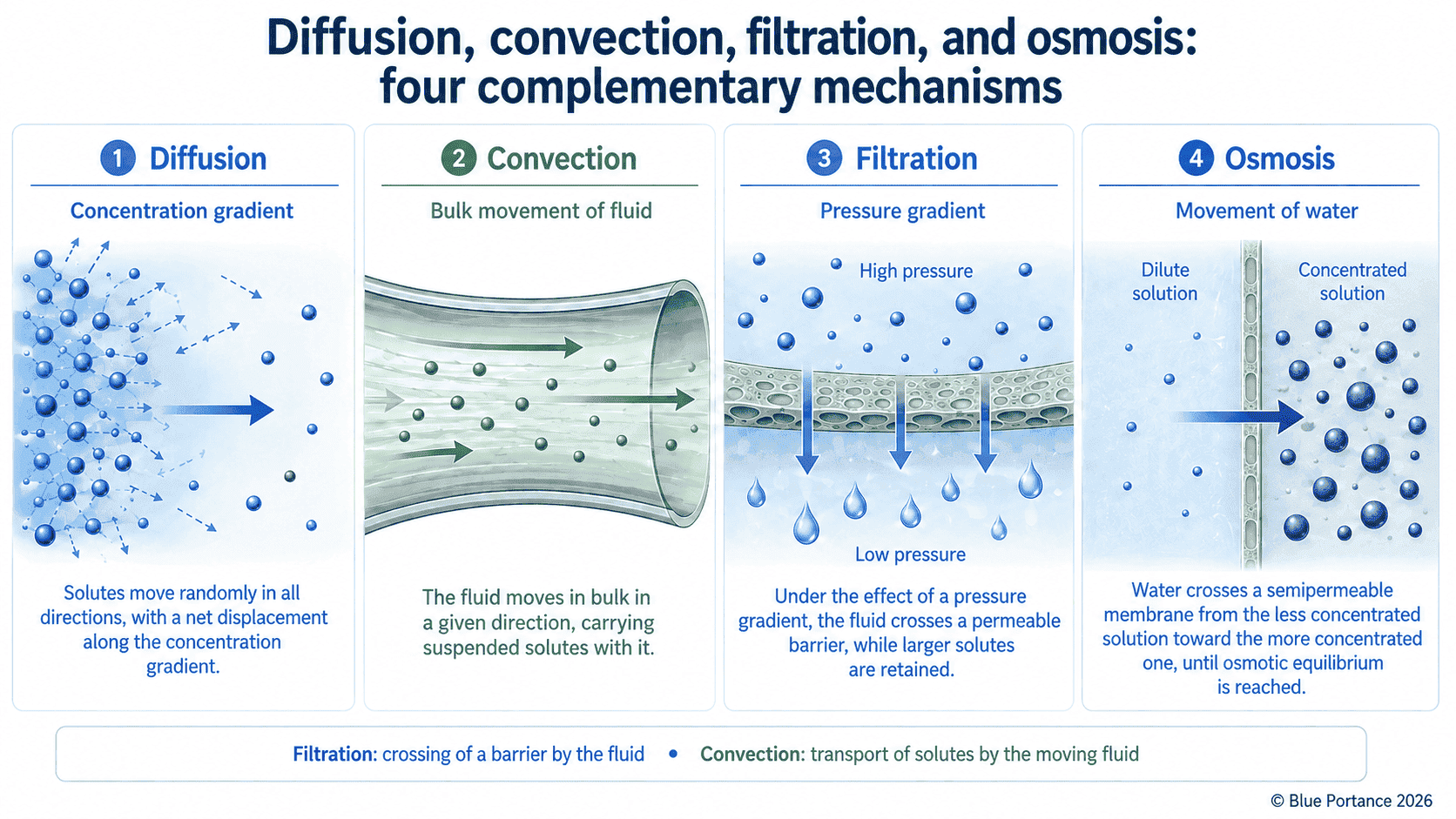
This mechanism is the net movement of molecules driven by a concentration gradient. Because of thermal agitation, molecules move in all directions. When a concentration gradient exists, the statistical result is a net flux. This flux runs from regions of higher concentration to regions of lower concentration, until the gradient is reduced.
Consequently, this process does not necessarily require a pump, a contraction, or a bulk flow of fluid.
Fick’s law formalizes the relationship between diffusive flux and the concentration gradient (Fick, 1855). In a simplified representation, this flux depends in particular on:
- the magnitude of the gradient;
- the diffusion coefficient of the substance;
- the exchange surface area;
- the distance to be covered.
Diffusion is especially important over short distances, for example between a capillary and nearby cells, or between a cell’s surface and its immediate surroundings.
Conversely, it becomes less effective as distance increases. The same is also true when the medium offers strong resistance, or when the molecule interacts with certain tissue components.
3. Diffusion in Real Tissue
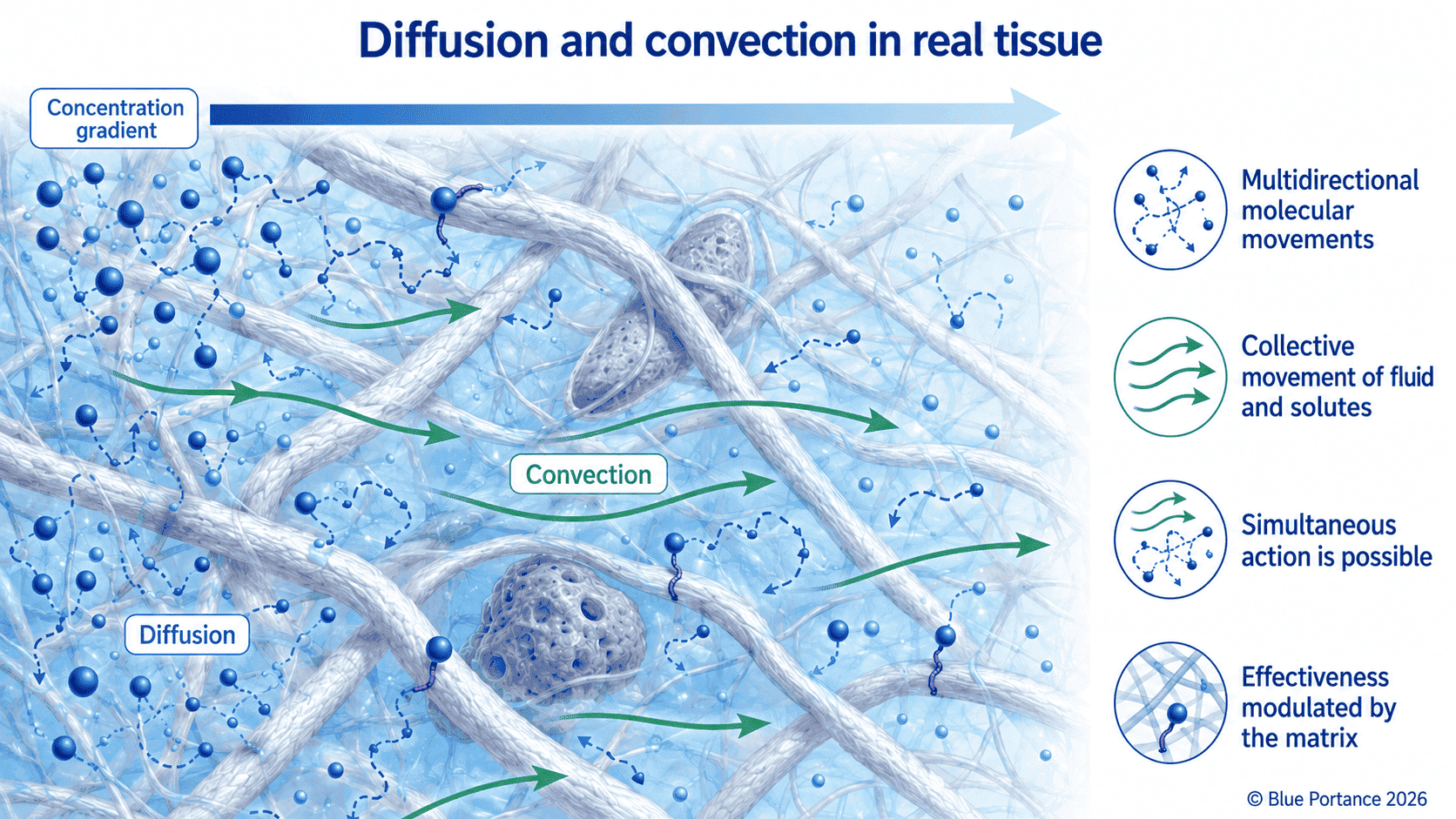
However, tissues are not homogeneous media comparable to a free solution. Indeed, molecules moving through them encounter fibers, macromolecules, membranes, and spaces of varying size.
The extracellular matrix can thus alter local diffusivity. For example, it can resist the movement of certain molecules or hold them temporarily. It can also alter their path according to their size, charge, and affinity for matrix components (Fan et al., 2014).
A distinction must therefore be made between:
- the diffusion coefficient of a molecule in a relatively homogeneous liquid;
- the apparent diffusivity in an organized tissue.
In tissue, movement is often slowed by the tortuosity of the network. In other words, a molecule does not necessarily follow a direct path between its starting point and its destination.
Some molecules may also bind temporarily to proteins or to glycosaminoglycans. This binding is not necessarily active transport. It can nonetheless alter the speed of movement and the local distribution of the substance.
4. Convection: Movement Carried by the Fluid
This phenomenon is the transport of solutes carried along by the bulk movement of a fluid.
In its simplest form, the convective flux of a solute can be expressed as Jconv = vC. In this expression, v is the mean velocity of the liquid and C is the solute concentration.
This relationship describes how the solute is carried along by the bulk movement of the liquid. In a porous tissue, however, it needs qualification: transport also depends on the movement of the fluid relative to the matrix, and on the hindrance the matrix imposes on solute movement (Yao & Gu, 2007).
Diffusion depends mainly on molecular agitation and a concentration gradient. Convection, in contrast, depends on a collective movement of the liquid. Solutes are then transported along with the volume of fluid that contains them.
In tissues, convection can be associated with:
- filtration across a microvascular wall;
- pressure gradients;
- movements of interstitial fluid;
- lymphatic uptake;
- certain local mechanical variations.
The bulk movement of liquid can carry ions, nutrients, dissolved gases, and metabolites. Depending on their dimensions and on tissue properties, certain macromolecules or extracellular structures may also be involved. However, water is not, here, a solute transported by convection: its movement constitutes the fluid motion that carries the dissolved substances.
Convection and Diffusion: A Combined Action
Convection does not replace diffusion. In fact, the two phenomena can occur simultaneously. A solute can be carried by the overall movement of a fluid while diffusing locally along its own concentration gradient.
Convection and diffusion can therefore act together. The bulk movement of liquid can transport solutes from one region to another, while diffusion then contributes to their local redistribution along their concentration gradients. Their relative contribution depends in particular on fluid velocity, solute properties, matrix structure, and the gradients present.
In adult articular cartilage, an avascular tissue, solutes are thus transported through the extracellular matrix by both diffusion and convection. In this case, the respective contribution of these mechanisms depends on the properties of the solute and the matrix, and on mechanical loading (Yao & Gu, 2007).
Similarly, Wiig and Swartz describe the interstitium as an environment in which fluids, solutes, and the extracellular matrix interact. They highlight in particular the role of interstitial convection in transport and in certain biological functions (Wiig & Swartz, 2012).
5. Filtration: Fluid Passage Driven by Pressure
This mechanism refers to the passage of a liquid through a barrier or a permeable medium, driven by a pressure gradient.
In tissues, it mainly concerns exchange between the microvessels and the interstitium. Liquid crosses the vascular wall when hydrostatic and oncotic forces favor this transfer.
Filtration is therefore not a standalone mode of solute transport equivalent to diffusion or convection. Instead, solutes that cross the barrier with the liquid are transported by convection. Even so, this remains limited by the permeability and selectivity of the interface.
The amount of liquid filtered depends in particular on:
- hydrostatic pressure;
- oncotic pressures;
- wall permeability;
- exchange surface area;
- the state of the endothelial glycocalyx;
- interstitial pressure.
The phenomenon must therefore be distinguished from a simple “push” exerted on a tissue. Indeed, external pressure applied to a tissue does not necessarily produce filtration identical to what occurs across a capillary wall.
6. The Revised Starling Principle
Fluid exchange across microvessels was long described in terms of a balance. This balance set hydrostatic pressures against oncotic pressures on either side of the vascular wall.
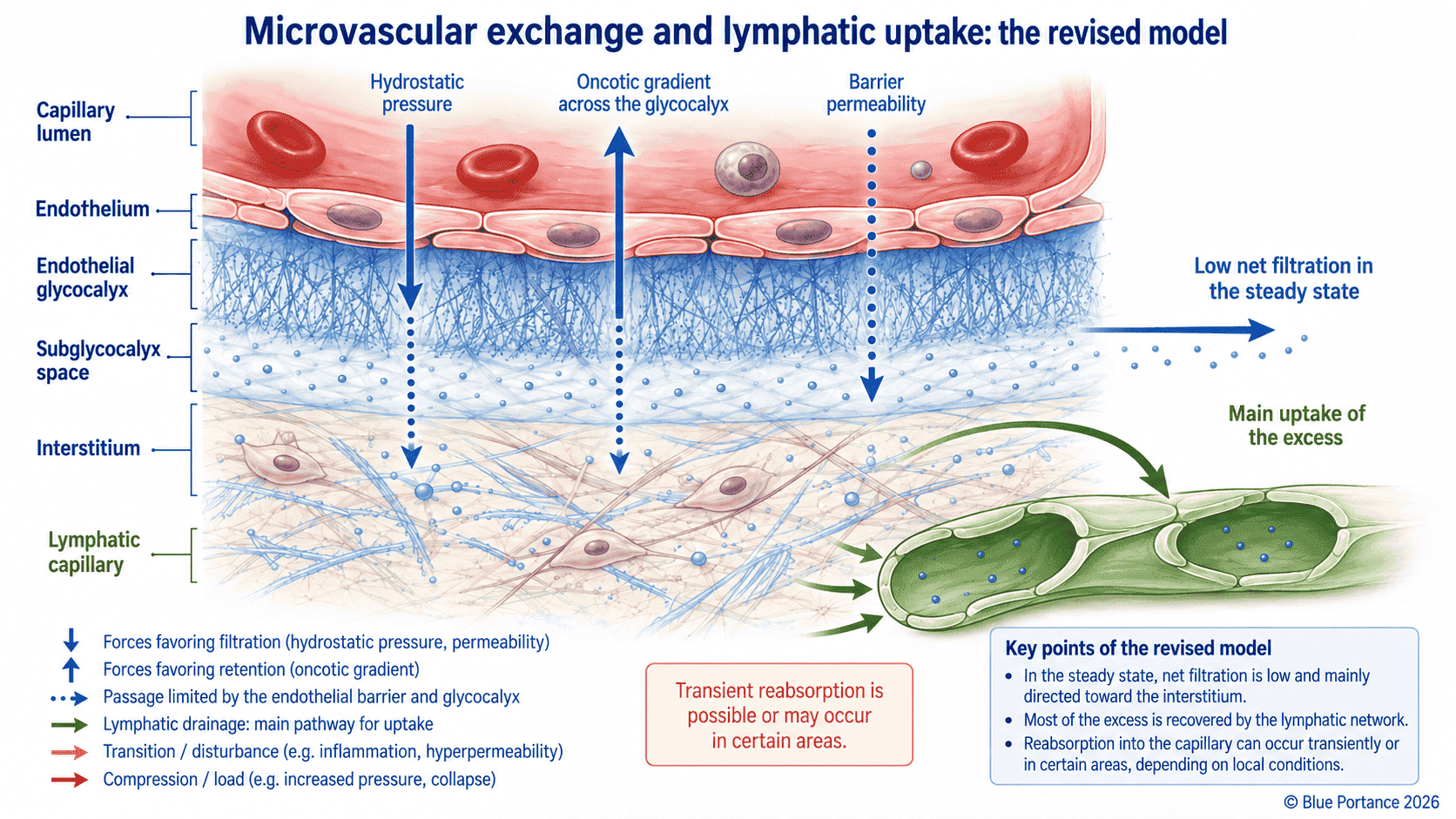
However, research on the endothelial glycocalyx has led to a revision of this picture. Specifically, the glycocalyx, located on the inner surface of the endothelium, contributes to barrier function and influences the exchange of water and proteins.
The revised Starling principle places particular emphasis on:
- hydrostatic pressure;
- the oncotic pressure gradient;
- the endothelium;
- the glycocalyx;
- the low protein concentration of the fluid lying immediately beneath the glycocalyx.
The relevant oncotic forces should therefore not be considered solely between plasma and the interstitium as a whole. They involve in particular the gradient between plasma and the sub-glycocalyx space (Levick & Michel, 2010; Woodcock & Woodcock, 2012).
In many tissues at steady state, a small net filtration persists. Excess fluid and macromolecules are mainly returned by the lymphatic system. Capillary reabsorption can nonetheless occur transiently, or in certain specialized vascular beds (Levick & Michel, 2010).
The revised model therefore does not imply that exchange is simple or uniform. On the contrary, it highlights the role of specialized barriers and local conditions.
7. Osmosis: The Movement of Water
This phenomenon refers to the net movement of water across a selectively permeable membrane or interface. It results from a difference in the chemical potential of water, related in particular to the presence of osmotically effective solutes.
Water thus moves according to the properties of the interface and the presence of solutes that do not cross it freely.
Osmosis mainly concerns the movement of water. It is therefore not a mechanism for the direct transport of dissolved molecules. Some solutes may nonetheless cross the interface separately, according to their own permeability properties.
Several pressures and gradients must also be distinguished:
- osmotic;
- oncotic, related more specifically to proteins and macromolecules;
- hydrostatic, related to the force exerted by a liquid;
- the concentration gradients specific to each solute.
These forces can interact, but they are not equivalent.
8. Complementary Mechanisms
In living tissue, diffusion, convection, filtration, and osmosis can occur simultaneously.
For example, a solute can:
- diffuse along its concentration gradient;
- travel with the bulk movement of the liquid;
- be carried by convection with the liquid crossing a barrier during filtration;
- be temporarily retained by the extracellular matrix;
- cross a membrane via a specific transport mechanism.
Water can also move in response to differences in chemical potential or pressure. Solutes, for their part, follow their own gradients and encounter specific barriers.
The real situation therefore depends on several parameters at once. For instance, an increase in pressure can alter fluid movement. Its effect on each solute, however, will depend on that solute’s size, charge, permeability, and interactions with the tissue.
Overall, this complexity explains why it is preferable to speak of exchange conditions rather than of a “single flow” or a “general current.”
9. The Role of the Extracellular Matrix
As established in the previous article of this guide, the extracellular matrix is the organized medium in which exchange takes place. It does not add a transport mechanism to those described above; rather, it alters their conditions locally.
Its fibrillar and non-fibrillar components can limit or facilitate the passage of molecules through the extracellular space. They can also contribute to the local regulation of interstitial pressure (Reed & Rubin, 2010) and retain certain growth factors or extracellular signals (Fan et al., 2014).
In particular, interactions between solutes and the matrix can:
- slow their movement;
- alter their distribution;
- retain them temporarily;
- create local gradients;
- favor their presentation to certain cells.
Nevertheless, these interactions must be distinguished from diffusion, convection, and filtration. They modulate these phenomena but are not equivalent modes of transport.
10. What This Means for Sitting
Sitting is a situation in which external forces change the shape of tissues and local pressure conditions.
Pressure applied by a support surface can influence:
- tissue deformation;
- stress distribution;
- the local volume of certain compartments;
- interstitial pressure;
- transfer conditions between the different tissue spaces.
These effects, however, cannot be directly equated with capillary filtration. After all, external pressure applied to tissues is not equivalent to the forces that govern exchange across the microvascular wall. For example, studies by Makhsous show that seat design and certain experimental pressure-relief maneuvers can alter interface pressures. They also show a change in measured perfusion in the buttock tissues (Makhsous et al., 2007, 2012). They document the local consequences of specific mechanical sitting conditions, but do not directly demonstrate the general clinical effectiveness of dynamic sitting.
Prolonged mechanical stress can alter local conditions of deformation, pressure, and transfer. This does not mean, however, that all exchange stops, or that a tissue immediately becomes impermeable.
11. Key Takeaways
To summarize, tissue exchange relies on several complementary mechanisms, whose local conditions are modulated by the extracellular matrix:
- diffusion: transports solutes along concentration gradients;
- convection: carries solutes with the bulk movement of a liquid;
- filtration: passage of a fluid across an interface driven by pressure differences;
- osmosis: mainly concerns the movement of water.
The extracellular matrix is not an additional transport mechanism. Instead, it modulates the mobility, retention, and local distribution of molecules.
Matter, then, does not move through tissues by a single mechanism. Rather, it moves through organized media subject to gradients, pressures, barriers, and matrix interactions.
This framing helps avoid two errors. The first is to speak of a single “flow” that would carry all substances indiscriminately. The second is to attribute to the extracellular matrix an autonomous pumping or drainage function.
Article Summary
Living tissues are thus traversed by exchanges of matter that combine several physical mechanisms. Diffusion acts along concentration gradients, while convection accompanies the bulk movement of fluids.
Filtration is the passage of a liquid across a permeable interface, driven by pressure differences. Osmosis, for its part, mainly concerns the movement of water.
Moreover, the extracellular matrix intervenes by modulating these phenomena. Its structure, porosity, charge, hydration, and interactions with solutes can alter their mobility and distribution.
In addition, microvascular exchange should be understood in light of the revised Starling principle. This principle gives a central role to the endothelial glycocalyx and the sub-glycocalyx space (Levick & Michel, 2010). Local conditions also depend on interstitial pressure, the matrix, and lymphatic uptake.
When sitting, the goal is therefore not to indiscriminately “unblock” flows. It is rather to understand how the duration and distribution of mechanical stresses, along with changes in support configuration, can locally alter exchange conditions.
Scientific References
Physical Mechanisms of Exchange
- Fan, D., Creemers, E. E., & Kassiri, Z. (2014). Matrix as an interstitial transport system. Circulation Research, 114(5), 889–902. https://doi.org/10.1161/CIRCRESAHA.114.302335
- Fick, A. (1855). On liquid diffusion. The London, Edinburgh, and Dublin Philosophical Magazine and Journal of Science, 10(63), 30–39. https://doi.org/10.1080/14786445508641925
- Wiig, H., & Swartz, M. A. (2012). Interstitial fluid and lymph formation and transport: physiological regulation and roles in inflammation and cancer. Physiological Reviews, 92(3), 1005–1060. https://doi.org/10.1152/physrev.00037.2011
- Yao, H., & Gu, W. Y. (2007). Convection and diffusion in charged hydrated soft tissues: a mixture theory approach. Biomechanics and Modeling in Mechanobiology, 6(1–2), 63–72. https://doi.org/10.1007/s10237-006-0040-3
Microvascular Filtration and the Revised Starling Model
- Levick, J. R., & Michel, C. C. (2010). Microvascular fluid exchange and the revised Starling principle. Cardiovascular Research, 87(2), 198–210. https://doi.org/10.1093/cvr/cvq062
- Reed, R. K., & Rubin, K. (2010). Transcapillary exchange: role and importance of the interstitial fluid pressure and the extracellular matrix. Cardiovascular Research, 87(2), 211–217. https://doi.org/10.1093/cvr/cvq143
- Woodcock, T. E., & Woodcock, T. M. (2012). Revised Starling equation and the glycocalyx model of transvascular fluid exchange: an improved paradigm for prescribing intravenous fluid therapy. British Journal of Anaesthesia, 108(3), 384–394. https://doi.org/10.1093/bja/aer515
Sitting and Tissue Pressures
- Makhsous, M., Priebe, M., Bankard, J., et al. (2007). Measuring tissue perfusion during pressure relief maneuvers: insights into preventing pressure ulcers. The Journal of Spinal Cord Medicine, 30(5), 497–507.
- Makhsous, M., Lin, F., Hanawalt, D., Kruger, S. L., & LaMantia, A. (2012). The effect of chair designs on sitting pressure distribution and tissue perfusion. Human Factors, 54(6), 1066–1074. https://doi.org/10.1177/0018720812457681
