


This article is part of the Expert Guide “Fascia.”
Chapter 5 — Blue Portance Knowledge BaseWhy Does Fascia Need Micro-Movements?
Summary — Even when a posture appears motionless, breathing, muscle activity, and postural adjustments produce small variations. These micro-movements shift load lines, partially alternate compression and unloading, mobilize tissue interfaces, and prevent the same mechanical configuration from persisting without interruption.
1. Complete Stillness Almost Never Exists
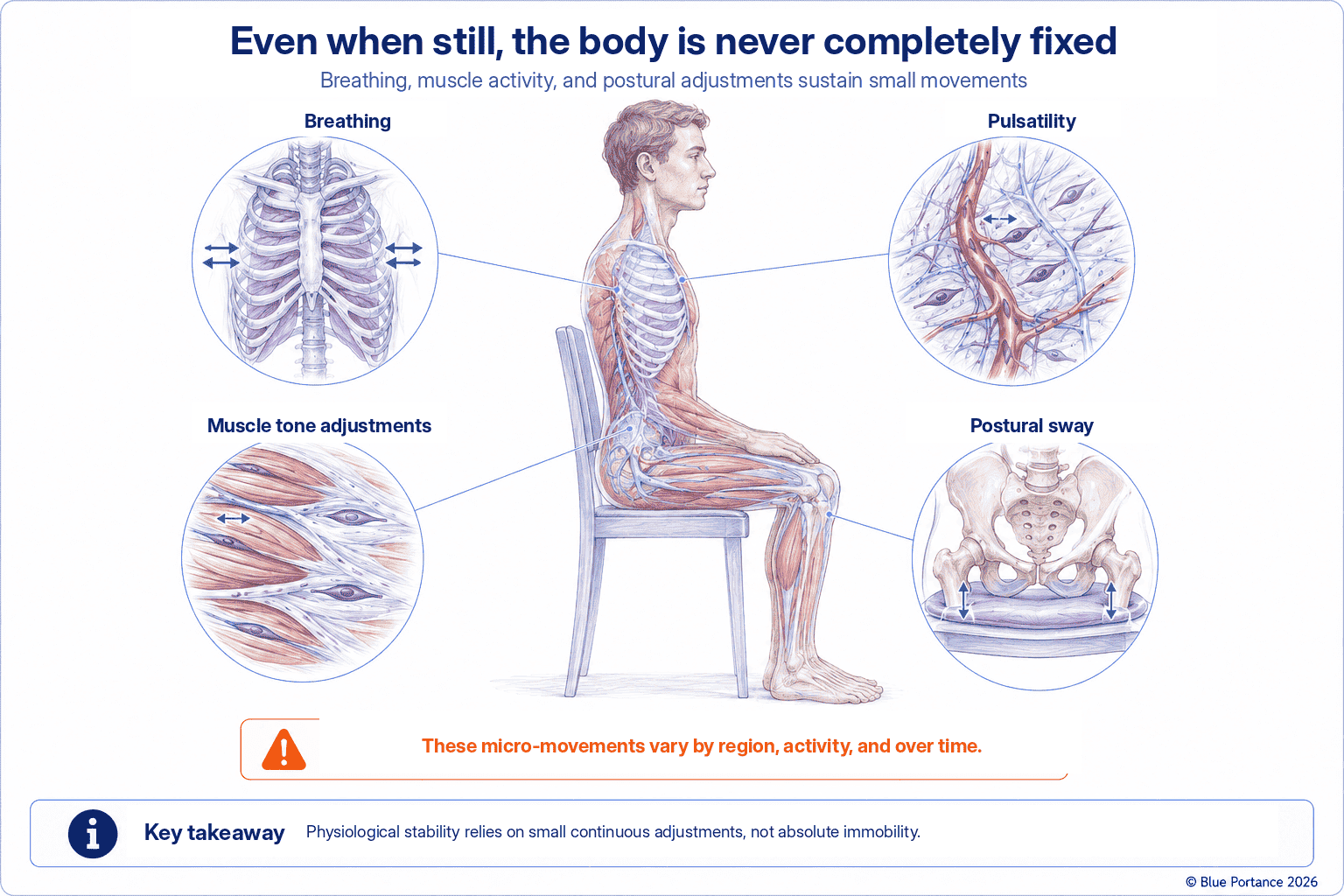
The living body exhibits postural sway, respiratory movements, pulsations, and low-amplitude contractions. These variations do not replace whole-body movement, but they continuously alter the local mechanical state. The following chapters thus successively examine the location of loads, creep, fluid exchange, and the notion of controlled variability.
These sources of variation are constantly superimposed on one another. Breathing mobilizes the diaphragm, the rib cage and, indirectly, the entire abdominal and lumbar connective tissue chain. It does so at a rate generally between twelve and twenty cycles per minute in adults at rest. The arterial pulse imparts a low-amplitude but continuous pulsation to the tissues surrounding the blood vessels.
Added to this are involuntary postural oscillations. The human body, whether standing or sitting, is in fact never perfectly stable: it sways slightly around a position of balance in order to actively maintain it (Winter, 1995). These different sources — respiratory, vascular, postural — remain very-low-amplitude movements, whose local mechanical magnitude has not been quantitatively established here. They should therefore not be conflated with one another, nor assumed to produce an equivalent fascial benefit.
A Tissue in Constant Dialogue with Movement
Even a person who tries hard to “stay still” thus remains the site of multiple sources of mechanical variation, independent of their will. This accumulation of observations has helped shift the representation of fascia, long regarded as a passive tissue, toward that of a tissue in constant dialogue with movement, however subtle. Lesondak’s synthesis traces this evolution in the general representation, without itself demonstrating the precise physiological mechanisms involved (Lesondak, 2019).
2. Changing the Location and Direction of Loads
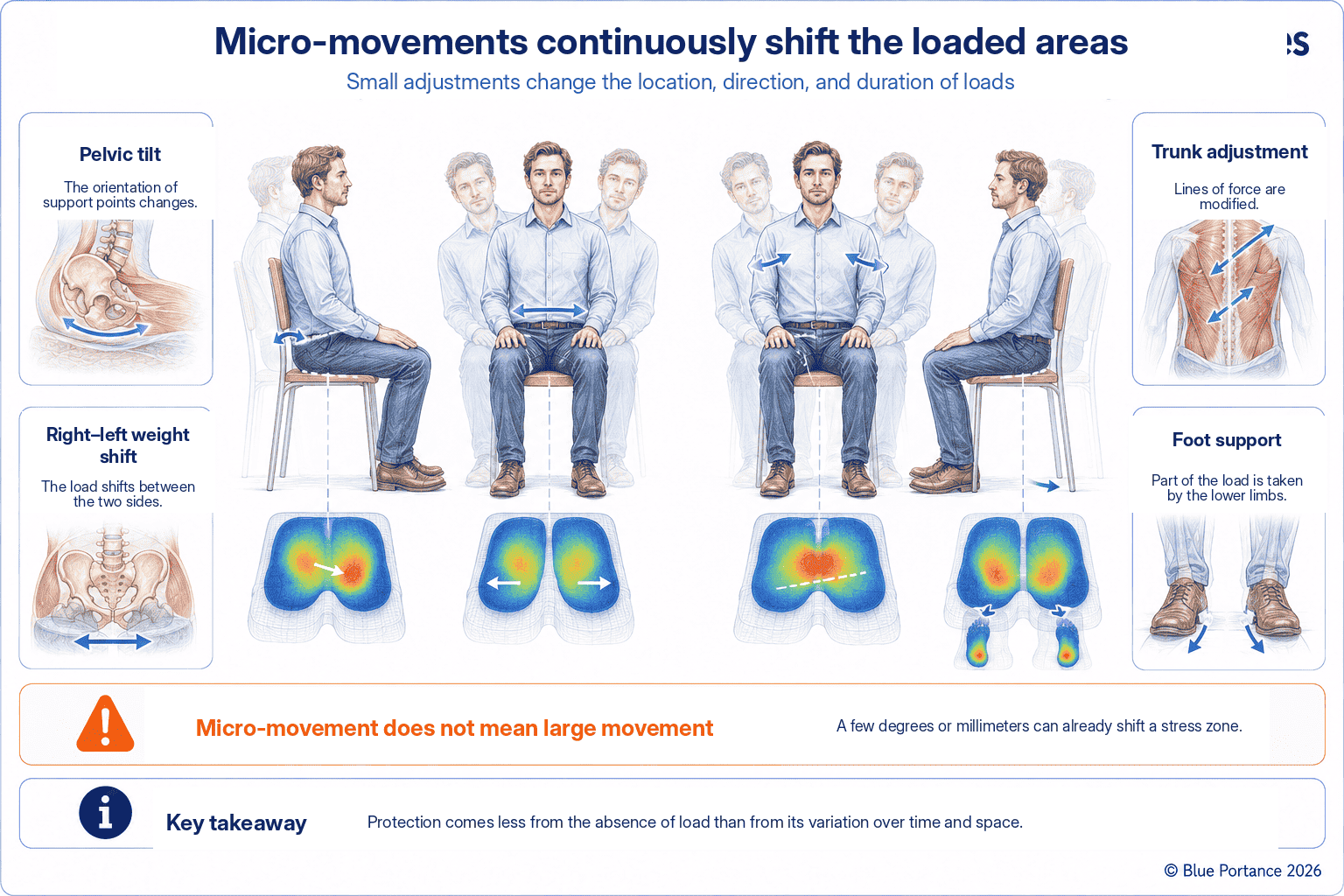
A useful micro-movement does not necessarily eliminate the total force. Rather, it shifts part of the load and changes the orientation of certain stresses. Several regions thus share the exposure instead of the same point being loaded continuously.
When sitting, a slight weight shift from one ischial tuberosity to the other, an anteroposterior tilt of the pelvis, or a change in forearm support thus modifies the pressure map beneath the body. This happens without requiring any change in posture visible from the outside. These often unconscious adjustments therefore redistribute load among areas that would otherwise remain continuously loaded. A change in direction matters as much as a change in location. A lateral tilt and an anteroposterior tilt do not, in fact, load the same fibers or the same gliding interfaces. Multidirectional variability can thus renew the loading of a greater number of interfaces than variation limited to a single axis.
On its own, however, it does not guarantee a demonstrated protective effect: that effect also depends on the amplitude, the frequency, and the tissue involved. The frequency and amplitude of these adjustments can indeed vary with the task, fatigue, attention, and sensorimotor state. These factors do not, however, act uniformly across all individuals.
What Studies of Spontaneous Postural Sway Show
This observation is echoed in studies of spontaneous postural sway, which show that a person standing or sitting continues to produce small displacements of their center of pressure even when they believe they are remaining perfectly still (Winter, 1995). Far from being a sign of instability, this continuous sway thus reflects active postural control, in constant adjustment. It redistributes the load borne by the different points of support in real time.
An abnormal reduction in this spontaneous variability — rather than its presence — is thus sometimes associated, in the postural control literature, with a reduced adaptive capacity of the system. This association nevertheless deserves clarification. The overall amplitude of sway is indeed only one of the parameters studied, alongside its velocity, its regularity, and its temporal complexity.
Moderate Variability Rather Than an Absence of Movement
A person may thus show a sway amplitude close to average while displaying reduced diversity in their sensorimotor strategies — a favored point of support, a repetitive pattern, less exploration of the margins of their base of support — without this translating into a wider displacement of the center of pressure. This finding therefore invites us to qualify a twofold intuition. A perfectly frozen posture would not necessarily be a sign of good control, any more than a wide oscillation would necessarily be a sign of better control.
Spontaneous variability present in moderate amounts, and diverse in its strategies, instead reflects a system capable of continuously perceiving its internal state and responding to it. It thus stands in contrast to a system frozen in a single configuration.
3. Interrupting Continuous Creep
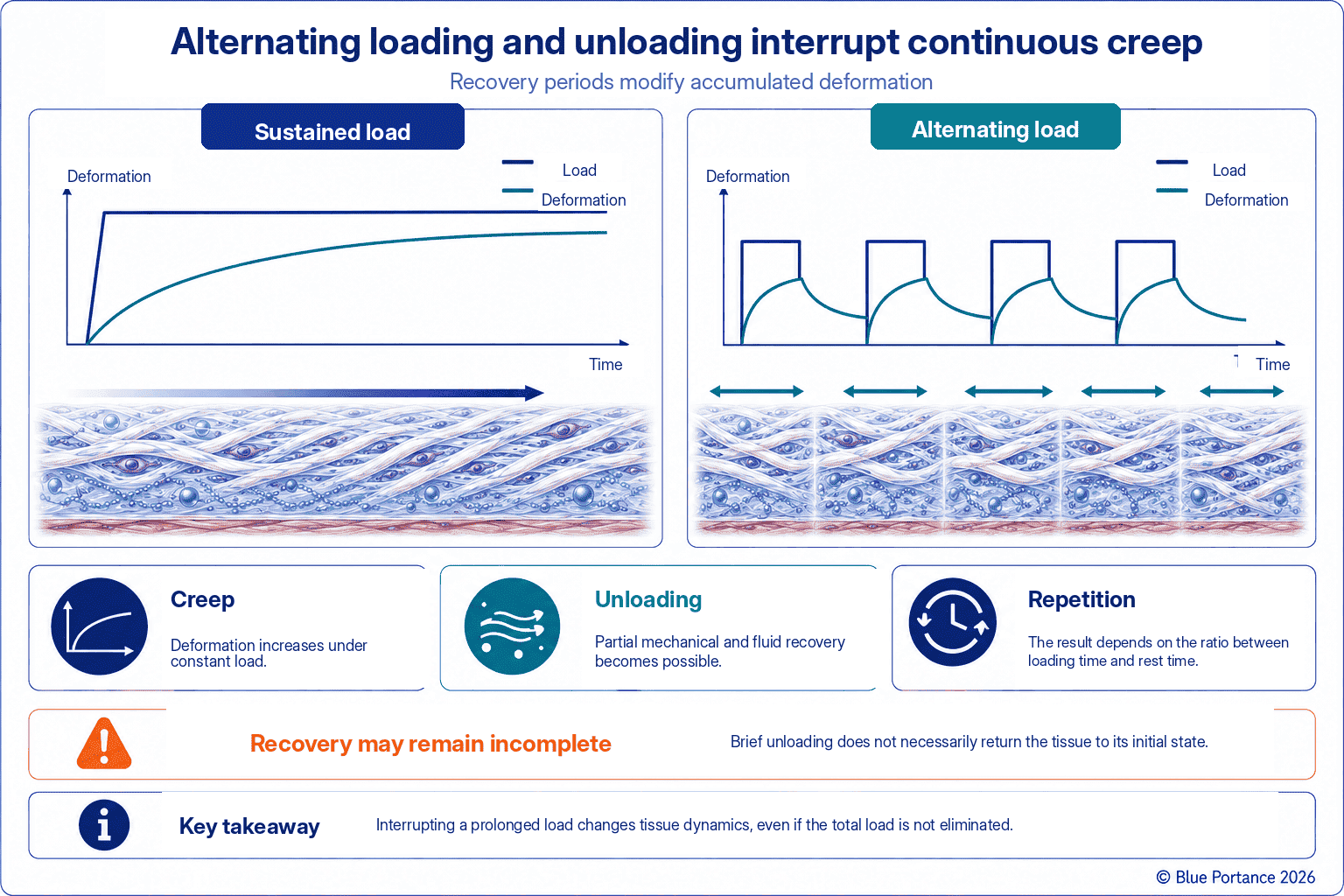
When a micro-movement actually reduces the load applied to an area, even partially, it can temporarily interrupt the continuity of that loading. Viscoelastic tissues show time-dependent recovery after unloading, but this recovery is neither instantaneous nor necessarily complete (Fung, 1993). Its extent depends on the amplitude of the unloading, its duration, the tissue involved, and the history of previous loads. An oscillation that is too small may thus fail to truly unload the area, while excessive movement may irritate it.
Unloading, Redistribution, and the Limits of Delayed Creep
Chapter 2 showed that a tissue held under constant load continues to deform through creep, and that the force needed to maintain a constant deformation decreases through stress relaxation. Yahia et al. thus characterized the stress relaxation and hysteresis of the human lumbodorsal fascia under tensile loading. Their study confirms its viscoelastic behavior. On its own, however, it cannot determine the optimal frequency of micro-movements or their effect in a seated situation (Yahia et al., 1993).
A micro-movement, when it actually unloads an area, can interrupt this process before it fully develops. Unloading, even partial and brief, thus allows the fluid phase to begin redistributing and part of the accumulated deformation to decrease.
A Tolerance That Varies from Person to Person
A micro-movement does not necessarily unload the structure in question, however: it may simply shift the direction or location of the stress, in which case creep continues elsewhere. Repeated at sufficiently short intervals, effective unloading limits the progressive accumulation of deformation that would occur under strictly continuous, uninterrupted load. Conversely, if recovery between cycles remains insufficient, creep can resume as soon as load is reapplied and continue to accumulate.
The optimal interval between two unloading episodes is not a universal value. It depends on the tissue involved, the intensity of the load, and the rate at which that tissue usually recovers. This therefore explains the wide individual variability observed in tolerance to the same sustained posture.
Same Seat, Different Tolerance Times
Two people sitting on the same seat, in the same position, may thus experience discomfort after very different lengths of time. These differences in tolerance can indeed result from multiple mechanical, vascular, morphological, sensory, and contextual factors, and no single mechanism can be inferred from the time to onset of discomfort alone.
This interindividual variability thus calls for caution toward any postural recommendation presented as universally valid, regardless of the person and the context. It argues instead for solutions capable of adapting to this variability rather than ignoring it or treating it as an anomaly to be corrected.
4. Maintaining Gliding and Fluid Movement
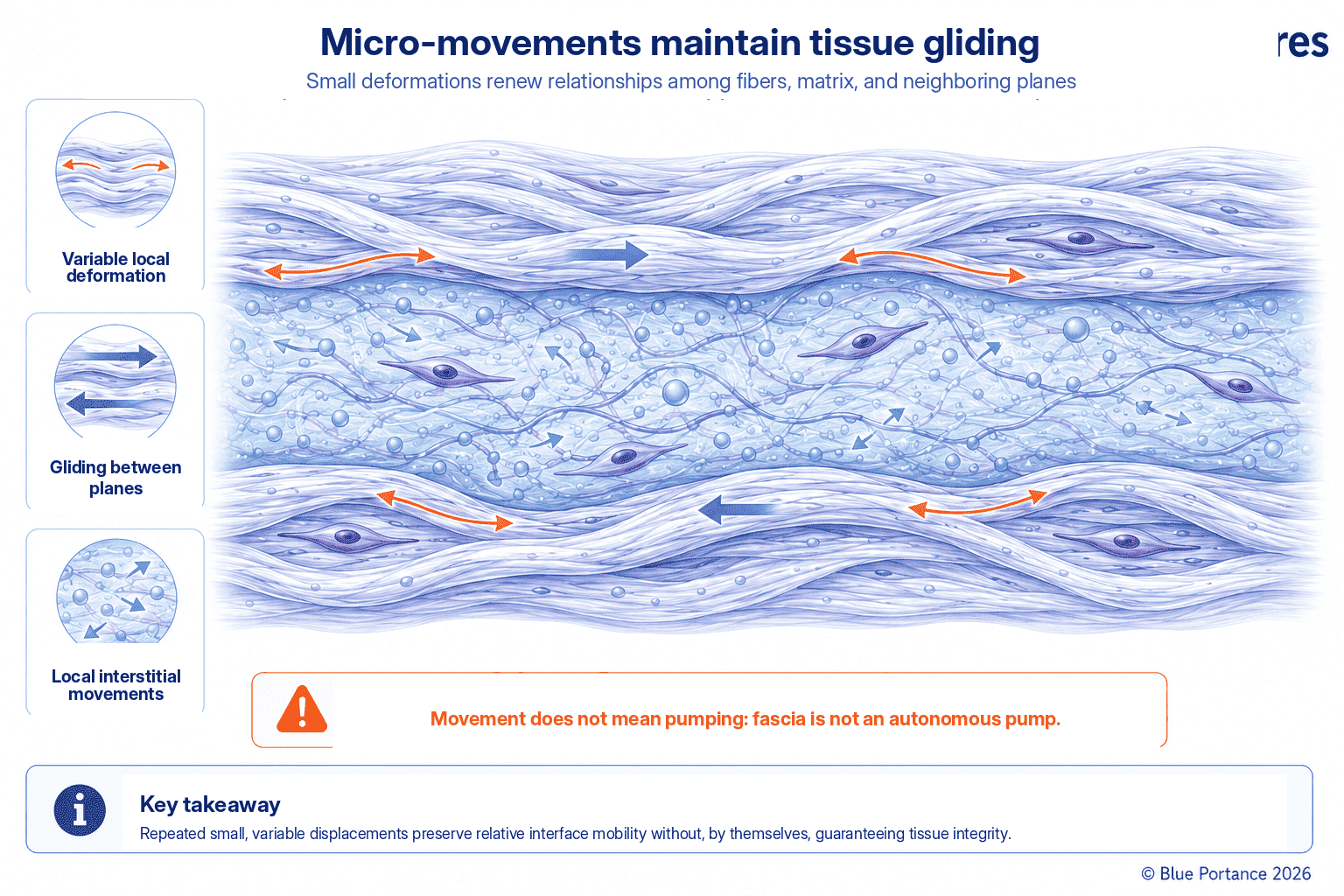
Changes in shape mobilize tissue layers and alter interstitial pressures. They may facilitate local exchange, without justifying the claim that they instantly “rehydrate” all fascia.
The gliding between fascial layers described in Chapter 4 relies in particular on a thin layer of loose connective tissue rich in hyaluronan, present between the deep fascia and muscle as well as between certain adjacent fascial layers. Its content varies with location and with the specific gliding function of each anatomical site (Fede et al., 2018). This gliding in fact depends on repeated mobilization to remain effective. An interface that is never loaded thus tends to lose part of its gliding capacity over time. Regular mobilization, even of low amplitude, on the contrary maintains exchange between the ground substance and the surrounding capillaries.
Three Scales Not to Be Confused
This mechanism remains local and gradual: it is not an immediate phenomenon comparable to the absorption of a liquid, but a continuous maintenance of the properties of connective tissue, cumulative over hours and days. Three scales that are often confused must therefore be distinguished. The first is the local movement of interstitial fluids around the fibers, the second is the metabolic turnover of matrix components by fibroblasts, and the third is blood perfusion proper, which depends on the surrounding capillary network.
Movement promotes the first mechanism, without demonstrating that any given micro-movement can, on its own, “restore” an interface already altered by prolonged immobilization or fibrotic remodeling. These acute effects, measurable over the course of a single session, must therefore be distinguished from longer-term tissue remodeling. The latter involves progressive cellular adaptation rather than a simple movement of fluid.
Exchange That Also Depends on Local Vascularization
This exchange notably involves the renewal of nutrients and the removal of cellular metabolic waste products in the least vascularized tissues, which depend more on diffusion and the movement of interstitial fluids than on a direct blood supply. In an area subjected to prolonged compression without variation, this exchange slows down, which may gradually alter the local biochemical environment of the cells involved.
These phenomena must also be distinguished from a reduction in blood perfusion. Interstitial transport, molecular diffusion, and vascular supply are indeed interrelated, but they do not refer to the same mechanism. Pressure relief maneuvers that are insufficient in amplitude or duration may thus reduce one without necessarily restoring the other (Makhsous et al., 2007).
5. Variability Does Not Mean Instability
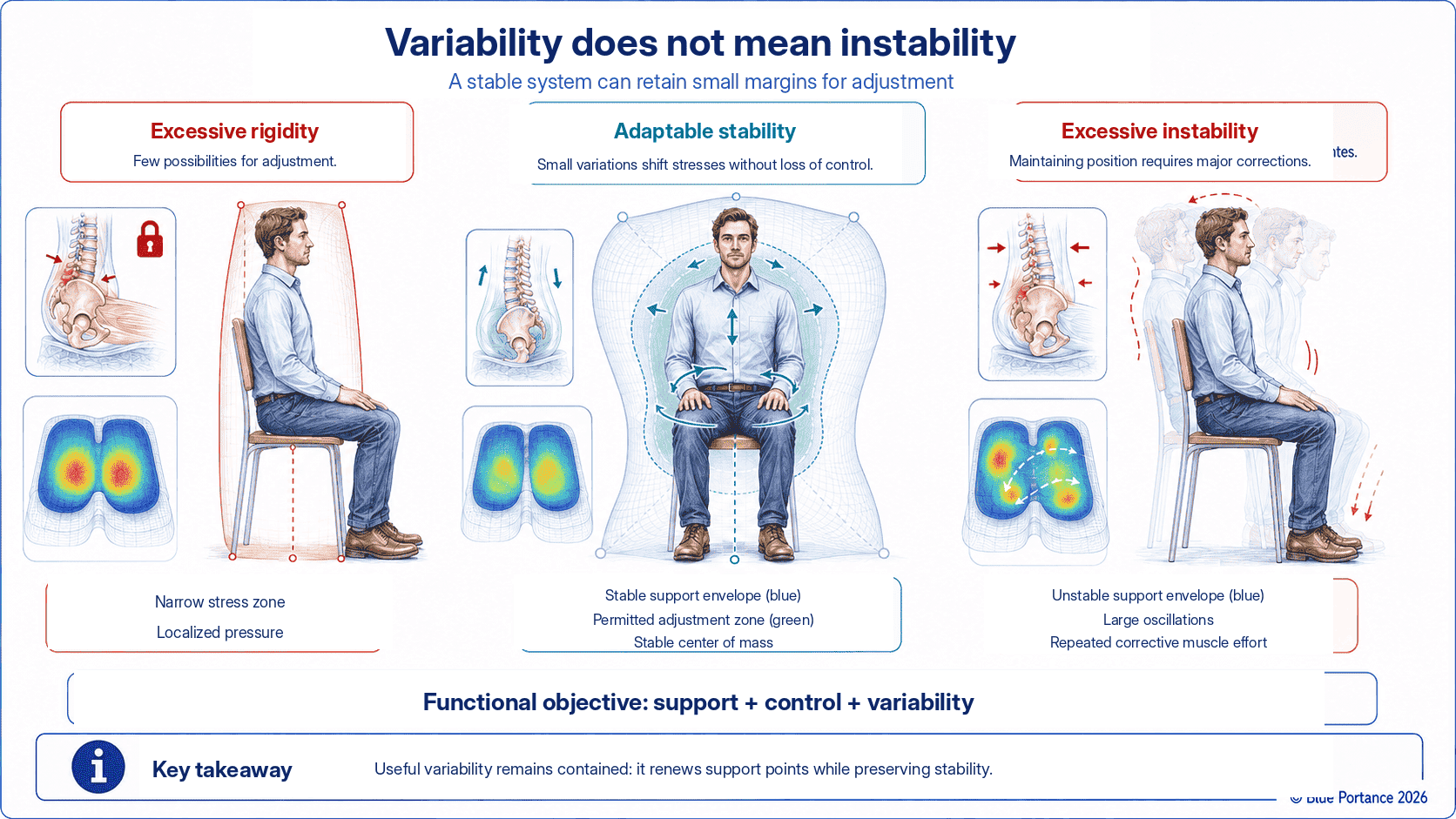
Good variability combines sufficient stability with room for adjustment. An unpredictable surface can thus increase muscular work and protective reactions. The goal is controlled mobility, not permanent imbalance.
This distinction is important to clarify, because it is often a source of confusion. Instability imposed by the support — for example, a seat that gives way or whose mechanical response is unpredictable — thus forces the nervous system to engage active, sustained postural control to avoid a fall or an outright loss of balance. This compensatory muscular work can itself become a source of fatigue and additional stress.
Useful variability, by contrast, is low-amplitude variation around a stable, predictable base. It thus leaves the body free to make small adjustments without ever threatening overall balance. The difference therefore lies not in the presence or absence of movement. It lies rather in whether that movement is chosen and controlled by the person, or imposed by an unstable support.
Implications for Seat Design
This distinction has a direct implication for seat design. A fixed support with little adaptability can maintain the same support map over long periods and limit certain spontaneous adjustments. Conversely, excessive or unpredictable mobility can impose continuous stabilization work. The stiffness or softness of the material alone is therefore not enough to predict the quality of load distribution. The seat’s geometry, support surface, pressure distribution, and morphological adaptation play an equally important role.
Three Forms of Movement While Sitting
It is useful here to distinguish several forms of movement while sitting. A permitted movement is a displacement that the structure of the seat allows without resisting it. A self-initiated movement, for its part, is an adjustment that the person voluntarily makes, such as a weight shift or a pelvic tilt. A support-imposed movement, by contrast, is a displacement that the person undergoes because the seat itself gives way or responds unpredictably.
Predictable Rather Than Imposed Mobility
Predictable mobility, whether self-initiated or simply permitted, lets the nervous system anticipate the mechanical response and adjust its control accordingly. Unpredictable instability, on the contrary, imposes defensive co-contraction, which is more costly and less specific and aims above all at avoiding imbalance rather than optimizing load distribution.
The challenge, therefore, is not to choose between stability and mobility. It is rather to provide a base stable and predictable enough not to require constant active control, while leaving users the physical possibility of making their own micro-adjustments without excessive mechanical stress. This requirement thus directly links the mechanical properties described in Chapters 2 and 3 — viscoelasticity, stress distribution — to the functional behavior sought in a seat designed to accompany the body’s natural variability rather than prevent it.
Key Takeaways
- Micro-movements shift stresses more than they eliminate them.
- They can partially interrupt a continuous load.
- They maintain gliding and alter interstitial pressures.
- Useful variability must remain controlled and tolerable.
Frequently Asked Questions
Is moving a lot always better?
Does an unstable seat create good variability?
Do micro-movements prevent all pain?
Is a micro-movement always enough to unload the tissues?
Scientific References
- Fede C, Angelini A, Stern R, Macchi V, Porzionato A, Ruggieri P, De Caro R, Stecco C. Quantification of hyaluronan in human fasciae: variations with function and anatomical site. J Anat. 2018;233(4):552–556.
- Fung YC. Biomechanics: Mechanical Properties of Living Tissues. Springer; 1993.
- Makhsous M, Lin F, Knaus E, et al. Measuring tissue perfusion during pressure relief maneuvers: insights into preventing pressure ulcers. J Spinal Cord Med. 2007;30(5):497–507.
- Winter DA. Human balance and posture control during standing and walking. Gait Posture. 1995;3(4):193–214.
- Yahia L, Pigeon P, DesRosiers EA. Viscoelastic properties of the human lumbodorsal fascia. J Biomed Eng. 1993;15(5):425–429.
- Lesondak D. Le Fascia. [Fascia.] Éditions Ressources Primordiales; 2019.
← Previous chapter: What Role Does Fascia Play in Tissue Dynamics and Protection?
Back to the Fascia guide
Next chapter: Mechanotransduction: How Does Stress Change Fascial Tissue? →
Note: this content explains general mechanisms. It does not constitute a medical diagnosis or a therapeutic recommendation.
© Gil Ayache. The original concepts, biomechanical models, diagrams, terminology, graphic representations, foundational figures, original texts, and principles presented on this page are works protected by copyright. They are made available to Blue Portance under an intellectual property license agreement, without transfer of economic rights or of authorship.
